“Don’t call me your sister. You and that child are the biggest stain this family has.”
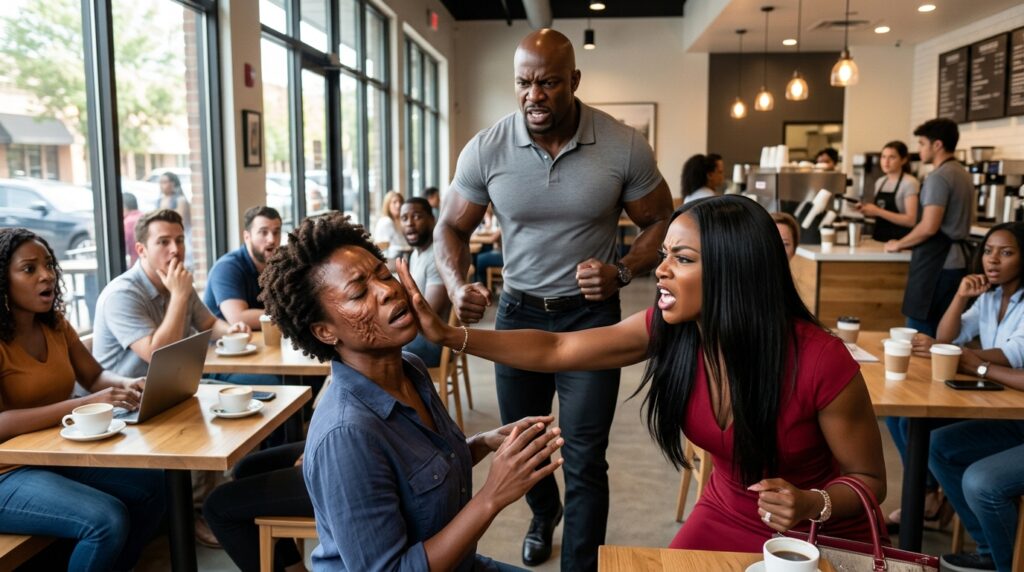
Then her hand came across my face. A full, open-palm slap, right on the scarred side, in the middle of a crowded cafe on a Saturday morning, while my six-year-old daughter clung to the hem of my shirt.
I didn’t cry out. I didn’t stumble. I stood rooted to the spot and stared at her in dead silence, and my composure seemed to pour gasoline on her fire, because she whipped around to the enormous man standing behind her and barked, “John. Are you just going to stand there while your wife gets disrespected? Deal with her.”
But John didn’t step forward.
The moment his eyes locked onto the scar running down the left side of my face, every drop of color drained out of his. This mountain of a man, a former Marine with shoulders like a doorway, stumbled backward, three full steps, his pupils blown wide, and stuttered out a sentence that froze even my sister where she stood.
“Impossible. Is that Captain Watson?”
To understand what that name did to that room, I have to take you back ten years, to a military trauma ward and the day I woke up under blinding white fluorescent lights.
The first thing I remember is the heat. A searing, consuming heat down the entire left side of my face, like someone had poured molten iron across my cheekbone and let it cool into the skin. The second thing is the smell, antiseptic so sharp it made my eyes water. Surgeons in green scrubs stood at the foot of my bed talking in low voices, and when they saw I was awake, they told me I was a hero. They told me that when our Humvee hit an IED on a dusty road outside Fallujah, the shrapnel I absorbed had saved the lives of my entire unit. Every soldier in that vehicle walked away breathing because the left side of my face caught what would have torn through the cabin.
I raised a shaking hand and touched the thick gauze wrapping my skull. It felt like touching someone else’s body. And underneath the pain, I felt something else. Pride. Quiet and strange, but real. A two-star general pinned a Purple Heart to my hospital gown while I was still too drugged to fully understand the ceremony. Nurses adjusted my IV like they were handling something precious.
I lay in that bed and I honestly believed that if the United States Marine Corps honored my sacrifice with medals and salutes, my own family would finally look at me with the same pride. I thought the worst was over. I had survived Fallujah. I thought the war was finished.
I had no idea the real battlefield was waiting for me at home, dressed in designer clothes and smelling like expensive perfume.
A month later, a military transport dropped me at the family estate. No banner. No balloons. The wrought-iron gate swung open in dead silence, and my boots crunched up the gravel drive, and I stepped into that grand marble foyer where my uneven footsteps echoed off the high ceilings and disappeared into nothing.
My parents stood by the parlor doors. They didn’t rush forward. They didn’t embrace me. They averted their eyes and whispered to the household staff like they were coordinating how to manage an uninvited guest.
Then my sister came down the spiral staircase in a cloud of floral perfume.
Jessica didn’t ask if I was in pain. She didn’t cry with relief that I’d survived a war zone. She didn’t so much as glance at the cane holding me up. Her eyes went straight to my freshly unbandaged cheek, and her perfect face twisted into pure revulsion, and she took a visible step backward, as if the wound might be contagious.
She didn’t even speak to me. She turned to the head butler.
“Keep her in the guest house during the charity gala this weekend. I won’t have my guests looking at that.”
That was my homecoming. Instructions to hide me like damaged furniture before the important people arrived. My father kept his eyes on the grandfather clock. My mother smoothed the front of her silk blouse, over and over, as if the motion could erase the discomfort of a scarred daughter standing in her pristine foyer.
The next morning I walked into the dining room, determined to sit at that absurd mahogany table and make them acknowledge I existed. Jessica sat at the head, scrolling her phone, coffee in hand. When I pulled out a chair, she slammed the cup down on its saucer so hard the crack echoed like a gunshot.
Popular Posts
→- 1
- 2
- 3
- 4




Recently Viewed
Stories you read recently will appear here.