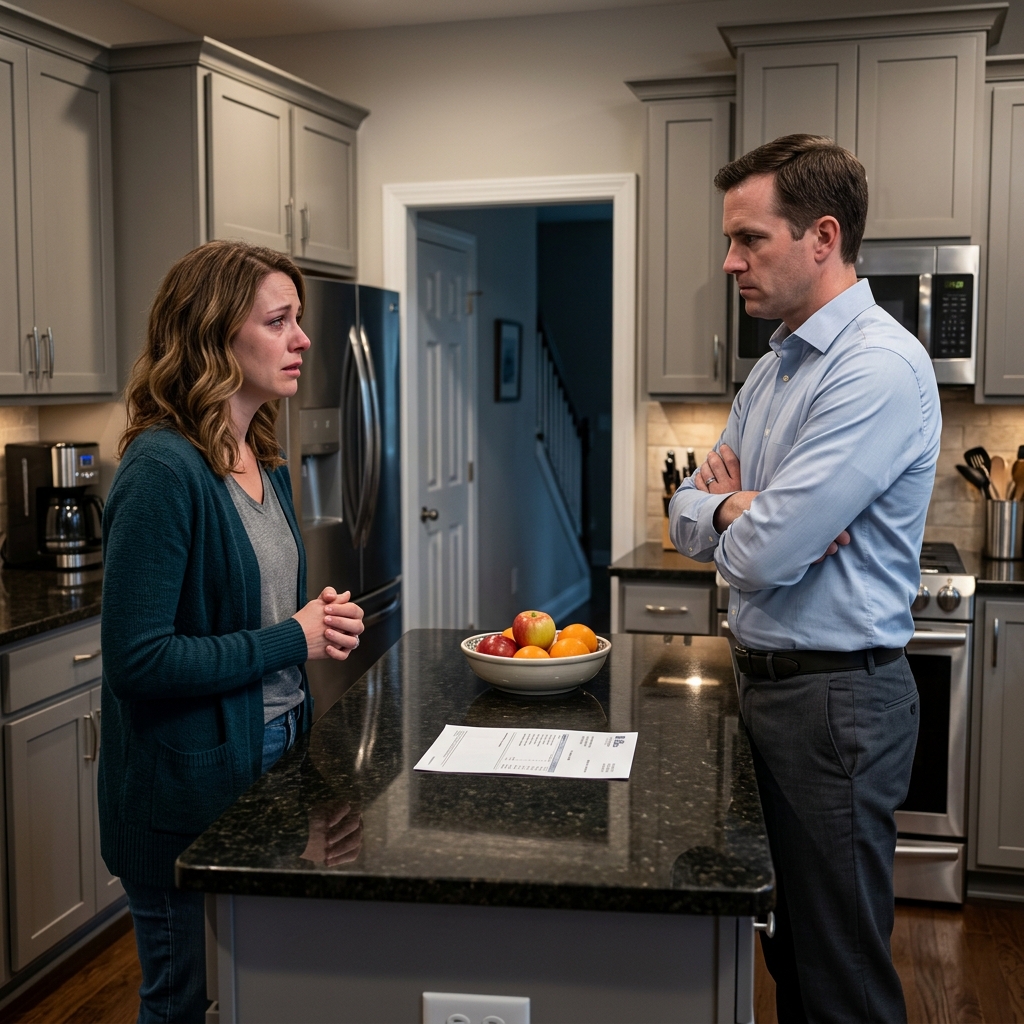
My husband looked me directly in the eye in our kitchen and said, “Your parents are your problem. Your money is yours. My money is mine.”
So I smiled.
I said nothing.
And the next morning, I stopped paying for his family.
Tyler was standing in our kitchen with his arms crossed and his chin slightly raised when he said it, and even in the middle of what would become the most important conversation of our marriage, I remember thinking one very clear thing.
He had rehearsed that sentence.
He had probably practiced it in the car before coming inside.
I hadn’t asked him for thousands of dollars.
I hadn’t asked him to take responsibility for my parents.
I hadn’t even asked him to contribute toward the medical bill sitting on our counter.
I had asked for one month.
Thirty days.
My mother had undergone a necessary heart procedure, and because of an insurance network issue nobody had explained clearly beforehand, a bill for $9,240 came back to her.
She was sixty years old.
My father was retired.
They could manage most of it eventually, but not immediately.
I wasn’t asking Tyler to pay it.
I was asking whether we could pause the roughly $2,500 that left our joint account every month and went toward his family.
Just once.
Susan’s mortgage assistance.
Gary’s truck payment.
Kayla’s phone bill.
Whatever emergency had appeared that month.
Thirty days.
That was all.
Tyler said no with his body before he said it with his mouth.
Arms crossed.
Feet planted.
Jaw set.
Then came the sentence.
“Your parents are your problem. Your money is yours. My money is mine.”
Something inside me became completely still.
Not angry.
Still.
There is a kind of silence that arrives when your brain finally stops defending someone.
I had spent years translating Tyler.
He means well.
He feels responsible for his family.
He grew up differently.
He has always been the one they depend on.
But that night, for the first time, I didn’t translate him.
I listened to the actual words.
I smiled.
That surprised him.
I saw it in the slight movement of his eyebrows.
He had expected tears.
An argument.
Maybe guilt.
Instead I said, “Okay.”
He blinked.
“Okay?”
“Your rule.”
He nodded, satisfied.
Like he’d won.
Then he went upstairs to change out of his work clothes, whistling something under his breath.
He had no idea that the argument was over.
Not because I had agreed with him.
Because I had finally believed him.
I stood at the kitchen counter after he left and looked at my mother’s hospital bill.
$9,240.
Then I looked toward the stairs.
And somewhere between those two things, a decision formed.
The next morning, Tyler left for a nine o’clock sales call.
I waited until his car disappeared from the driveway.
Then I made coffee and opened our banking app.
Four recurring transfers.
Susan Mercer — $600 twice a month toward the mortgage.
Gary Mercer — $640 monthly toward the truck.
Kayla Mercer — phone plan plus assorted expenses averaging a few hundred dollars.
A fourth transfer labeled simply FAMILY, which moved depending on who needed what.
I canceled all of them.
It took less than four minutes.
Three years of family financial support.
Gone in four minutes.
Then I opened a savings account in my name only.
Hannah Voss.
Voss was my name before I became Hannah Mercer.
I didn’t think about the meaning of that while opening the account.
Later, I thought about it often.
I transferred $1,100.
My first deposit.
Then I closed the laptop.
My coffee was cold.
I drank it anyway.
My name is Hannah Voss.
At the time, I was thirty-four years old and had worked in medical billing for nine years.
Medical billing teaches you something uncomfortable about money.
Financial trouble rarely arrives as one enormous disaster.
It arrives as thirty manageable things.
A deductible here.
A missed payment there.
A fee nobody noticed.
A recurring charge.
A bill someone assumed another person was handling.
By the time the entire picture becomes visible, the damage has often been happening quietly for months.
Sometimes years.
I had spent nine years identifying those patterns for strangers.
I had somehow missed the same pattern inside my marriage.
Tyler and I married three years earlier at a vineyard outside Yellow Springs, Ohio.
October fourteenth.
String lights.
Long wooden tables.
A cold evening that turned perfect right before sunset.
Tyler had spent two hours helping the venue coordinator hang lights because he wanted everything exactly right.
That was Tyler at his best.
He was generous with time.
Generous with attention.
Generous with charm.
If someone needed help moving furniture, Tyler came early.
If someone was nervous about a job interview, Tyler called before and after.
If my mother cooked dinner, Tyler always complimented something specific.
The potatoes.
The pie crust.
The seasoning.
People loved him because he made them feel noticed.
Popular Posts
→- 1
- 2
- 3
- 4




Recently Viewed
Stories you read recently will appear here.


