PART 1: TEN MINUTES IN UNIFORM
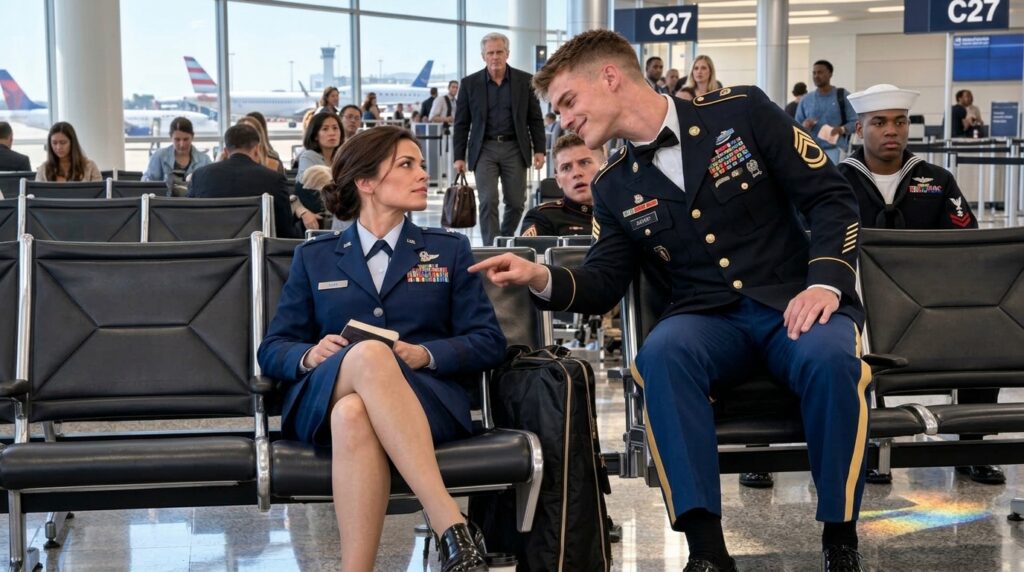
My Army uniform had barely survived ten minutes at Gate C27 before a young Marine decided it had to be fake.
“Real officers don’t look like you.”
He said it loudly enough for half the gate to hear.
Then he flicked my sleeve like he was testing fabric on a Halloween costume.
His two friends had been laughing a moment earlier.
After that, nobody laughed.
I looked at the hand he had just used to touch my uniform, then at his face.
He was young.
Not child-young, though in that moment he looked like it. Twenty-one, maybe twenty-two. Close-cropped hair. Clean shave. Marine Corps sweatshirt over a green undershirt. A backpack at his feet with a luggage tag turned just enough for me to read the last name.
CARTER.
I had already heard one of his friends call him Evan.
Lance Corporal Evan Carter.
I knew his rank because ten minutes earlier, before he’d decided to make me his entertainment, he had been talking loudly enough for everyone in our section of the terminal to hear about his unit, his leave, his sergeant, and how he was going to hate reporting back after the weekend.
His friend Mason Reid had laughed at most of it.
Mason wasn’t laughing now.
Neither was the third Marine sitting beside him.
Neither was the exhausted mother across the aisle with two sleeping children leaning against her.
Neither was the elderly couple sharing a paperback.
Even the businessman who had somehow occupied four airport seats with one body, two phones, a laptop, and a jacket had stopped typing.
The terminal smelled like burned coffee, floor cleaner, fast food grease, and too many people who had been awake since before sunrise.
My own coffee sat on the floor beside my boot.
Cold.
Untouched for the last twenty minutes.
I had four hours left in my layover, a garment bag on the seat beside me, one paperback open in my hands, and exactly no interest in becoming anybody’s story.
That had been my plan.
Read.
Stay quiet.
Make the connection.
Get where I had been ordered to go.
My Army service uniform had not been my choice for commercial travel.
If it had been, I would have been wearing jeans and a sweatshirt like half the terminal.
Instead, I had been specifically instructed to arrive at my destination in uniform because there would be no time to change before I was met at the airport and taken directly to a formal rehearsal.
So there I sat.
Service coat fitted properly.
Nameplate straight.
Insignia exactly where regulations said it belonged.
Ribbons aligned.
Gold oak leaves on my shoulders.
Lieutenant colonel.
Everything Carter had been staring at for the last ten minutes was real.
Apparently that bothered him.
It began with glances.
I noticed them because soldiers learn to notice when someone is studying them.
At first, I ignored it.
Then came the whispers.
“Look at that.”
I turned a page.
“No way.”
Another page.
“Come on, man.”
Mason’s voice that time.
Quieter.
Uncomfortable.
Then Carter laughed.
“I’m serious. That has to be fake.”
I kept reading.
The easiest way to deal with a stranger performing for friends is often to deny him the audience he thinks he deserves.
I’d learned that long before I earned my first commission.
People who provoke strangers are rarely interested in truth.
They want reaction.
They want anger.
Embarrassment.
A raised voice.
Something they can carry away afterward as proof that they controlled the moment.
Carter wanted me to turn around and defend myself.
He wanted me to explain the uniform.
Maybe list my assignments.
Maybe prove every ribbon.
Maybe pull out military identification and hold it up for inspection while he and his friends decided whether I had earned the right to sit quietly in an airport.
I wasn’t going to do it.
So when he said, “Guess costume shops are getting realistic these days,” I turned another page.
His friends laughed.
Mason’s laugh lasted perhaps half a second.
Then he looked at the floor.
I noticed that.
Carter noticed my silence.
What he interpreted as weakness was actually restraint.
That is a dangerous mistake to make around anyone, but particularly around somebody who has spent twenty-three years being trained to decide when a situation requires action and when it requires patience.
He stood.
I watched his reflection in the dark screen of a television mounted across the gate.
He crossed the aisle.
Dropped into a chair one seat away from me.
“Hey.”
I finished the sentence I was reading before looking up.
His grin widened.
“That a costume?”
I said nothing.
“Seriously. Where’d you get it?”
His eyes traveled over my coat.
My ribbons.
My nameplate.
My rank.
Popular Posts
→- 1
- 2
- 3
- 4




Recently Viewed
Stories you read recently will appear here.


