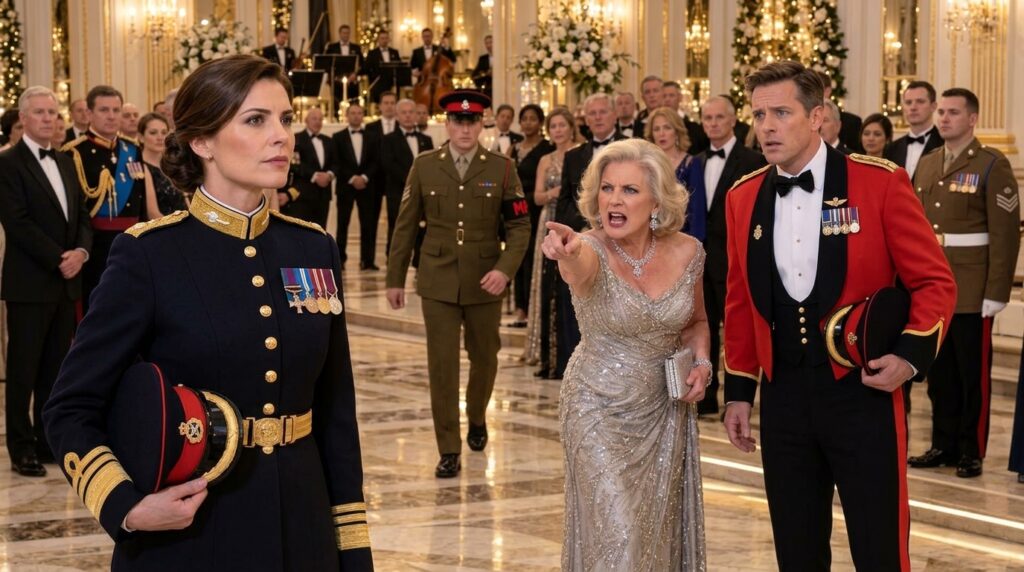
My Mother-in-Law Accused Me of Impersonating a Navy Officer in Front of Admirals. Then the Ballroom Learned Who I Really Was.


PART 1: ARREST HER

My mother-in-law was smiling when the Military Police officer walked toward me.

That was the part I remember most clearly.

Not the silence.

Not the hundreds of eyes suddenly fixed on my white uniform.

Not even the way my husband, Frank, went pale as he realized his mother had finally crossed a line none of us could pretend not to see.

It was Helen Whitmore’s smile.

Triumphant.

Certain.

For seven years, she had treated me like an embarrassing accessory to her son’s success.

Now she believed she was finally going to prove she had been right about me all along.

She stood near the entrance to the ballroom in a silver evening gown, diamonds shining at her throat, one hand still lifted from where she had pointed me out.

“That woman does not belong in that uniform,” she had announced.

Her voice had carried farther than the brass quartet.

“Remove her. Arrest her if necessary.”

Then, louder:

“She is impersonating an officer.”

The entire Admiral’s Winter Ball had gone silent.

Admirals.

Commanding officers.

Senior enlisted leaders.

Military spouses.

Several senators and their guests.

Decorated men and women who had spent decades learning exactly what every stripe, ribbon, insignia, and device meant.

All of them watched the MP cross the ballroom toward me.

I didn’t move.

There was nowhere I needed to go.

The officer stopped in front of me.

He was young enough that I could see how uncomfortable he was beneath the disciplined expression.

“Ma’am,” he said carefully, “a complaint has been made regarding your uniform and identity. I need to verify your credentials.”

Behind him, Helen smiled wider.

I heard someone inhale sharply.

Frank said, “Mom, stop this.”

She ignored him.

I reached inside my jacket.

My fingers found my military identification.

I removed it.

Held it between two fingers.

And handed it to the officer.

“Of course.”

He took it.

Looked down.

One second passed.

Then two.

On the third, his entire posture changed.

His shoulders squared.

His chin lifted.

The uncertainty disappeared from his face.

Across the ballroom, Admiral Hargrove pushed back his chair.

Helen didn’t notice.

She was too busy watching me.

Waiting for humiliation.

Waiting for handcuffs.

Waiting for the moment she could tell everyone she had always known there was something suspicious about her son’s wife.

The MP looked at my identification again.

Then at me.

Then toward Admiral Hargrove.

“Captain,” he said.

One word.

Helen’s smile flickered.

The officer carefully returned my identification.

Then he turned toward her.

“Mrs. Whitmore,” he said, his voice carrying through the silent ballroom, “you need to hear exactly who you just tried to arrest.”

Seven years.

That was how long it had taken to reach that sentence.

Seven years of little smiles.

Little insults.

Little corrections delivered with such polished sweetness that if I objected, I became the unreasonable one.

Seven years of Helen introducing me as Evelyn.

Never Captain Whitmore.

Never commanding officer.

Never a woman who had served twenty-two years in the United States Navy.

To Helen, I was simply the woman her accomplished son had married.

The woman with the forgettable office job.

The woman who, apparently, had spent seven years secretly waiting to steal a uniform and infiltrate a ballroom filled with people capable of recognizing a fake officer from fifty feet away.

The absurdity of it might have been funny.

If it hadn’t taken so long to get there.

Frank moved beside his mother.

His jaw was tight.

“Please,” he said quietly. “For once in your life, just listen.”

Helen looked from him to the officer.

Then to me.

Confusion was beginning to replace certainty.

But I knew that expression.

Helen did not change her mind quickly.

Especially when changing her mind meant admitting she had underestimated someone.

Especially me.

The MP opened his mouth.

And in that moment, standing under chandeliers while the entire room waited for the truth, I thought about the first time Helen had decided what kind of woman I was.

She had made that decision seven years earlier.

Within twelve minutes of meeting me.


PART 2: THE LITTLE DESK JOB

Frank had warned me about his mother before he introduced us.

Not in any dramatic way.

He was almost apologetic.

“She can be a little… intense.”

We had been sitting in a small restaurant near the waterfront. Frank had turned his coffee cup slowly between his hands.

“Intense how?”

“She asks questions.”

“That sounds survivable.”

He smiled.

“She asks questions and then answers them herself.”

That should have told me everything.

Frank was a commander then, already well established in his Navy career. He was smart, capable, disciplined, and nothing like Popular Posts
→- 1
- 2
- 3
- 4




Recently Viewed
Stories you read recently will appear here.


