PART 2:
For the next three weeks, my ribs healed faster than everything else. I woke from nightmares hearing Cruz inside the burning vehicle, Petrov calling her daughter’s name, and Rowan asking whether his wife had been notified. During the day, I followed doctors’ orders, answered Army paperwork, and tried not to think about my father. At night, I kept seeing that empty Thanksgiving chair.
Colonel Caldwell visited me twice and made it clear she was not going to let me disappear. During one visit, she mentioned that General Adrian Mercer, Chairman of the Joint Chiefs of Staff, would attend the gala and had personally read the report from the attack that earned me the Silver Star. I asked why someone at his level would read my report. Caldwell only said,
“He didn’t read every one.”
Meanwhile, Vivian became engaged to Derek, and Dad posted photographs online with a caption about her “building a legacy.” Vivian later texted me privately and asked one more time if I would wear a black dress instead of my uniform. I told her no. She replied, “Why are you doing this?” as if simply showing up as myself were an act of aggression.
The night of the gala, I pinned the Silver Star above my left breast and looked at myself in the mirror. My father would see cheap fabric, Vivian would see a threat to her perfect evening, and strangers might see a decoration. I saw Rowan, Petrov, and Cruz. Then I whispered, “I’m going,” and walked out.
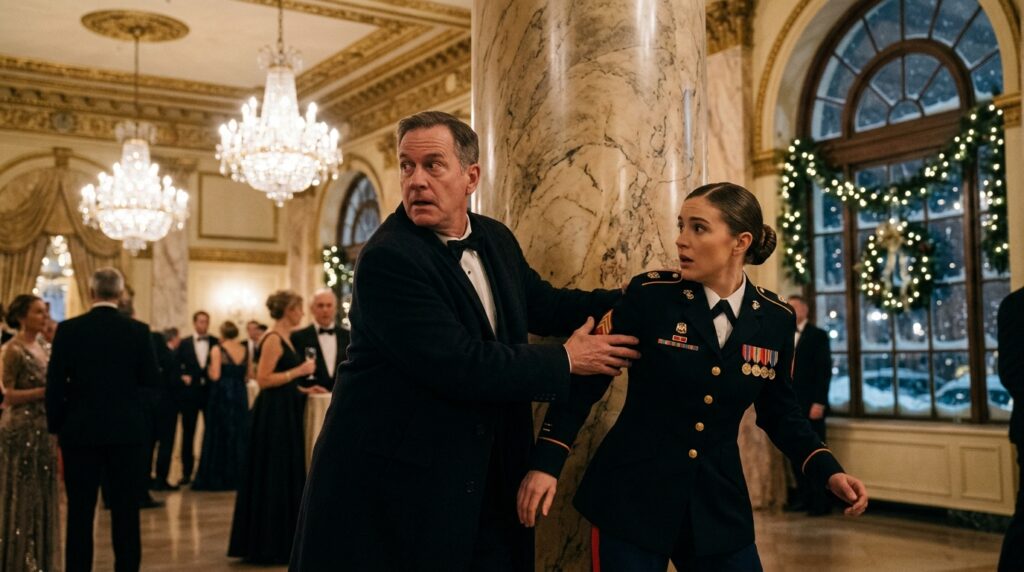
Beaumont Hall glowed under the falling snow,
crowded with senators, military leaders, wealthy donors, and executives. Vivian found me almost immediately, stared at my uniform, and whispered, “Oh my God. You actually wore it.” Then Derek approached and looked at the Silver Star with a recognition that my own family had never shown.
He shook my hand and said, “Major Stewart?” Vivian quickly explained that I “didn’t talk much about work,” but Derek’s expression told me he already understood there was more to the story. Before he walked away, he said something simple that caught me off guard: “I’m glad you came.” My father arrived seconds later.
“What have you done?” Dad demanded. He said Derek’s parents were there, business partners were watching, and my uniform was turning Vivian’s engagement celebration into something uncomfortable. I asked why my military service threatened anyone.
He answered, “You have always needed everything to become about you.”
That was when I stopped letting him rewrite history. I reminded him how he pushed me out of family photographs, discouraged me from wearing my uniform at Vivian’s graduation, and removed my Thanksgiving place setting before I ever arrived. He grabbed my elbow hard enough to send pain through my ribs. For one split second, training took over and my body prepared to break his grip.
I stopped myself. “Let go of me,” I said. Something in my voice finally reached him, and he released my arm just as Vivian and Derek returned.
Dad pulled me behind a marble column, away from the center of the ballroom. Then he delivered the sentence that finally stripped away every excuse I had ever made for him: “Don’t humiliate us with that cheap uniform.”
He told me to stay hidden, keep quiet, and not tell anyone “war stories.”
I asked him to explain exactly what embarrassed him. Dad pointed toward my medal and said I carried too much tragedy around—wounds, dead friends, military stories, all of it. Vivian tried to soften his words, but then admitted something that hurt almost as much: “You disappear for months, and suddenly you’re the brave one. People ask about you.”
For the first time, I understood that Dad’s comparisons had damaged both of us. Vivian had been taught that my success threatened hers, while I had been taught that her success proved my failure. But before I could decide whether that truth changed anything, Dad looked at the Silver Star on my chest and gave his final judgment.
“You have built a life people feel sorry for.”PART 3:
I stared at my father after he said those words, and something inside me went completely still. He kept talking, saying I lived in a depressing apartment, earned a government salary, came home injured, and had nothing outside my job. Then he pointed toward my Silver Star. “You wear that piece of metal like it makes all those decisions worthwhile.”
“The medal doesn’t make anything worthwhile,” I answered. I told him it did not bring Rowan back, did not bring Petrov back, and did not bring Cruz back. My voice nearly failed when I said Cruz’s name, but I forced myself to continue. “It reminds me that I owe them enough respect not to be ashamed of surviving.”
Popular Posts
→- 1
- 2
- 3
- 4




Recently Viewed
Stories you read recently will appear here.


