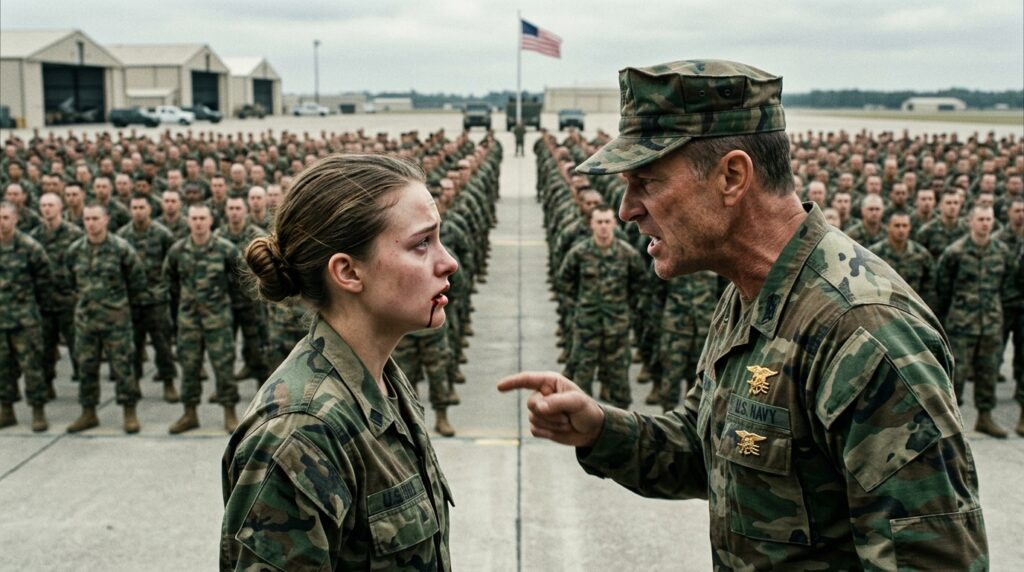
He stood beneath the California sun with a microphone in one hand and a confident smile on his face, certain the quiet “administrative captain” in front of him would lower her eyes and accept the embarrassment. What Commander Brock Sullivan did not know was that most of my actual service record was hidden behind classification restrictions, or that one man near the reviewing stand already understood exactly who he was challenging.
The morning had begun like any formal military demonstration at Naval Amphibious Base Coronado. More than a thousand sailors, Marines, officers, and SEALs stood in formation while the American flag moved sharply in the ocean breeze. Senior leaders filled the reviewing stand, and invited observers waited along the edges of the parade field.
My name is Captain Avery Hayes.
To almost everyone there, I was simply a visiting Navy officer assigned to observe a joint training exercise and review administrative coordination between several commands. I wore no unusual insignia. I had no large entourage. I had arrived carrying a slim folder and had spent most of the morning listening instead of speaking.
I had spent years being underestimated.
Usually, I found it useful.
Commander Brock Sullivan apparently considered it permission to treat me as insignificant.
He walked toward the microphone with ribbons covering his uniform and the confidence of a man accustomed to having a room become quiet when he entered. After questioning one of my observations about the exercise, he turned the disagreement into something personal.
“Remember my rank,” he said through the microphone.
The words carried across the entire parade field.
Then he looked directly at me.
“You’re standing here because somebody decided we needed another administrative observer. That doesn’t mean you understand what happens on this field.”
The formation went completely silent.
I could feel more than a thousand people waiting to see whether I would argue, retreat, or apologize.
I did none of those things.
I slowly raised my eyes toward him.
Near the reviewing stand, Sergeant Major Thomas Reed was watching us. His face remained disciplined, but I recognized something in his expression immediately.
Concern.
Not for me.
For Brock.
Reed knew what almost nobody else on that field knew. I was not simply an administrative officer, and the quiet gaps in my public service record were not empty years.
They were classified ones.
“Apologize,” Brock ordered.
I held his gaze.
“For what?”
A faint murmur moved through the formation.
His jaw tightened.
“For disrespecting a superior officer.”
“I disagreed with your assessment of the exercise.”
“You questioned my judgment.”
“I questioned a decision.”
Brock stepped closer to the microphone.
“Same difference.”
“No, Commander. It isn’t.”
That was the moment the mood changed.
The California sun was still bright, the flag was still moving above us, and the formation had not shifted, but the field suddenly felt quieter.
Brock gave a short, dismissive laugh.
“Finished with your performance, Captain?”
I closed the folder in my hands.
“No.”
Then I looked straight at him.
“You are.”
His smile disappeared.
Before he could answer, a voice came from the reviewing stand.
“Commander Sullivan, stand down.”
Every head turned.
A senior admiral was already descending the steps.
But when I looked toward him, I realized he was not watching Brock first.
He was looking directly at me.
And the expression on his face told me that the secret Brock Sullivan had spent the morning mocking was about to become impossible to ignore.
The rest of the story is in the first comment.
The admiral stopped several feet away from us.
Commander Sullivan straightened immediately.
So did everyone else.
For several seconds, nobody spoke.
Then Admiral Nathan Caldwell looked at me and said five quiet words.
“Captain Hayes, I remember everything.”
Brock’s expression changed.
It was subtle at first. The confidence remained on his face, but his eyes moved from the admiral to me and then toward Sergeant Major Reed.
Reed did not look surprised.
That seemed to bother Brock even more.
Admiral Caldwell turned toward the reviewing stand and asked for the microphone.
“Today’s demonstration is temporarily suspended.”
A ripple of confusion moved through the formation.
The admiral continued.
“There will be no further public discussion of Captain Hayes’s service history on this field.”
Brock cleared his throat.
“Sir, with respect, this was simply a disagreement between officers.”
Caldwell looked at him.
“No, Commander. It became a command issue the moment you used a public formation to pressure another officer into apologizing for giving a professional assessment.”
Brock’s confidence faded another degree.
The admiral then looked toward me.
“Captain Hayes, please remain.”
I nodded.
“Understood, sir.”
The formation was dismissed in sections, but people moved more slowly than usual. Everyone wanted to look back without appearing to look back.
Within minutes, the enormous parade field had become strangely empty.
Only a handful of senior officers remained.
Brock stood several yards away from me, no longer smiling.
He finally asked the question that had been forming behind his eyes.
“Who are you?”
I picked up my folder.
“The same captain I was when you decided I didn’t belong here.”
That answer did not satisfy him.
Popular Posts
→- 1
- 2
- 3
- 4




Recently Viewed
Stories you read recently will appear here.


