For thirteen months, nobody came looking hard enough to find me.
Then one Tuesday afternoon, my phone rang.
A small voice whispered one word that changed everything.
“Grandma?”
But that came later.
The real beginning was Easter.
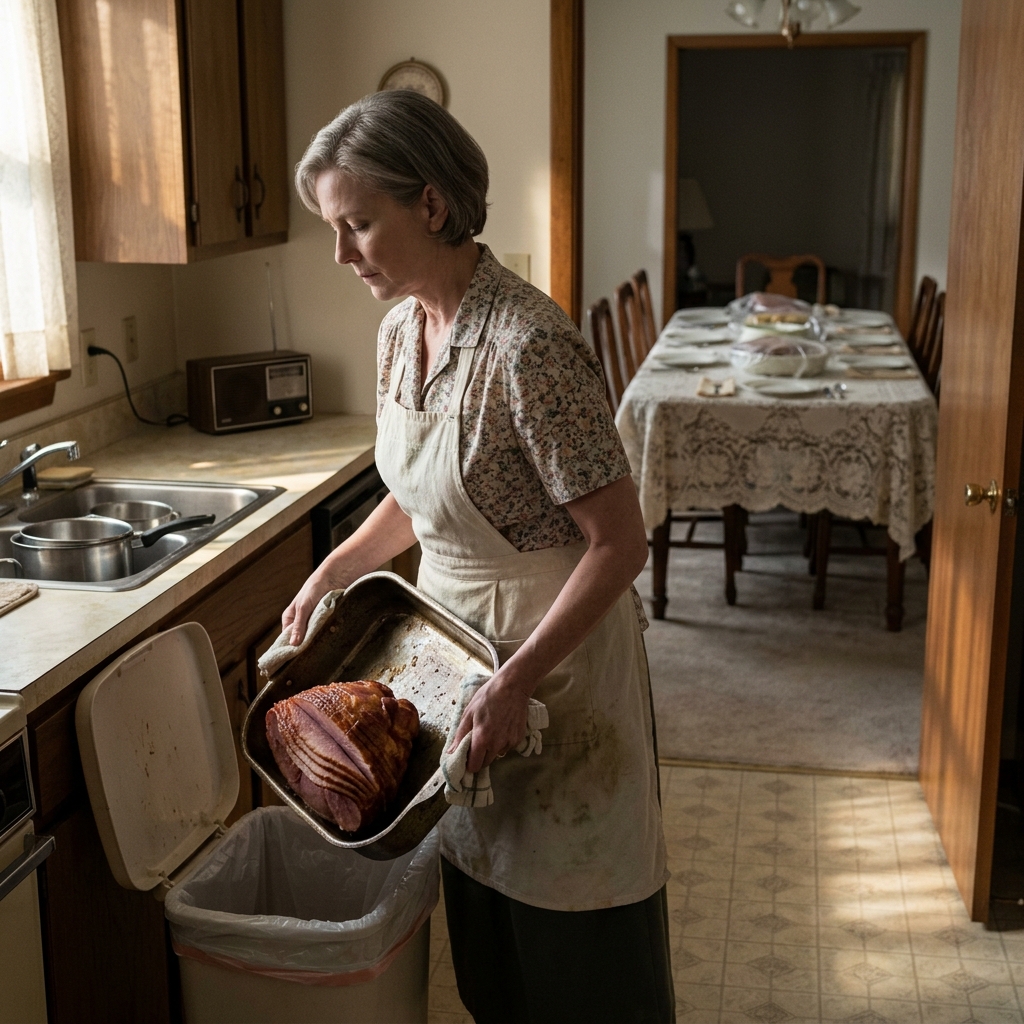
I stood over my kitchen trash can holding a full glazed ham in both hands.
Then I let it go.
The aluminum pan landed heavily at the bottom of the bag.
After that came the pot roast.
Then the scalloped potatoes I had started preparing at six that morning.
Then green beans.
Dinner rolls.
A bowl of macaroni salad nobody had touched.
Nine place settings remained on the dining-room table behind me.
Nine cloth napkins folded into triangles exactly the way my mother taught me more than fifty years earlier.
Nine glasses.
Nine plates.
Nine chairs.
Not one chair had been pulled out.
I was sixty-one years old.
I had spent ten years as a widow.
And that Easter morning I had done what I had done on almost every major holiday since my husband Walt was gone.
I cooked like everybody was coming.
Because everybody had said they were coming.
My sister Diane texted at nine that morning.
Running behind. See you soon.
My other sister Lorraine had said earlier in the week that she expected to make the drive.
My daughter Emily said she, her husband Dale, and the children would come after helping Dale’s mother with something.
My son Grant never confirmed properly.
Grant rarely confirmed anything.
But he lived twelve minutes away.
I had counted on him anyway.
Eleven became noon.
Noon became two.
At two-thirty, I turned the oven down.
At three, I moved the dinner rolls beneath a clean towel so they would not dry out.
At four, I finally started calling.
Diane answered on the sixth ring.
A television was loud behind her.
“Oh, Carol.”
The tone told me before the words did.
“I completely lost track of time. We ended up at Bill’s sister’s instead.”
I looked at the untouched table.
“You ended up there?”
“It just happened.”
“You were coming here.”
“I know. I know. I’m sorry.”
She lowered her voice.
“We’ll do better next time.”
We’ll do better next time.
Diane had been saying that since we were girls.
I called Lorraine.
No answer.
Emily sent a thumbs-up emoji in response to my message asking whether they were still coming.
That was all.
A thumb.
Grant’s phone went straight to voicemail.
“You’ve reached Grant. Leave a message.”
I didn’t.
I went back into my dining room and looked at it properly.
The tablecloth had belonged to Walt’s mother.
She gave it to us when we married.
I had ironed it that morning until every fold was straight.
Deviled eggs sat under plastic wrap.
Warm now.
The homemade rolls were there because years earlier, during one of the rare Christmases when everybody actually stayed long enough to enjoy dinner, my granddaughter Piper had told me homemade bread tasted better than anything from a store.
She had probably been seven.
Maybe eight.
I remembered.
Of course I remembered.
I had spent years storing little facts about everybody I loved.
Piper likes homemade rolls.
Grant takes his coffee without sugar.
Emily hates raisins in stuffing.
Diane likes the crispy corners of scalloped potatoes.
Lorraine wants extra gravy.
I remembered everybody.
Somewhere along the way, almost nobody remembered me.
I touched the back of the chair where Piper would have sat.
Cold metal.
Untouched.
I turned on the radio because Walt had once told me never to let the house get too quiet.
An old hymn came on.
One he used to hum while shaving.
And something inside me finally stopped negotiating.
There was no dramatic breakdown.
No shouting.
No phone thrown against a wall.
I did not cry.
I simply became very still.
I looked at the trash bag.
At the empty chairs.
At the house Walt and I had bought thirty-one years earlier.
And I understood something I had avoided understanding for a decade.
I had become optional.
Not hated.
Not rejected outright.
Optional.
That is a very particular kind of loneliness.
If someone tells you they want nothing to do with you, you can grieve.
You can make sense of it.
But when people say they love you, promise to come, tell you they miss you, ask for favors, accept your birthday checks, call you when they need something, and then repeatedly fail to arrive when nothing is required of them except their presence, there is no clean moment to mourn.
You just keep waiting for next time.
I had spent ten years doing that.
That Easter, I stopped.
My husband’s name was Walter Voss.
Walt.
We met in 1979 at a Sears in Zanesville, Ohio.
I sold appliances.
He came in three times in one week pretending to compare lawn mowers.
Popular Posts
→- 1
- 2
- 3
- 4




Recently Viewed
Stories you read recently will appear here.


