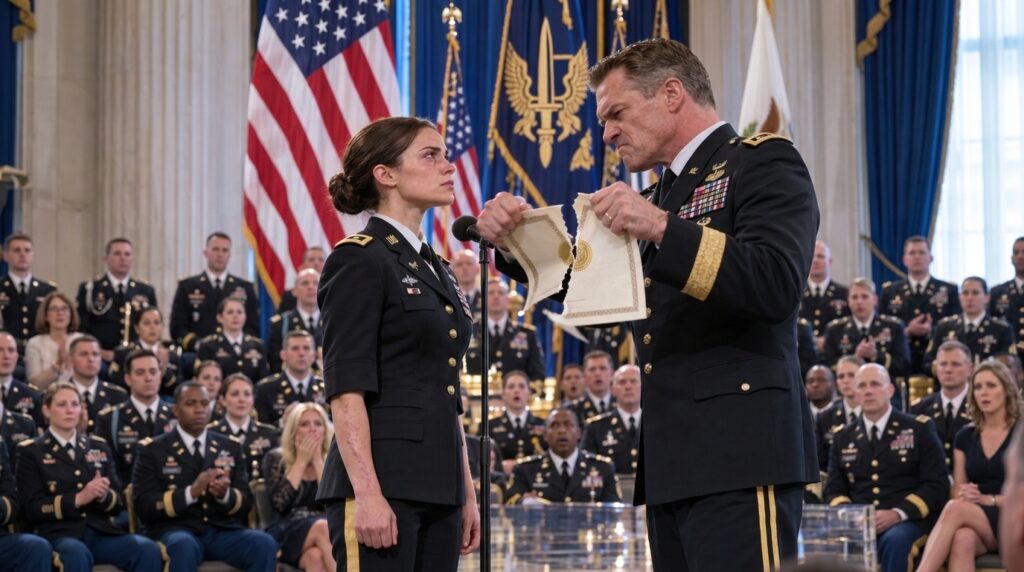
PART 1: THE CERTIFICATE ON THE FLOOR
“YOU HAVE NO RIGHT TO BE STANDING ON THIS STAGE.”
Lieutenant Colonel Blake Turner crossed the polished platform before the applause had even begun.
One second, the commendation was resting in my hands.
The next, it was gone.
Blake ripped it away so violently that the heavy paper snapped against my fingers.
The microphone caught the sound.
Every officer in the auditorium heard it.
For one frozen moment, I kept my palms open in front of me.
Then I slowly lowered them.
Blake held the certificate beside my scarred left arm as if he were presenting evidence in a trial.
The scar began just above my wrist and traveled toward my elbow in a pale, uneven line. Three surgeries had softened it. Eleven months of rehabilitation had restored most of my strength.
Nothing had erased it.
Blake looked at the scar.
Then he looked at me.
A cold curve appeared at the corner of his mouth.
“A scar doesn’t make someone a hero.”
The auditorium changed.
It was almost impossible to explain how silence could have weight, but that silence did.
Rows of officers sat beneath American flags and deep-blue SEAL banners. Families filled the civilian section. A few children sat beside fathers or mothers in dress uniforms.
Nobody moved.
Nobody spoke.
I looked once at the certificate in Blake’s hand.
Then at him.
“I never asked anyone to call me one.”
That should have ended it.
Instead, something hardened in his face.
He folded the commendation in half.
The gold seal disappeared beneath the crease.
My stomach tightened.
Not because of the paper.
Because I knew whose signature was at the bottom.
I knew who had authorized the citation.
And I knew Blake had just folded a direct order from General Mercer as casually as a restaurant receipt.
He gripped both sides.
Then he pulled.
The commendation tore straight through the middle.
The sound was rough.
Deliberate.
Almost intimate in the quiet auditorium.
“Then you don’t need this.”
One half floated to the stage beside my boot.
The other slid beneath the lectern.
A captain in the first row inhaled sharply.
Another officer looked toward the side doors.
Nobody intervened.
I stared at the half near my foot.
Part of the official seal remained visible.
For a second, I wasn’t standing beneath ceremony lights in Virginia.
I was somewhere else.
Dust in my mouth.
Blood running beneath my sleeve.
A radio screaming static against my ear.
Someone shouting my name.
Kane!
Kane, stay awake!
I dragged myself back into the auditorium before the memory could take hold.
Blake pointed toward the rear rows.
“Go sit with the support staff.”
I didn’t move.
His hand remained extended.
“Lieutenant.”
I looked at him.
“I was instructed to stand here.”
“You were instructed incorrectly.”
“The ceremony order came directly from General Mercer’s office.”
That changed him.
Only slightly.
But I saw it.
His mouth tightened.
“General Mercer isn’t here.”
I glanced toward the clock above the side exit.
The ceremony had begun twelve minutes late.
General Mercer had not arrived.
Neither had his aide.
No explanation had been given.
Those twelve minutes were the reason Blake had dared to climb onto the stage.
The ceremony director had been preparing to stall when Blake rose from his assigned seat, walked past the front row, and announced that he would “correct an embarrassing administrative mistake.”
Then he came for me.
Now he stood beneath the medal display as if the entire auditorium belonged to him.
His voice sharpened.
“Last chance. Step down.”
I looked at the torn certificate.
Then I noticed the six chairs again.
First row.
Center section.
Reserved.
Six place cards.
All facedown.
They had bothered me from the moment I entered the room.
The ceremony director had told me not to touch them.
“These are reserved for operators,” she had said.
“Which operators?”
“You’ll see.”
That was all she gave me.
Now Blake followed my eyes.
“Those seats are for operators, Lieutenant Kane.”
“I know.”
“Then quit staring at them.”
I returned my gaze to him.
“Did you actually read the authorization?”
His expression changed again.
This time irritation replaced certainty.
He kicked the closest half of my citation.
The paper slid across the polished floor and struck the base of a microphone stand.
The metal pole rattled loudly.
“I don’t need to read every line to recognize a consolation award.”
The auditorium somehow grew quieter.
My heartbeat slowed.
That happened sometimes when I became angry.
People expected anger to feel hot.
Mine usually felt cold.
Very cold.
Especially after the mission.
Especially after eleven months spent learning how to use my arm again.
I kept my voice level.
“You didn’t read it.”
“I read enough.”
“No, sir.”
His eyes narrowed.
“You want to be very careful with your tone.”
Popular Posts
→- 1
- 2
- 3
- 4




Recently Viewed
Stories you read recently will appear here.


