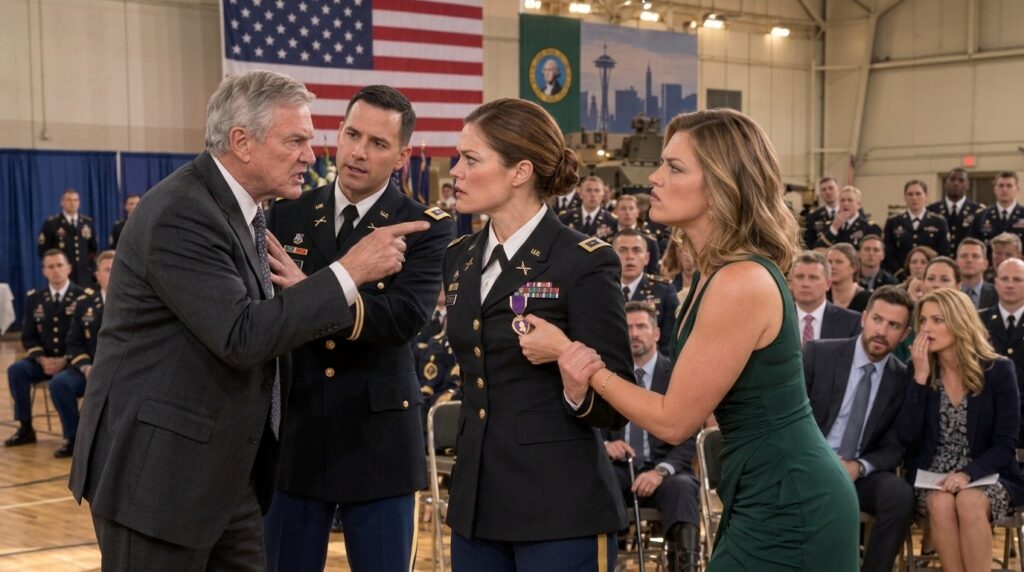
PART 1: THE MEDAL UNDER HER FINGERS
My sister had her fingers wrapped around my Purple Heart when my father told me to let go of her.
Not her.
Me.
“Avery,” Dad said sharply, as though I were the one causing the problem. “Release your sister.”
I stared at him.
For one strange second, the room seemed to tilt.
Brooke’s wrist was locked in my hand. Her other hand was still pressed against my dress uniform, her fingers tangled around the edge of the medal she had just tried to yank from my chest.
Around us, conversations had stopped.
The Washington National Guard Armory was packed with soldiers, spouses, officers, civilian guests, and families who had come for that evening’s awards ceremony. Less than twenty minutes earlier, people had been laughing near the coffee station. Somebody had been rearranging place cards. A captain I knew from headquarters had been trying to keep his two children from climbing under a banquet table.
Now there was silence.
I could hear the hum of the lights overhead.
The small scrape of Brooke’s heel against the floor.
My own breathing.
And somewhere beneath all of it, buried where no one else could hear it, the memory of an explosion.
Burning rubber.
Hot metal.
A man screaming my name.
I tightened my jaw.
“Take your hand off the medal,” I told Brooke.
Her cheeks flushed.
“You’re hurting me.”
“You tried to rip it off my uniform.”
“I was trying to make a point.”
“With your hand?”
Dad stepped closer.
“Avery.”
There was warning in his voice.
The same warning he had used when I was sixteen and argued too loudly at the dinner table.
The same warning he had used when I was eighteen and told him I had enlisted.
The same warning he had used over the years whenever my military career threatened to become too real inside the carefully organized world he preferred.
I looked at him.
“Her hand is on me.”
“She’s your sister.”
“So?”
His expression hardened.
“So you don’t grab your sister like that in public.”
Something inside me went very still.
Brooke gave another small tug, either because she was nervous or because she still believed I would eventually surrender the way I always had.
The pin pulled against my uniform.
Pain flashed beneath my left shoulder.
Not severe.
Not new.
But familiar enough that the armory disappeared for half a heartbeat.
Dust.
Blood.
The metallic taste in my mouth.
A torn glove.
My knees grinding into gravel while I tried to keep pressure on a wound that wasn’t mine.
Then the room came rushing back.
I released Brooke’s wrist only after she let go of the medal.
She jerked her hand back and cradled it against herself.
“You see?” she said to Dad. “This is what I mean. Everything with her has to become some huge military thing.”
I almost laughed.
I didn’t.
I had spent twenty-two years learning how not to react when reacting would make a situation worse.
Twenty-two years in uniform had taught me how to stand still while people shouted, how to make decisions while exhausted, how to swallow fear long enough to get somebody else home.
Apparently none of that training was enough to prepare me for my little sister grabbing the Purple Heart off my chest and accusing me of being dramatic.
Dad lowered his voice.
“Can we please not do this here?”
“Do what?”
“Make a scene.”
I looked around.
Three lieutenants near the back wall were pretending not to watch.
A senior NCO had stopped halfway through pouring himself coffee.
Two soldiers from my unit were standing near the aisle with expressions so carefully neutral that I knew exactly how angry they were.
Brooke noticed them too.
Her embarrassment deepened.
That should have ended it.
Instead she folded her arms.
“I just think wearing it tonight is a lot.”
I stared at her.
“A lot.”
“Yes.”
“The Purple Heart is part of my authorized uniform.”
“I know what it is.”
“No,” I said quietly. “You know what it looks like.”
She flinched.
Dad exhaled through his nose.
“Avery.”
But I was finished being corrected.
I had arrived that evening expecting a ceremony.
The Bronze Star Medal I was about to receive had taken months to reach this stage. There had been paperwork, witness statements, reviews, signatures, delays, questions, more paperwork.
I had not enjoyed any of it.
People who had never been under fire sometimes imagined valor awards as victories.
They weren’t.
Not to me.
A citation could reduce the worst minutes of your life into clean language printed on heavy paper.
Under enemy fire.
Without regard for personal safety.
Despite her injuries.
Successfully evacuated wounded personnel.
Words could make chaos sound organized.
They could make terror sound noble.
They could make blood look clean.
Popular Posts
→- 1
- 2
- 3
- 4




Recently Viewed
Stories you read recently will appear here.


