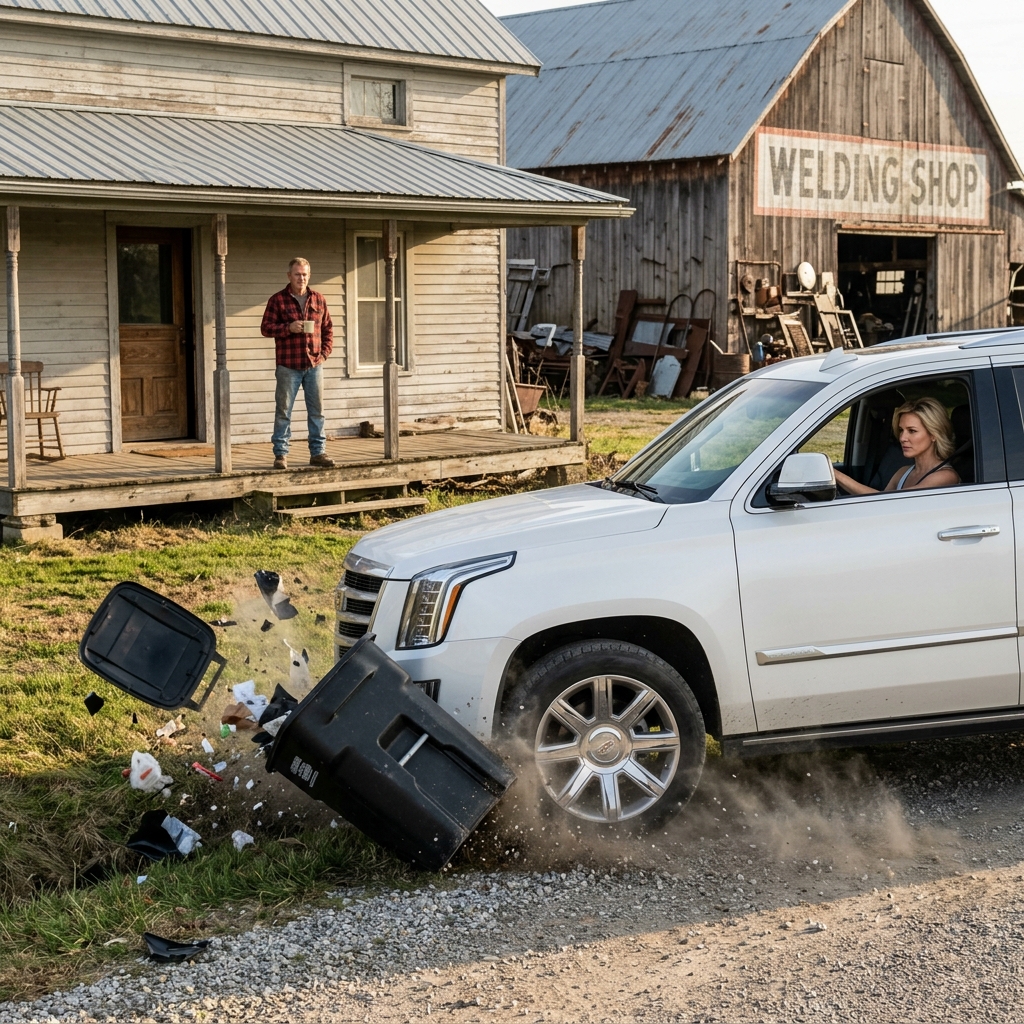
For eighteen months, Sloan Westbrook Calhoun destroyed my trash cans every Friday morning on her way to Pilates.
Not accidentally. Not once or twice. Not because the road was narrow or because the cans were sitting where they shouldn’t have been.
She aimed for them.
I know because I watched her do it. Then I installed cameras and watched her do it again. And again. And again.
By the twenty-third incident, I had replaced twelve county-issued trash cans at seventy-six dollars apiece, filed enough complaints to fill a sheriff’s folder, and learned one important thing about people like Sloan.
They don’t stop when you ask politely.
They stop when continuing becomes expensive.
My name is Quinn Galloway. I’m a retired welding instructor from Holmes County, Ohio, and I’ve spent most of my life teaching young people that steel has no opinion about your intentions. A weld either holds or it doesn’t. A structure either carries the load or it fails. Physics doesn’t care how important you think you are.
Sloan learned that lesson on a Friday morning at 7:32.
Her Cadillac Escalade learned it first.
My family has lived on Township Road 167 outside Millersburg since 1956, when my grandfather, Ruben Galloway, moved north from West Virginia looking for steady work. He had spent eighteen years underground in the coal mines before layoffs started eating through Logan County. With four children to feed, he bought a four-and-a-half-acre parcel in Holmes County for forty-two hundred dollars and moved into a two-story farmhouse built before the Depression.
The house wasn’t pretty then. It still isn’t fancy now.
But it is ours.
My father grew up there, and so did I. I was born upstairs in the north bedroom in November of 1961. By the time I was eight, I was taking apart lawn mower engines. By twelve, I could usually put them back together without having leftover bolts.
My grandfather introduced me to welding when I was four.
He was repairing a wagon hitch behind the house and let me hold his striker. I remember the smell of hot steel, the burst of sparks, and the absolute certainty that came over me when two separate pieces became one.
That was it.
I knew what I wanted to do.
I graduated from the Holmes County vocational program in 1979 and worked structural steel for several years before returning to the school as a teaching assistant. By 1989, I was the lead welding instructor.
I stayed thirty years.
During that time, thousands of students came through my shop. Some became welders. Some became pipefitters. Some went into engineering. Some decided metalwork wasn’t for them and found other lives.
I was proud of all of them.
At my retirement dinner, an engineer from the county manufacturing association told me, “Quinn, I’d bet every bridge built around here since the nineties has at least one weld made by somebody you taught.”
I told him I hoped that was a compliment.
He said, “It’s the only compliment that matters.”
I retired in 2019 and converted my father’s old barn into a fabrication shop. I already had most of the equipment accumulated over decades: welders, plasma cutter, lathe, milling machine, clamps, grinders, saws, tables, racks of pipe and plate.
I poured a proper concrete floor, wired the place the way I wanted it, and started doing small custom jobs.
Farmers needed brackets.
Contractors needed repairs.
Neighbors needed gates, railings, trailers, hinges, frames, and things nobody sold in a catalog.
I liked it.
After thirty years of teaching, it felt good to work quietly with my own hands again.
My wife, Hazel, had retired from nursing home administration a few years before me. We had been married since 1983. She was the kind of woman who could make a room calmer without saying anything.
We had one son, Wesley, who became a civil engineer with the Ohio Department of Transportation.
Roadside infrastructure was his specialty.
Guardrails. Barriers. Right-of-way safety. Traffic-control systems.
That detail would become important later.
Pinebrook Estates appeared along our southern property line in 2017. Before that, the land had belonged to a dairy family. Then a developer bought it, divided it into large suburban lots, built thirty-six expensive houses, and marketed the neighborhood to commuters working in Akron and Wooster.
At first, we barely noticed them.
They stayed on their side. We stayed on ours.
Then Sloan Westbrook Calhoun arrived.
She and her husband, Holden, bought one of the larger homes in 2020. They had three children, a white Cadillac Escalade, and the unmistakable confidence of people accustomed to entering a room already convinced they were the most important people in it.
Sloan was forty-four, blonde, polished, athletic, and always dressed like she had somewhere more exclusive to be.
She had worked in commercial real estate marketing before deciding, according to neighborhood gossip, to focus on “community leadership.”
Popular Posts
→- 1
- 2
- 3
- 4




Recently Viewed
Stories you read recently will appear here.


