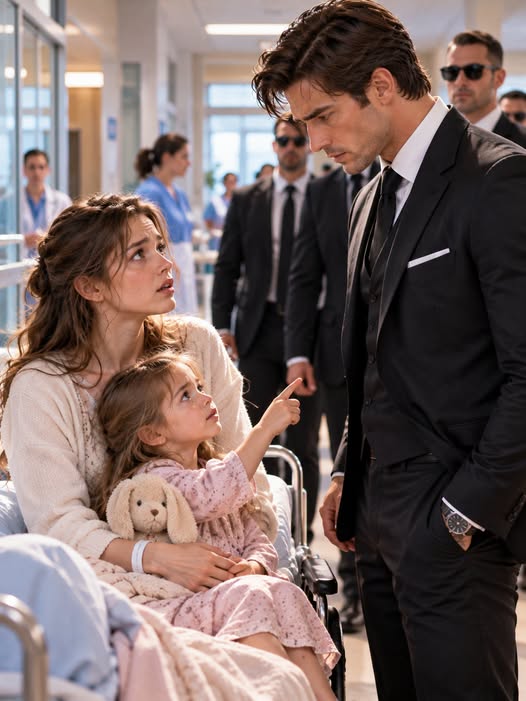
Avery was six years old, with two missing front teeth and a faith in strangers that terrified her mother, and in the bright, antiseptic roar of the hospital lobby she studied the man for exactly three seconds before she asked the question that had been buried for six years. “Mommy,” she said, loud enough for his bodyguards to flinch, “why does that man have my eyes?” The folder slid out of his hand. Papers went everywhere. And Noelle watched the most dangerous man she had ever loved stand perfectly still in the middle of the disaster, as if the whole world had just stopped returning his calls.
CHAPTER ONE
The coffee stain on Noelle Vance’s scrubs was shaped vaguely like the state of Ohio, and she was twenty-three minutes late, and both of those facts were about to become the least interesting things about her morning.
She had spent the drive to St. Catherine’s Medical Center rehearsing the landlord’s voicemail — the one she’d been avoiding since six a.m., the one she already knew by heart. The building had been sold. The new owners wanted four hundred dollars more a month. Four hundred dollars was groceries and gas and Avery’s after-school program and the little white envelope she kept in the freezer, the one she’d been rebuilding for three years, one careful deposit at a time, every time life kicked the bottom out of it.
Somewhere in her jacket there was a permission slip signed with the wrong date. Her pager had died in the rain. And at 7:42 a.m., Noelle rounded the corner near the fourth-floor elevator bank with her chin buried in a patient chart, and she walked straight into a wall of expensive wool and heat.
“I’m so sorry—”
She looked up.
The apology died halfway out of her mouth.
Landon Kessler was standing in her hospital.
Seven years had done something severe to him. At twenty-two he had been all shoulders and stubbornness, his hands permanently stained from the shop, a boy who drove a truck that needed three attempts to start in the cold and who had once fixed her wobbly kitchen table with a scrap of duct tape and sheer force of will. The man in front of her wore a charcoal suit that probably cost more than she made in a month. His hair was shorter. His jaw was harder. And pinned to his lapel was a small silver emblem that looked official without explaining a single thing about what he had become.
Two men stood behind him in dark coats. They were not looking at her. They were watching the hallway the way a lighthouse watches water — patient, tireless, waiting for something to change.
“Nell,” Landon said.
Nobody had called her that in seven years. Not since the summer she turned twenty-three, when she’d been a girl who still believed the world could be shaped by hand, and Landon had given her a name that belonged only to him. She’d been Noelle to everyone since. Noelle was the name that fit the life she’d actually lived — the life without him.
“Your uncle,” she said. “Is he—”
“Emergency bypass, last night.” His voice was the same low, careful instrument it had always been, the voice of a boy who’d learned early that saying too much could get you hurt. “He’s stable. Room four-twelve.”
“I’m sorry.”
“He’s going to be fine.”
“That’s good.”
They stood in the fluorescent hum, a thousand questions stacked between them like dynamite, none of them safe to light in a hallway where strangers carried their own disasters past.
“I need to get to work,” Noelle said.
“Nell.”
She stopped. She did not turn around.
“I’m sorry,” he said.
The words landed exactly where they had landed seven years ago — in the parking lot behind Birchwood Market, when he’d held both her hands with his knuckles gone white and told her he had to go. He couldn’t explain. It wouldn’t be forever. She had believed him for two weeks, until his phone went dead and his apartment was empty and the garage closed without a note, without a forwarding address, without a single reason why.
“You already said that,” she told him, and walked away.
Her hands did not start shaking until she reached the nurses’ station.
“Nell.” Celia Navarro glanced up from her computer with her eyebrows doing an interrogation. “You look like you’ve seen a ghost.”
“Low blood sugar.”
“You ate half a breakfast sandwich ten minutes ago.”
“I’m very fragile.”
Celia narrowed her eyes, but a call light flashed across the board before she could launch a full investigation, and Noelle fled into the mercy of work.
For the next ten hours she lost herself in the rituals she knew better than her own heartbeat: meds to chart, families to soothe, discharges to process, the old man in Room 428 who kept hiding his hearing aids inside his pillowcase because he was certain someone was stealing them. Work was good for that. It gave panic a uniform and a schedule and a place to stand.
At five-fifteen she collected Avery from the after-school room at Riverside Elementary.
Her daughter came at her like a small cannonball — purple backpack, one sock pulled higher than the other, a gap where two front teeth used to be.
“Mom, Milo ate an eraser.”
“Why?”
“He wanted to know what it tasted like.”
Popular Posts
→- 1
- 2
- 3
- 4




Recently Viewed
Stories you read recently will appear here.


