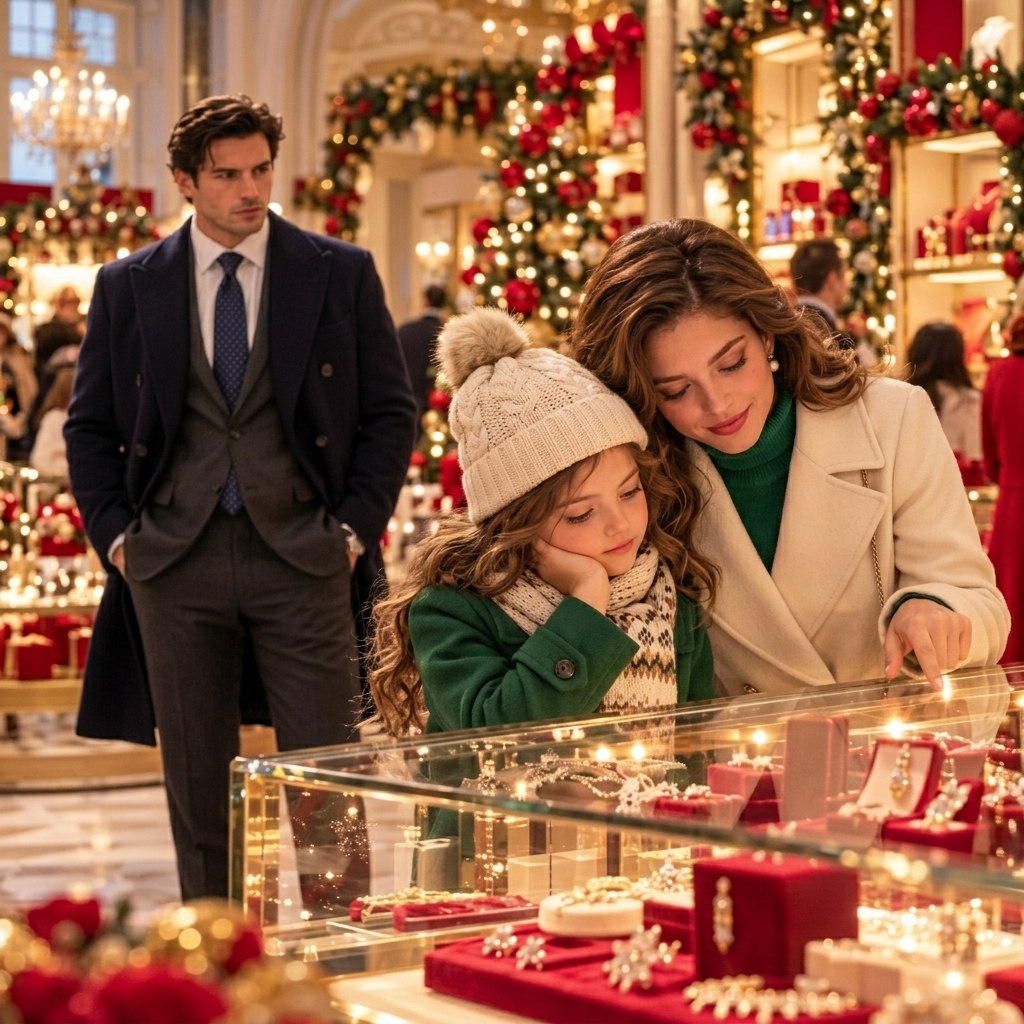
The shoes cost thirty-eight dollars. Anna Kowalski earned forty-two a week, and every dollar of it already had a name.
Anna crouched beside her and whispered, “Not today, sweetheart.”
A tall man in a camel-hair coat stood three steps behind them. He had bought a hundred expensive things in his life. He had never once given anybody a miracle.
Then he walked toward them — and asked for permission.
# CHAPTER 1
The ovens in Novak’s Bakery were already hot at five in the morning.
It was New York, December 1984, and Anna Kowalski stood at the long wooden table with flour up to her elbows. She was twenty-eight. She had worked at the bakery six years, and her hands knew the work without her.
She shaped the rye loaves. She rolled the poppy-seed rolls. She glazed the donuts in slow circles, the way Mr. Novak had shown her the first week, and at seven she opened the door to the first customers — the bus drivers, the night nurses coming off shift, the old men who bought one roll and read the newspaper at the counter for an hour.
She earned forty-two dollars a week. Every dollar had its place. The rent for the small flat on the third floor of a building on West 47th Street. The milk and the bread that Mr. Novak let her take home for free. The winter coat for her daughter, which she was still paying off at the shop on the corner, a few dollars at a time.
Her husband had left when Rosie was two. He had said he was going to Chicago to find work. He had never written.
Anna had not cried about him for a long time. She had simply decided that she and Rosie were enough for each other, and she kept that promise every single day, in small ways, without ever saying it out loud.
Rosie was six. She had dark curls and serious brown eyes and a pencil that was always in her pocket. She drew everywhere — on the backs of paper bags from the bakery, on old newspapers, and once, to Anna’s horror, on the wallpaper beside her bed. What she drew were dresses. Long dresses with bows. Short dresses with buttons. Dresses for princesses, and dresses for the old lady downstairs.
On Saturdays Anna finished at eleven. And on the second Saturday of every December, mother and daughter had a tradition that cost nothing at all.
ADVERTISEMENT
Discover more
Get Marriage Tips
Movies
Stream Indie Films
They took the bus to Fifth Avenue. They walked past the decorated windows in the snow. They went inside Bergman’s to look at the great tree that reached all the way to the ceiling, and they stood beneath it among the crystal chandeliers and the marble and the music, and for half an hour they felt that the most beautiful place in the city belonged to them too.
They never bought anything. That was not the point.
This December, the second Saturday, the snow came down thin and steady. Rosie wore the red knitted hat Anna had made her, and she pressed her nose to the cold bus window the whole way, breathing little circles onto the glass. Anna kept her cracked hands in her coat pockets and watched her daughter’s reflection.
At noon exactly, they reached the revolving doors of Bergman’s.
Two things arrived at the same moment. A tall man in a camel-hair coat, stepping out of a black car. And a young woman in a red scarf with a little girl in a red knitted hat.
They almost collided.
Anna stepped back at once.
“Oh, I’m sorry. Please, you first.”
The man stepped back too. He made a small bow, like a man from an old film, and held out his hand toward the door.
“Please,” he said. “After you.”
She looked up at him and smiled. It was a simple smile, a little tired and very warm, and it went straight through him.
The little girl beside her took the edge of her coat in two fingers and made him a perfect curtsy, exactly like a princess in a picture book.
The man laughed out loud. He had not laughed like that in a long time.
They went in. He stood at the doors one second longer than he needed to, and something in the shape of the day had already begun to change.
Popular Posts
→- 1
- 2
- 3
- 4




Recently Viewed
Stories you read recently will appear here.


