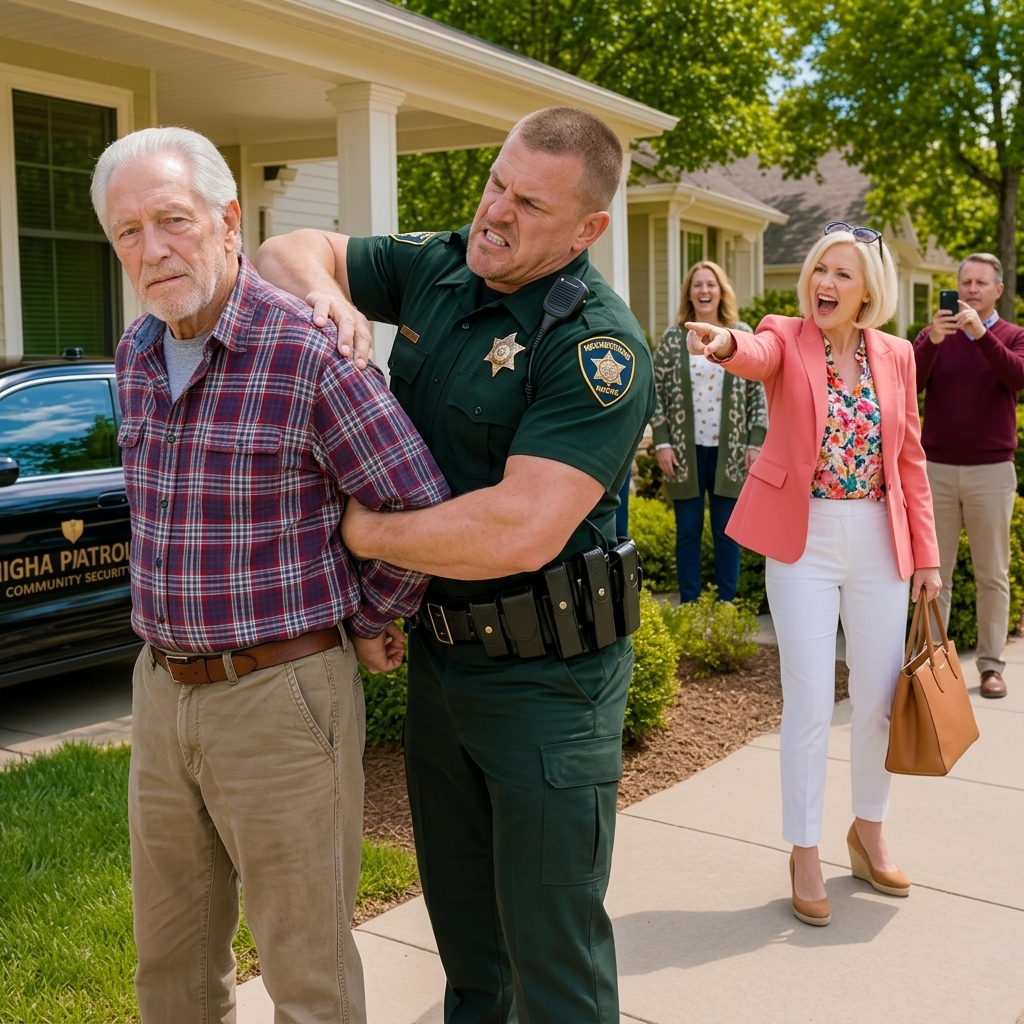
“Get off this porch. Right now.”
My father looked up from his coffee.
“Ma’am, this is my house.”
“Your house is a disgrace, Mr. DeVoe. And that disgusting patch of weeds behind your shed? I want it gone by Monday.”
“Those are my wife’s roses.”
“I don’t care whose roses they are.”
“She planted them before she died.”
Brenda Whitmore adjusted her designer sunglasses, glanced at the deputy standing beside her, and smiled.
“Deputy Burgess, I believe we’re finished discussing this. Handcuff him.”
My father was seventy-two years old. He had a bad left knee, two artificial teeth, and a heart that had never fully recovered from losing the woman he loved. He had spent forty-two years working as an electrician, served his country in Vietnam, and paid off his house without ever missing a mortgage payment.
And on that Thursday afternoon, he was forced onto his knees on the front porch he had built with his own hands.
His coffee mug rolled across the concrete.
The handcuffs clicked shut.
Brenda raised her phone and began recording.
“You should have cooperated, Raymond,” she told him. “Some people simply refuse to understand that rules apply to everyone.”
My father lowered his eyes.
He didn’t fight.
He didn’t curse.
He didn’t even ask for help.
But what Brenda didn’t know was that I had spent the previous four hours inside the Wake County District Attorney’s Office, presenting evidence of a criminal scheme that had destroyed three families, stolen hundreds of thousands of dollars, and turned an entire neighborhood into a private hunting ground for a corrupt homeowners association president.
She also didn’t know that six black SUVs were already heading toward Brierwood Lane.
And she certainly didn’t know that the man she was humiliating had a son who had spent eight years investigating people who abused their authority.
My name is Marcus DeVoe.
And this is what happened when Brenda Whitmore finally discovered the difference between having power and being allowed to get away with something.
My father bought his house at 14 Brierwood Lane in Raleigh, North Carolina, in September 1989.
He paid $67,000 for it.
It was a modest three-bedroom brick ranch with a detached workshop, a half-acre backyard, and a concrete driveway that needed replacing. The roof was sound, the plumbing was adequate, and the electrical wiring had been installed by a contractor whose workmanship offended my father so deeply that he spent his first two weekends correcting it.
My mother, Clara, thought that was hilarious.
“Raymond,” she told him one Saturday, “we bought a house, not a hospital.”
“Bad wiring doesn’t know the difference.”
She kissed him on the cheek and went outside to plan her garden.
That was how our family worked.
My father fixed things that could break. My mother made things worth keeping.
By the following spring, the backyard had become her personal kingdom.
She planted azaleas along the eastern fence, lavender beside the kitchen steps, and roses near the detached workshop. The roses were her favorites. She loved the way the morning light caught the petals and how their fragrance drifted through the open kitchen windows in May.
She had names for every variety.
New Dawn. Peace. Mister Lincoln. Queen Elizabeth.
She could tell you which ones needed more sunlight, which tolerated humidity, and which would reward patience with another round of blooms.
My father couldn’t remember their names.
He called them the pink ones, the red ones, and the stubborn yellow ones.
My mother pretended to be offended.
“You can memorize the electrical code, but you can’t remember four roses?”
“The electrical code doesn’t change its mind about where it wants to grow.”
She laughed so hard she had to sit down.
That was my childhood.
Saturday mornings smelling like cut grass and fresh coffee. My father in the workshop, explaining why you always shut off a breaker before touching a wire. My mother outside with dirt on her knees, calling me over to see a flower that had finally opened.
Our neighborhood was small then.
Eight houses on a dead-end road bordered by water oaks and soybean fields.
Nobody cared what color your mailbox was. Nobody measured your grass. Nobody sent threatening letters because a garden didn’t match a professionally designed landscaping plan.
If someone’s fence needed fixing, the neighbors helped.
If somebody got sick, casseroles appeared on the porch.
And if you wanted to sit outside in your underwear on a Sunday morning, that was your business, provided you didn’t frighten the mail carrier.
For nearly thirty years, Brierwood Lane was a place where ordinary people built ordinary lives.
Then my mother got sick.
The diagnosis came in February 2017.
Ovarian cancer.
By the time the doctors found it, the disease had already spread.
Popular Posts
→- 1
- 2
- 3
- 4




Recently Viewed
Stories you read recently will appear here.


