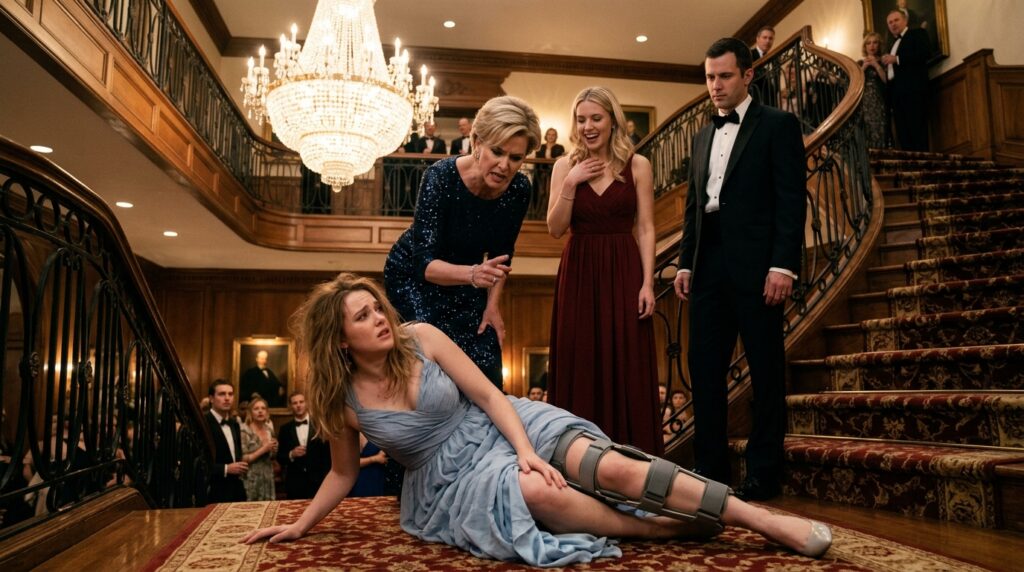
Chapter 1 – The Fracture of Illusions
Outside the third-floor window, the dawn over Rhode Island broke in bruised streaks of charcoal and lavender. Below, out on Narragansett Bay, the early fog clung to the water, obscuring the masts of luxury yachts docked at the marina. Those yachts belonged to men who played tennis with my father at the yacht club, men who bought diamond bracelets for women like my mother, men whose daughters smiled effortlessly for bridal society magazines.
I was not smiling.
I lay anchored to a narrow motorized hospital bed, my right leg elevated on an angled foam wedge, packed inside ice cuffs that hissed quietly every forty seconds as automated cold water cycled over my ruined knee. The local nerve block they had injected directly into my femoral sheath was finally wearing off, leaving behind a deep, throbbing ache that pulsed all the way up into my lower spine. Every beat of my heart felt like a hammer striking an exposed nerve.
On the bedside tray sat the small plastic cup holding my morning pain medication, untouched, next to my smartphone.
The screen of the phone was illuminated, glaring white against the dim room.
The text message from my mother, Blythe, had arrived at 5:14 a.m.
Your sister is crying because you ruined the rehearsal dinner. She’s worried about having puffy eyes in her wedding photos tomorrow. You need to arrive by 9 a.m. and apologize, or don’t come at all.
No inquiry about my orthopedic scan. No question about whether the numbness in my toes had receded. No acknowledgment that when my father, Judson, had shoved me into a taxi outside the estate like a discarded prop, my right leg had hung limp, unable to support an ounce of weight.
To Blythe, a ruptured surgical graft was merely bad lighting. A shattered meniscus was an inconvenient interruption to an itinerary she had micromanaged for fourteen months.
I didn’t answer the text. Instead, I stared at the banking portal on my screen, my thumb hovering over the pending transactions ledger of my corporate emergency credit card.
Pending Authorization:
Merchant: Belle Rive Estate & Manor — Hospitality & Banquet Services
Amount: $42,500.00
Time of Charge: 11:42 PM
Terminal: Front Desk / Concierge Master POS
Forty-two thousand, five hundred dollars.
My corporate line through North Atlantic Marine Underwriters was intended for catastrophic field expenditures: chartering emergency tugboats in the middle of winter, paying off dockside salvage fees in dry docks, covering port authority bonds when a multi-million-dollar cargo manifest was impounded during an international claims dispute. It was linked directly to my firm’s commercial ledger, guaranteed under my professional bond.
The timestamp was nearly midnight.
At 11:42 p.m., while I was lying in a hospital gown undergoing an emergency CT scan and MRI, someone had swiped my card across the marble counter of Belle Rive Manor to cover Sloan’s open bar, her vintage champagne towers, and the final installment for the imported European catering.
My father had taken my handbag from the bridal dressing suite when he shoved me into the cab. He had told the valet he would “hold Merritt’s belongings for safekeeping.”
Safekeeping.
A harsh, breathless laugh escaped my throat, vibrating down into my ribcage. For thirty-four years, I had absorbed their slights like an old shock absorber on an industrial crane. When Sloan had cut my prom dress into ribbons with kitchen shears, I had sewn together scrap fabric and told myself she was only thirteen. When Judson had emptied my college savings account of $3,000 to pay Sloan’s luxury apartment deposit, I had taken night shifts waiting tables at a greasy diner and convinced myself that families simply weathered imbalances. When Blythe introduced Sloan as an “aesthetic luminary” and introduced me as “Merritt, who works with dock paperwork,” I had held my tongue, took comfort in my $185,000 salary, my pristine credit score, and my Victorian home in Providence.
I had told myself that competence was its own shield.
I had been an idiot.
Competence wasn’t a shield against predators who shared your DNA. Competence was merely an attractive target. It made you the unpaid guarantor of their delusions.
The door to room 314 clicked open.
A tall woman wearing an unwrinkled charcoal-gray trench coat over tailored trousers stepped inside. She had cropped iron-gray hair, aviator reading glasses perched on the bridge of a sharp nose, and two large ceramic cups of black coffee in a cardboard holder.
Greer Vance.
Popular Posts
→- 1
- 2
- 3
- 4




Recently Viewed
Stories you read recently will appear here.


