Act I
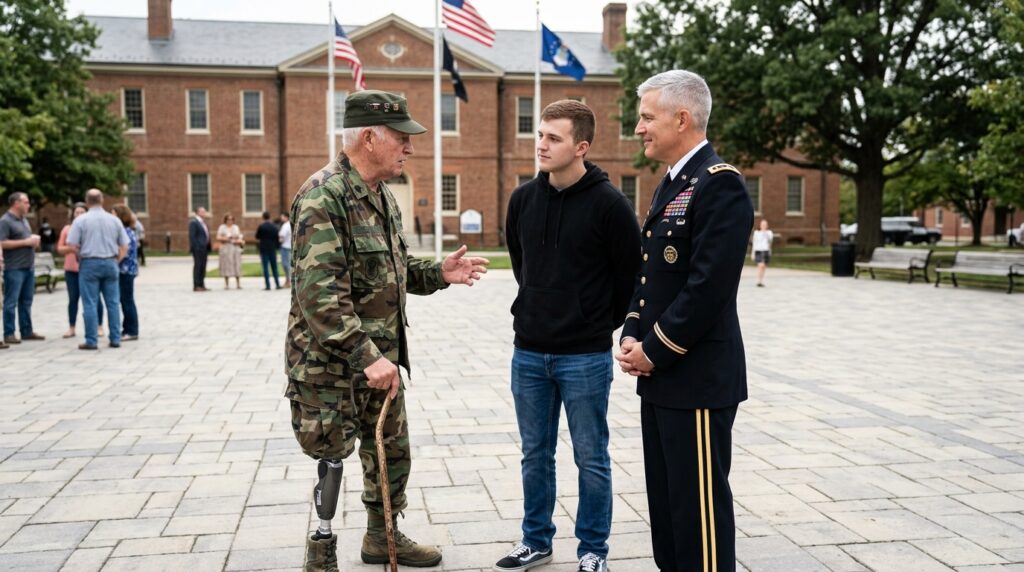
Sixty-eight-year-old Samuel Rowan tried to pass with a small cane in one hand. His prosthetic leg moved stiffly beneath gray khakis, and the winter wind pushed against his olive military jacket.
The group’s leader, Tyler Vance, stepped directly into his path.
He imitated Samuel’s uneven stride for his friends, then tapped the old veteran’s cane away with the side of his expensive sneaker.
Samuel steadied himself beside a folding chair.
“I served this country…”
Tyler charged forward and kicked him hard in the chest.
Samuel fell beside the memorial wreath. His cane clattered across the pavement, his black veteran cap rolled beneath the folding chairs, and his elbow struck a metal chair leg.
A thin red trace appeared beneath his sleeve.
“Trash. Nobody cares what you served.”
The crowd leaving the ceremony stopped.
Several witnesses gasped and backed away, but Tyler’s friends remained behind him, laughing nervously as though cruelty became harmless when enough people watched.
Tyler stepped closer and struck Samuel twice more while he lay curled beside the wreath.
“Stay on the ground, old man.”
Brakes screamed outside the center.
Three black SUVs stopped along the curb. Doors opened sharply, and Major General Nathaniel Cross rushed toward the entrance with two uniformed escorts.
The escorts moved between Samuel and the group.
General Cross stopped beside the fallen veteran cap, his expression changing the moment he saw the embroidered patch above its brim.
“Stop right now. Do you know who you just hit?”
Tyler’s grin vanished.
“Who is he?”
Samuel Rowan had retired as a decorated command sergeant major after more than three decades of service.
Years earlier, he had helped establish the very community center outside which he now lay. The building was created to provide rehabilitation, counseling, transportation, and social support for disabled veterans.
General Cross had not come merely to attend the memorial ceremony.
He was leading a federal review of the center’s finances.
Samuel was the confidential witness who had requested it.
Inside his fallen cap, tucked behind the sweatband, was a folded list of veterans whose names had been used to bill for rehabilitation sessions they never attended.
Samuel’s name appeared seventy-three times.
And according to the center’s records, he had walked through its doors on days when the accessible entrance had been locked.
The assault had knocked the only copy of that list into plain sight.
Act II
The Rowan Veterans Community Center opened twelve years earlier.
Samuel and several local veterans had raised the first donations through dinners, small business pledges, and memorial events. The county provided the land, while state and federal grants funded construction.
The original agreement was simple.
The center could host public events to support operating costs, but veterans’ services had to remain its primary purpose. The entrance, rehabilitation rooms, meeting halls, and transportation program were protected under a permanent charitable-use covenant.
Samuel insisted on that provision.
He had watched too many well-funded projects begin with promises and end as buildings veterans could no longer use.
During the center’s first years, the promise held.
Physical therapists worked in the east wing. Volunteer drivers transported veterans to medical appointments. Family-support groups met twice a week, and the main hall hosted job fairs, legal clinics, and remembrance ceremonies.
Then the founding director retired.
His replacement, Martin Kessler, treated the building less like a service center and more like an underperforming venue.
The main hall had high ceilings, polished floors, and a large commercial kitchen. Wedding planners began renting it on weekends.
Corporate groups followed.
Soon, private rentals produced more immediate revenue than veterans’ programs.
Kessler claimed the money strengthened the mission.
Instead, the mission slowly moved out of the way.
Veterans were asked to leave early when decorators arrived.
Counseling sessions were moved to smaller rooms.
The adaptive rehabilitation area became storage for event furniture.
The accessible entrance was frequently blocked by floral arches, portable bars, photography walls, and delivery equipment.
Samuel complained after arriving for a mobility workshop and finding the ramp closed for a luxury reception.
The center’s administrator marked his complaint resolved.
Nothing changed.
He began asking other veterans what they had experienced.
Some said transportation requests were denied because the center’s vans were unavailable. Others discovered the vans parked outside hotels, carrying wedding guests.
A former service member using a wheelchair was told that the elevator could not be operated during a private banquet.
A veterans support group lost its meeting room because a company had paid extra for a cocktail lounge.
Yet the center’s annual reports showed expanding programs.
Attendance increased every year.
Rehabilitation sessions multiplied.
Transportation services reached more veterans than ever.
Samuel knew those numbers were impossible.
Popular Posts
→- 1
- 2
- 3
- 4




Recently Viewed
Stories you read recently will appear here.


