Chapter 2: Chain of Custody
A magnetic bolt struck inside the front doors.
The sound was small, almost polite. Then came a second metallic snap at the employee entrance, followed by a third at the vehicle bay.
Every light on the access-control panel changed from green to red.
Cole looked toward the lobby as if the locks had insulted him personally.
Chief Mercer understood first.
“No one touches a terminal,” he shouted. “Nobody leaves. Hands away from your desks.”
The precinct fell into an uneven silence. Phones continued ringing because machines did not care that authority had shifted.
Mercer rounded on Cole.
“You put your hands on a federal agent?”
“She never identified herself.”
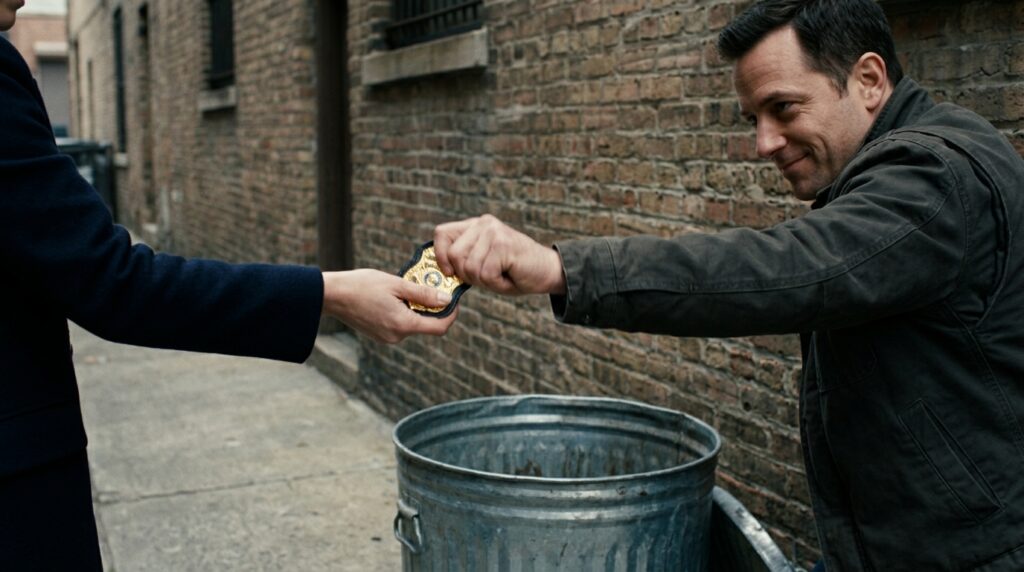
Claire’s credential remained visible through the trash liner near his polished shoe.
Mercer pointed at it. “That is her identification.”
“She flashed something at me. I was securing it.”
“You threw it in the garbage.”
“I thought it was fake.”
“Then you secure it as suspected evidence. You call a supervisor. You do not grab it from a federal agent and perform for the room.”
Cole’s jaw tightened. He was searching for the version of events in which volume could still rescue him.
Claire ended the call and placed her phone on the desk beside the audit folder.
“Chief Mercer, step away from Officer Cole.”
Mercer obeyed.
“Agent Bennett, whatever happened here, I assure you it is not representative of this department.”
“I did not come here to evaluate your manners.”
“No, ma’am.”
“I came to reconcile nineteen controlled-substance seizures assigned to the North River component of a federal task force. Your department reported those seizures as transferred to federal custody. Federal receiving records show that only eleven arrived.”
Mercer glanced at the folder.
Cole glanced at Mercer.
It was a quick exchange, but Claire saw it.
She had spent twelve years learning that panic rarely announced itself. Sometimes it was only a pair of eyes moving at the same time.
Mercer lowered his voice. “I was told this was a routine audit.”
“It was.”
“And now?”
“Now it is an active evidence-preservation operation.”
The employee entrance rattled. A civilian records clerk had tested the handle.
“Step away from the doors,” Claire called without turning.
The clerk did.
Mercer approached more carefully. “You cannot imprison an entire police division because one officer lost his temper.”
“The public lobby’s emergency exit remains functional. Fire egress is unaffected. No one is being detained without review. Your secured work areas are temporarily frozen under the joint-task-force agreement you signed, the preservation order served electronically six minutes ago, and the warrant being executed by the federal team outside.”
“A warrant?”
“The affidavit was prepared before I entered. Officer Cole supplied the final exigent facts.”
Cole gave a short laugh. “You had a warrant sitting around just in case someone annoyed you?”
Claire faced him. “No. We had evidence that narcotics, cash, and digital records were being diverted inside this building. You just created probable cause to believe federal credentials and audit materials were also at risk.”
He opened his mouth.
Mercer cut him off. “Stop talking.”
For the first time, Cole did.
Claire pointed to an empty chair beside the booking counter.
“Officer Cole, sit down. Keep your hands visible. Do not touch your weapon, radio, phone, or body camera.”
“You don’t command me.”
Mercer’s reply cracked across the room.
“Sit down.”
Cole looked at the chief, waiting for some private reassurance. None came. He sat, slowly, his knees spread and his hands braced on his thighs.
Claire turned to the two patrol officers who had watched the confrontation.
“Names.”
“Officer Lena Ortiz,” the first said.
“Patrolman Eric Shaw,” said the second.
“You both witnessed Officer Cole make physical contact with me?”
Ortiz answered at once. “Yes.”
Shaw hesitated. His eyes moved toward Mercer.
Claire noted it.
“Patrolman Shaw?”
“Yes, ma’am.”
“You witnessed him take my credential after I identified myself?”
“Yes.”
“And discard it?”
“Yes.”
“Do either of you have body cameras active?”
Ortiz touched nothing. “Mine is recording.”
“Mine too,” Shaw said.
“Leave them on. Do not dock, mute, review, or transmit the footage.”
Claire looked across the room.
“Everyone wearing a camera will leave it in its present state. Everyone with access to department systems will step away from keyboards. If a phone rings, let it ring unless it is an emergency line. If you are processing a prisoner, raise your hand.”
Three hands went up.
“Continue necessary care and booking functions under direct observation. Everything else stops.”
Mercer watched his own officers obey her. His fear was no longer centered on Cole. It had moved to the audit folder.
Vehicles entered the secure bay outside. Tires crossed the metal drainage grates. Doors opened in disciplined sequence.
Popular Posts
→- 1
- 2
- 3
- 4




Recently Viewed
Stories you read recently will appear here.


