Chapter 1 – THE RULE NO CHILD SHOULD LEARN
“Daddy, did I break the smiling rule?”
Malcolm did not answer immediately. His daughter had asked the question so softly that I might have pretended not to hear it if I had been a different kind of grandmother. The red drum lay on its side between his shoes, a bright circle of plastic in a room where everything else suddenly looked cold.
He sat beside Maya on the sofa and lowered his face until their eyes were level.
“There isn’t a smiling rule,” he said.
Maya blinked. “There is when company comes.”
“Not anymore.”
She studied him the way she studied adults when she wasn’t certain which version of them would answer. “Even if I spill?”
“Even if you spill.”
“What if Grandma cries?”
“Grandma gets to cry, too.”
That was when she finally began to sob. Not the sharp, panicked crying of a child anticipating punishment. This was heavier, messier, the kind that comes when a body decides it no longer has to hold itself together. Malcolm folded himself around her without demanding she stop.
Across the room, Sloane stood beside her perfectly arranged flowers.
“Are we really going to encourage this?” she asked.
Malcolm looked at her. “Don’t speak to her.”
“I am her mother.”
“And right now she’s frightened of you.”
“You have no idea what happened while you were away.”
“I came through the door,” he answered. “I saw what happened.”
She glanced at me. I was leaning against the sofa, trying to make my breaths shallow enough not to hurt. Until that moment I had known Sloane as a woman with a polished smile and a need for control. Now I knew how quickly she could arrange her face when she needed an audience.
A siren rose outside. Her eyes moved toward the windows.
“Malcolm,” she said, changing her tone, “think about what police arriving at this house will look like.”
He adjusted Maya’s weight against his chest. “I’m thinking about what my daughter just asked me.”
The paramedics came first. One crouched beside me, asked where I hurt, and watched how I tried to draw a breath. The other spoke to Maya without touching her or asking her to repeat the story. I loved him for that small kindness. He offered her a sticker of a yellow star and told her she could decide whether to wear it.
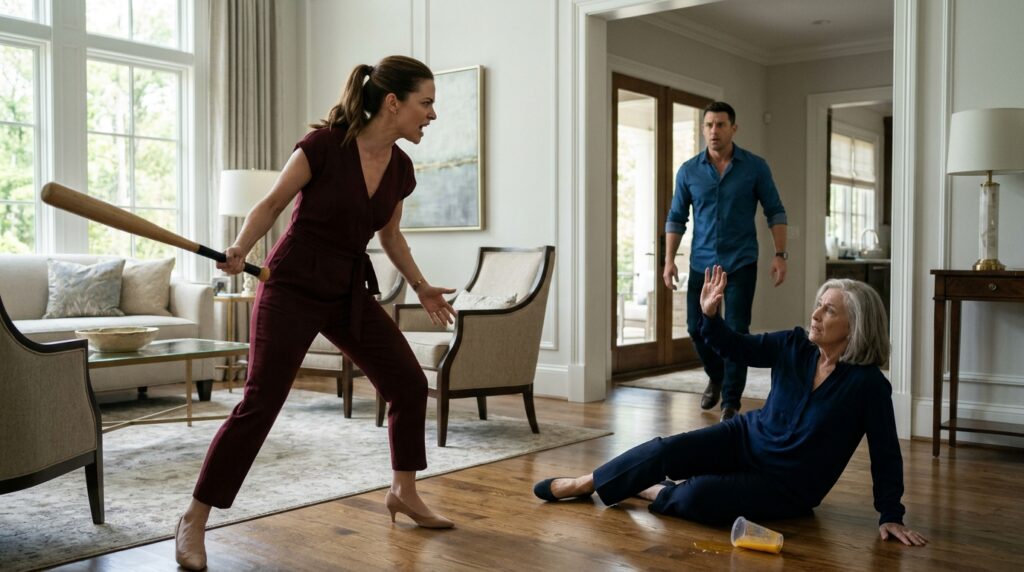
I told the paramedic my name was Ruth Ellison, that I was sixty-two, and that my daughter-in-law had kicked me while I shielded my granddaughter. Speaking it aloud made the event real in a way the pain had not. The paramedic asked whether I could stand. I said yes, because I had spent most of my life saying yes when someone needed a task completed.
He helped me slowly to my feet. Halfway upright, something caught beneath my right ribs and I made a noise that frightened Maya again.
“Grandma?”
“I’m here, little bird.”
It was what I had called her since she first learned to climb stairs. She reached for me, then caught herself, as though coming to comfort me might break another rule. I held out one hand until she let herself touch it.
Two officers arrived while they were preparing the stretcher. One stayed by the front entrance with Sloane. The other, Officer Ruiz, came to us. Malcolm explained what he had witnessed. He did not elaborate or invent details he hadn’t seen. He said that when he entered, his wife had her foot raised over his mother and daughter. Then he said he wanted the entire incident documented, no matter what it meant for his marriage.
Sloane heard him. “I was trying to stop your mother from hurting Maya.”
I almost answered, but Officer Ruiz raised a gentle hand. “We’ll take separate accounts.”
“Of course you will,” Sloane replied. “And you’ll hear about how Ruth has been acting for weeks.”
Something inside me sank. The accusation was already assembled, as though she had written it down in advance.
At the hospital, imaging showed a cracked rib and bruising along my side. No collapsed lung, no immediate danger, the physician said, but a painful recovery and reasons to return urgently if my breathing worsened. Dr. Patel explained the findings while Malcolm sat beside my bed, his hands clenched so tightly the knuckles had turned pale.
Maya was with a hospital child-life specialist in an adjoining room. She had been offered crayons, blocks, and permission not to talk. Malcolm had arranged for his friend and attorney, Priya Shah, to join us, but she arrived as a friend first, bringing a clean sweater and a phone charger.
Popular Posts
→- 1
- 2
- 3
- 4




Recently Viewed
Stories you read recently will appear here.


