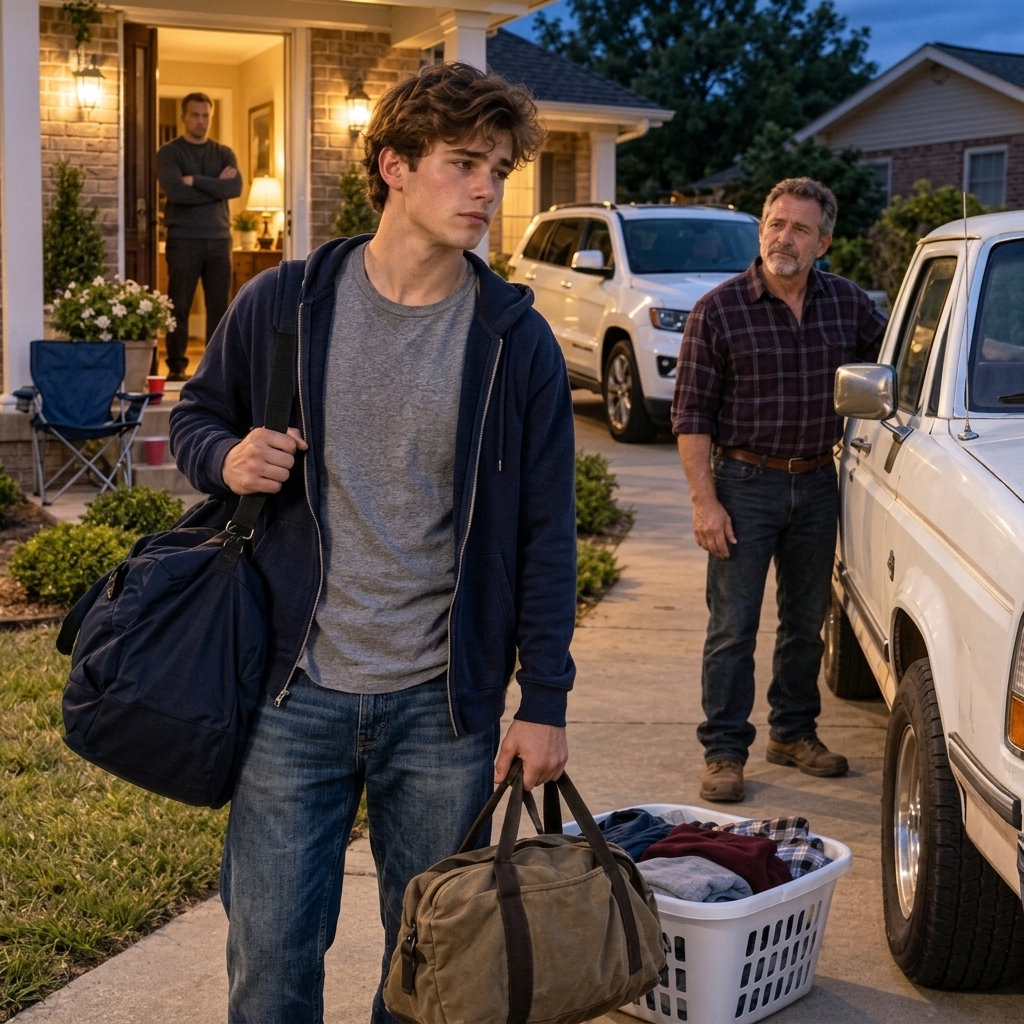
At my high school graduation party, Dad told me there was no money for college because “school was always harder” for me—while my 16-year-old sister had a new Jeep and $60,000 in her college fund. I already had a college acceptance letter in my pocket, but he wouldn’t even complete the financial-aid form. When I packed to move in with the uncle he called “the family loser,” Dad stood in the hallway and said, “You’ll be back by the Fourth of July.”
My dad told me there was no college money at my own high school graduation party. Standing by the garage with a paper plate of pulled pork in his hand. “School was always harder for you, buddy.” He said it nicely, like he was doing me a favor. Mom nodded along next to him. “We just didn’t think you’d really go, honey.” 20 ft away in the driveway sat my little sister Skyler’s white Jeep. She got it in March on her 16th birthday.
Her college account had just passed $60,000. I knew the number because Dad told me himself back in the spring. He was proud of it. That night, I packed two duffel bags and a laundry basket. Dad watched from the hallway with his arms crossed. “Go on then. Go live with the family loser. You’ll be back by the 4th of July.” At 11:00, my uncle Hoyt’s old white Ford pulled into the driveway right behind the Jeep.
On the door, in hand-painted red letters, it said Emmett and Sons Pumping. About 10 miles down the highway, he asked me. “He ever tell you why he calls me that?” “Because you took Grandpa’s business.” I said, “That’s what he always said.” Hoyt drove a whole mile before he answered. “That’s what he tells people.” He didn’t bring it up again for 6 years. I’m Reed. 6 years after that night, my dad sat across a desk from me asking for a job.
My sister sat next to him asking for one, too. And before he walked out, he told me half of my uncle’s company was his. Let me back up. My dad’s name is Monty. For 26 years, he was the controller at the wire plant on the east side of Sedalia, Missouri. If you don’t know what a controller is, don’t worry.
He’d be happy to explain it to you. He explained it to every waitress, every pastor, and every guy who ever sold us a lawn mower. He was the first one in his family to finish college, and he never let a Thanksgiving go by without somebody hearing about it. Dad ran our house the way he ran the plant.
There was a spreadsheet for the electric bill. There was a spreadsheet for Christmas and there was a college account for Skyler that he opened the week she was born. I know that because he told the story at her baptism lunch, at her 8th grade graduation, and at my high school graduation party about 40 minutes before he told me there wasn’t one for me. I never had an account.
I found that out at 14 when I asked. Dad said, “We’ll cross that bridge, buddy.” I guess we crossed it by the garage. Skyler was the smart one. That was just a fact in our house. Like the furnace being in the basement. She read early. She got the little certificates. She made the honor roll every quarter.
And Mom stuck every one of them to the fridge with a magnet shaped like a cardinal. I was a C student until about my junior year when something clicked and I started pulling B’s and then mostly A’s in anything with numbers in it. Nobody moved the magnet. I also had a job. From 15 on, I worked summers and Saturdays at the grain elevator on the west side of town, sweeping, running the probe on trucks, whatever they needed.
By graduation, I had $6,800 saved. Not a fortune, but it was mine. And here’s the part my parents didn’t know. In October of my senior year, I’d applied to the University of Central Missouri over in Warrensburg by myself on the computer at the school library. In December, I got the letter. Accepted business major.
I didn’t tell anybody. I wanted to show them at the party. I had the letter folded in my back pocket the whole time Dad was talking about how school was harder for me. I wasn’t going to ask them for money. I’d already done the math. I was going to ask for one thing.
There’s a financial aid form every college student in America fills out. And until you’re 24, the government treats you like your parents are still paying for you, whether they are or not. So, they need your parents’ tax information. Without it, you get almost nothing. That’s all I wanted. Dad’s half of a form, 20 minutes at the kitchen table.
Popular Posts
→- 1
- 2
- 3
- 4




Recently Viewed
Stories you read recently will appear here.


