Chapter 2 – The Badge on the Table
The interrogation room smelled of floor wax, stale coffee, and decades of nervous sweat. Under the harsh hum of the fluorescent tube overhead, Chief Thomas Reynolds looked considerably older than his official portrait in the precinct lobby.
His hand hovered over the open leather wallet on the scratched metal table.
Inside rested a gold federal shield flanking a laminated credential: *United States Department of the Treasury — Internal Revenue Service, Criminal Investigation Division (IRS-CI). Special Agent Evelyn Vance. Special Operations / Financial Crimes Task Force.*
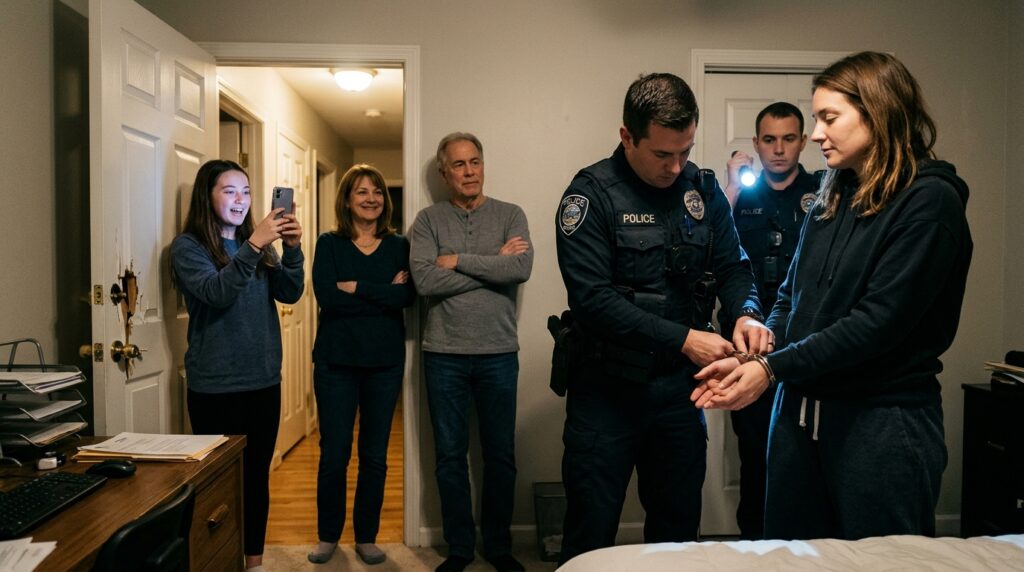
The chief pulled his fingers back as if the leather were coated in lye. He looked at the badge, then up at me, taking in my oversized knit sweater, my sleep-rumpled jeans, and the red chafing left behind by the handcuffs on my wrists.
“Special Agent Vance,” he said, his voice flat, cautious, and stripped of the bluster he had carried into the room thirty seconds prior. “You want to tell me why Kansas City South patrol just dragged an active federal investigator out of her house at quarter to two in the morning on a county warrant?”
“Because,” I said calmly, leaning back against the cold vinyl of the chair, “Detective Miller didn’t verify the supporting affidavits before presenting the warrant to a night-duty magistrate.”
Chief Reynolds pinched the bridge of his nose. He closed the badge case with a muted snap and pushed it across the table toward me. “Miller said there was an emergency petition filed yesterday afternoon. Bank fraud, unauthorized transfer of ancestral trust assets, falsification of probate affidavits. Signed off by attorney Marcus Albright.”
“Marcus Albright,” I repeated, letting the name hang in the chill between us. “And accompanied, I imagine, by certified copies of bank transfer receipts provided by my sister, Fiona Vance, and my parents, Harold and Beatrice.”
Reynolds didn’t answer right away. He pulled out the chair across from me and sat down, his heavy frame creaking against the metal. “They were very convincing. They brought printouts of offshore wires. Digital footprints traced back to your home IP address. Your family claimed you were liquidating your grandfather’s entire estate into untraceable cryptocurrency accounts before the probate dispute could be heard in civil court.”
“Did you look at the IP logs attached to Miller’s warrant application, Chief?”
“I didn’t review the package personally,” Reynolds admitted, a muscle twitching along his jawline. “It crossed the night magistrate’s desk at ten p.m. Given the dollar amount—five million dollars—and the risk of immediate flight, the magistrate signed the dynamic entry order.”
“The IP address in that file belongs to a commercial VPN routing through a server in Zurich,” I said evenly. “If Miller had run a basic packet trace instead of accepting Marcus Albright’s neatly bound binder, he would have discovered the local origin point wasn’t my router. It was a secondary Wi-Fi network registered to Albright & Associates’ downtown office.”
Reynolds went very still. “You’re telling me an officer of the court submitted forged evidence to secure an arrest warrant against a federal agent.”
“I’m telling you that Marcus Albright has spent the last four years operating a boutique probate fraud ring targeting elderly estates across Jackson County,” I said. “He liquidates real estate, drains legacy accounts, and funnels twenty percent back to complicit family members while hiding the rest in shell corporations registered in Delaware and Belize.”
The chief stared at me, calculating the catastrophic fallout. A botched nighttime raid. A civil rights violation against an armed federal officer. A magistrate deceived by fabricated financial records. And, worst of all, the entire unlawful arrest broadcast live to more than a million viewers across social media by my own sister.
“How long?” Reynolds whispered.
“Sixteen months,” I said. “My grandfather, Arthur Vance, wasn’t just a retired real estate developer. Before he died, he realized Marcus Albright was tampering with his living trust. He called the Treasury whistle-blower hotline himself. When the case crossed my director’s desk, Arthur asked for me specifically.”
My chest tightened slightly at the memory of my grandfather’s voice during our last private conversation in the hospital garden. His hand had trembled around mine, not with fear, but with quiet fury. *“Your father sold his spine decades ago, Evelyn,”* he had told me, his breath thin against the autumn wind. *“And Marcus thinks an old man with failing lungs can’t read an altered ledger. Show them what happens when they play games with the law.”*
Popular Posts
→- 1
- 2
- 3
- 4




Recently Viewed
Stories you read recently will appear here.


