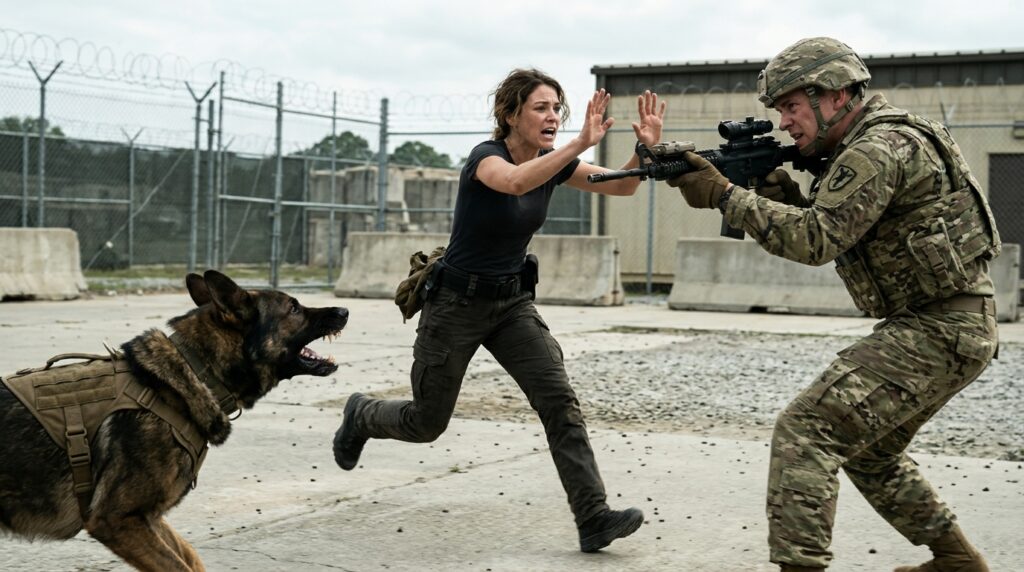
Chapter 1: PART 1 – THE DOG THEY WERE ABOUT TO SHOOT
“GET THAT DOG UNDER CONTROL—NOW!”
The command echoed across the military training yard.
An officer raised his weapon.
Several soldiers backed away.
And a Belgian Malinois stood motionless beside a maintenance cart, his teeth exposed and his body rigid.
His growl was deep enough to make the men nearest him retreat.
But something about his posture made my stomach tighten.
He wasn’t preparing to attack.
He was protecting something.
“Don’t shoot!”
My voice tore through the yard.
The officer turned toward me.
“Ma’am, stay back!”
I took one careful step forward.
“Lower your weapon.”
The dog growled again.
The officer tightened his grip.
“That animal is dangerous!”
I looked directly at him.
“Then don’t give him another reason to panic.”
My name is Maya Calder.
I was thirty-eight years old, a military veterinary specialist with more than fifteen years of experience treating injured and traumatized working dogs.
I had seen animals become aggressive because of pain.
Because of fear.
Because someone had handled them roughly.
And because they believed the person or object they loved was in danger.
But the dog standing in front of me was different.
His temporary identification number was K9-417.
He had arrived at our facility three days earlier.
His transfer records were incomplete.
His original handler wasn’t listed.
And the personnel who delivered him described him as unstable.
They warned us that he had refused commands, resisted handling, and reacted aggressively whenever someone approached his injured side.
I had requested his complete medical and deployment history.
The request remained unanswered.
Now the dog was standing in the middle of the training yard, surrounded by frightened soldiers.
And someone was preparing to shoot him.
Commander Brock Maddox approached from the far side of the yard.
He was fifty-six years old, broad-shouldered, with closely cropped gray hair and a deeply lined face.
He had commanded military working dog operations for years.
He was respected for making difficult decisions.
But even he looked alarmed.
“What happened?” he demanded.
The handler holding the empty leash shook his head.
“Sir, he broke position.”
“Why?”
“I don’t know.”
Maddox looked toward the dog.
Then toward the armed officer.
“Hold your position.”
I moved forward slowly.
“Commander, I need everyone to stop approaching him.”
Maddox turned toward me.
“Calder, explain.”
I pointed toward the maintenance cart.
“He’s guarding something.”
The handler frowned.
“He’s just being aggressive.”
I shook my head.
“Look at his feet.”
The dog stood with his front paws planted on either side of a small object partially hidden beneath the cart.
Every time someone moved closer, he shifted to block their view.
He wasn’t trying to escape.
He wasn’t pursuing anyone.
He was maintaining a defensive position.
Maddox studied him.
Then nodded.
“Everyone back up.”
The soldiers retreated.
The armed officer lowered his weapon slightly.
I crouched several yards away.
The dog’s eyes followed me.
His ears remained forward.
His breathing was rapid.
I spoke softly.
“Ruhig.”
The German word for calm.
His ears twitched.
I waited.
Then repeated it.
“Ruhig.”
His growling softened.
The handler stared.
“He hasn’t responded to anyone.”
I kept my eyes on the dog.
“Maybe nobody has been using the commands he remembers.”
I lowered my hands.
Waited.
And allowed him to decide whether to move closer.
He took one cautious step.
Then stopped.
His eyes shifted toward the maintenance cart.
I followed his gaze.
Something metallic lay beneath it.
A small rectangular object.
Damaged.
Covered in dirt.
A military identification tag hung from one corner.
My heart began pounding.
I looked toward Maddox.
“Sir, there’s something underneath that cart.”
He crouched beside me.
The dog watched him.
But didn’t growl.
Maddox leaned forward.
Then froze.
“What is that?”
I studied the object.
It appeared to be a damaged recording device.
The identification tag attached to it was stained and scratched.
Only part of the name remained visible.
HARRIS.
Maddox’s expression changed.
I looked toward him.
“Commander?”
He didn’t answer.
Instead, he studied the dog’s harness.
The temporary identification plate read K9-417.
But beneath it, someone had scratched away an older engraving.
Maddox leaned closer.
His face drained of color.
“Ranger?”
The dog froze.
His ears lifted.
Then he made a small, broken sound.
Maddox staggered backward.
“No.”
His voice trembled.
“That’s impossible.”
I looked toward him.
“Sir?”
He stared at the dog.
“Ranger died four years ago.”
His eyes filled.
“With Lieutenant Daniel Harris.”
The yard fell silent.
And I realized the animal everyone wanted to shoot might be the only surviving witness to a mission the military had already declared closed.
Popular Posts
→- 1
- 2
- 3
- 4




Recently Viewed
Stories you read recently will appear here.


