Chapter 1: THE SLAP AND THOMAS’S WARNING
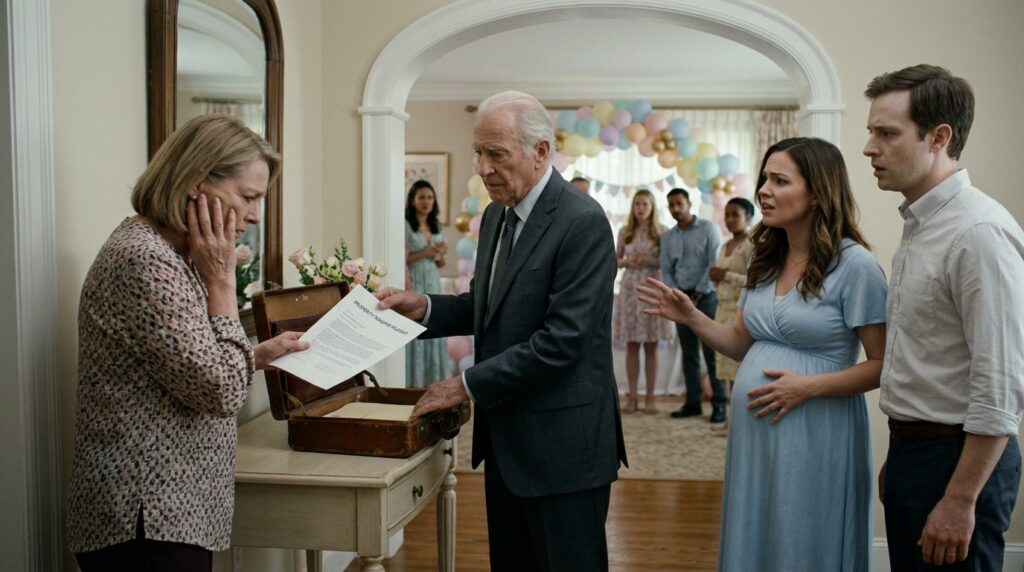
My daughter slapped me across the face in front of sixty people at her baby shower and said, “Touch my child again, and I’ll make sure you never see your grandbaby.”
Then she pointed toward the dirty plates stacked beside the kitchen.
“And clean that up before you leave.”
For several seconds, nobody moved.
The soft instrumental music Madison had chosen for the party continued playing through the speakers.
A champagne glass clicked faintly against a serving tray.
Somewhere behind me, a little girl whispered a question to her mother and was immediately shushed.
I was sixty-eight years old.
My husband had been dead for eighteen months.
And I had spent three days preparing the celebration where my only daughter had just struck me.
My cheek burned where her palm had landed.
I looked at Madison, trying to find some sign that she understood what she had done.
Shock.
Regret.
Embarrassment.
Anything.
Instead, she stood in front of me with one hand protectively covering her pregnant stomach and the other still slightly raised.
Her husband, Ryan, stared at the carpet.
His mother, Diane, had one hand over her mouth.
Around us, sixty relatives, neighbors, colleagues, and friends had suddenly discovered intense interest in their shoes, the balloons, the half-eaten cake, anything except the woman who had just slapped her mother.
“Mom,” Madison said sharply, “did you hear me?”
I heard her.
I also heard another voice.
Not in the room.
In my memory.
My husband Thomas, thin from pancreatic cancer, sitting beside the bedroom window eighteen months earlier.
One day, Ellie, you may have to teach her the difference.
At the time, I had refused to ask what difference he meant.
Standing beneath a gold balloon arch spelling BABY, I finally understood.
The difference between kindness and permission.
The difference between helping someone and allowing them to use you.
The difference between being a mother and surrendering your dignity because you are terrified your child might stop loving you.
My purse sat on a chair beside the fireplace.
I walked toward it.
Madison gave a short, disbelieving laugh.
“So you’re leaving?”
I lifted my purse.
Inside it was a photograph of Thomas carrying five-year-old Madison on his shoulders at a neighborhood picnic.
I had placed that photograph beside the fireplace earlier that afternoon.
Madison had told me to remove it because she didn’t want her baby shower to feel like a memorial.
So I had slipped it into my purse.
I had not argued.
I rarely did.
“Yes,” I said.
“I’m leaving.”
“Fine.”
I turned toward the front door.
Then Madison added, “But clean the kitchen first.”
I stopped.
She pointed past me.
The counters were covered with used platters, glasses, napkins, frosting-streaked plates, serving utensils, and trays I had brought from my own house.
My feet had been aching since noon.
I had arrived at seven that morning.
I had arranged the white hydrangeas, checked the caterer, assembled decorations, moved chairs, carried boxes, and spent an hour fixing a dessert table Madison decided looked “too crowded.”
I had paid for most of the shower.
And my daughter expected me to remain after being slapped so I could wash dishes.
Something inside me became very still.
“No, sweetheart,” I said.
Madison frowned.
“What?”
“I won’t be cleaning anything.”
The room seemed to change.
It surprised me that such a small word could create more shock than the slap.
No.
I had said it to students when I taught second grade.
I had said it to suppliers when Thomas and I managed Whitmore Residential.
I had said it to contractors, banks, insurance representatives, and parents who insisted their children could never possibly have misbehaved.
But with Madison, I had spent most of my life turning no into maybe and maybe into yes.
Her expression hardened.
“You made half the mess.”
“I organized your shower.”
“You offered.”
“I did.”
“So finish what you started.”
I looked at her.
“No.”
Ryan finally raised his head.
“Eleanor, everybody’s emotional.
Maybe we should all calm down.”
I almost laughed.
Not because anything was funny.
Because for the first time I noticed how carefully he had phrased it.
Everybody was emotional.
As though I had participated equally in what had just happened.
As though Madison’s hand and my cheek had somehow met in the middle.
“I’m perfectly calm,” I said.
Madison scoffed.
“That’s your favorite act.”
“My act?”
“That sweet little voice.
You always do that when you want everyone to think I’m unreasonable.”
I felt sixty pairs of ears listening.
I refused to give them a performance.
“I’m going home.”
Madison folded her arms.
“Then go.”
So I did.
Or I tried.
I had taken three steps toward the door when the bell rang.
No one moved to answer it.
The bell rang again.
Popular Posts
→- 1
- 2
- 3
- 4




Recently Viewed
Stories you read recently will appear here.


