PART 1
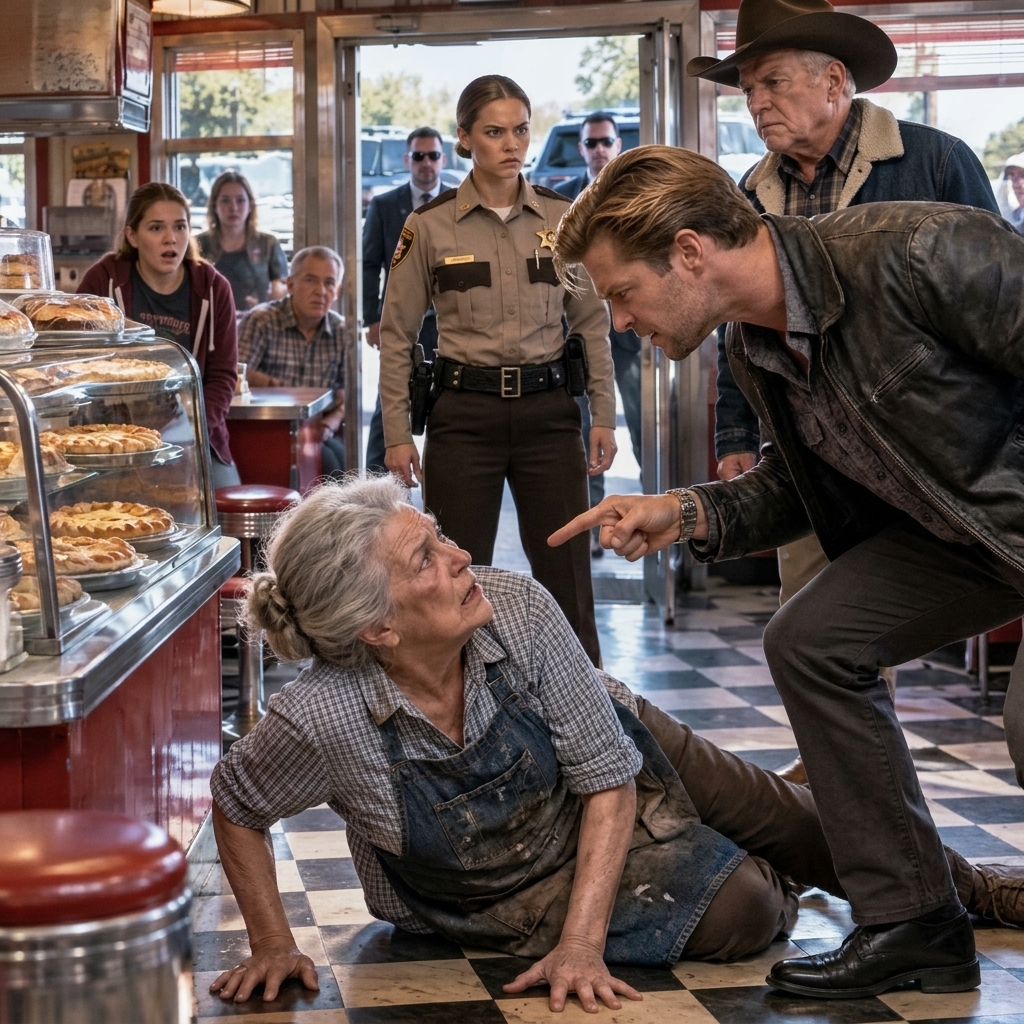
When a wealthy bully shoved my 75-year-old mother to the floor inside her own diner and sneered, “Around here, I do whatever I want,” nobody stepped forward. The sheriff called it “a clumsy fall,” the witnesses suddenly forgot what they had seen, and the entire town seemed terrified of one family. What they didn’t know was that I was already on my way home—and Travis Cain had no idea who my mother’s daughter really was.
The video lasted exactly twelve seconds.
I was inside a secure briefing room at Fort Bragg, North Carolina, surrounded by twelve officers, when my phone lit up with my neighbor Carol’s name. I still had a laser pointer in my hand when I stepped into the hallway.
“Nicole,” she whispered. “You need to see what happened to your mother.”
The video arrived before she finished speaking.
There was Turner’s Family Diner—the red booths, chrome tables, brass bell above the door, everything exactly as I remembered it. My mother, Evelyn, stood behind the counter in her faded apron, the same stubborn woman who still opened before sunrise and remembered every customer’s coffee order.
Then I saw Travis Cain.
His father, Wade, owned nearly half the commercial property in the county and had spent months trying to force my mother to sell the diner and the strip of land behind it.
My mother raised both hands, palms out.
No.
Travis shoved her.
She crashed behind the counter, and her glasses slid beneath a booth.
Nobody moved.
People she had fed on credit stared into their plates. Men who had spent twenty years drinking her coffee suddenly found the table more interesting than the elderly woman lying on the floor.
Travis straightened his jacket and smiled.
“Around here,” he said, “I do whatever I want.”
I requested emergency leave immediately.
I had served more than twenty years in the United States Army and commanded a Ranger battalion, but on that flight home, none of that mattered.
I was just a daughter.
I found Mom in the hospital with a damaged shoulder and bruises darkening across her face.
“You shouldn’t have come,” she whispered.
“A man put you on the floor of your own diner.”
“I’m fine.” Her good hand squeezed mine. “Please don’t make this bigger.”
“What does Wade Cain want?”
“The diner. The land.” She looked toward the door. “Your father refused him too.”
My father had died six years earlier in a single-car crash on Route 9.
Dry road. Clear weather. A road he had driven thousands of times.
For the first time, the accident felt different.
The next morning, I questioned everyone who had been inside the diner.
“I didn’t see anything,” they all said.
But their hands trembled.
Sheriff Don Harper dismissed the assault as “an unfortunate fall.” He refused to examine my video.
“Without a cooperating witness,” he told me, “there’s nothing to investigate.”
That night, someone knocked on Mom’s door.
Kayla, the waitress, stood outside in a hoodie, terrified.
“I recorded more.”
Her video lasted forty-seven seconds.
It showed Travis demanding my mother’s signature.
And standing beside the pie case was Wade Cain.
Watching.
Doing nothing.
I made three copies.
Then I searched county records.
Thirty families had sold property to Cain Realty after suddenly facing tax liens, failed inspections, permit problems, or unexplained property damage.
Every complaint ran through Sheriff Harper.
Every zoning request passed through Mayor Linda Brooks.
Then I found my father’s name.
An assessor’s report called him “uncooperative” after he rejected Wade Cain’s third offer.
Below it was a handwritten note.
“Escalation recommended.”
Dated three weeks before my father died.
The next morning, I walked into the diner wearing faded jeans and an old university sweatshirt. My mother was behind the counter with one arm in a sling.
I sat down quietly.
Then two black government SUVs pulled up outside.
And the diner door opened.
PART 2
The brass bell rang, and every fork in Turner’s Family Diner stopped moving.
The man who walked in wore a gray suit that didn’t belong in a town like ours and a navy windbreaker over it with three yellow letters on the back. FBI. He was taller than I remembered, grayer at the temples, but he still walked like a cadet who’d never quite gotten the West Point posture out of his spine.
Special Agent Marcus Reyes. My classmate, my study partner for four miserable winters on the Hudson, and the only person I had trusted with the second copy of Kayla’s video at two o’clock that morning.
Behind him came a woman with a laptop bag and a badge clipped to her belt. Agent Dana Whitlock, he’d told me on the phone. Public corruption. She didn’t smile at anybody.
Marcus slid onto the stool next to mine as though we’d planned to meet for breakfast.
Popular Posts
→- 1
- 2
- 3
- 4




Recently Viewed
Stories you read recently will appear here.


