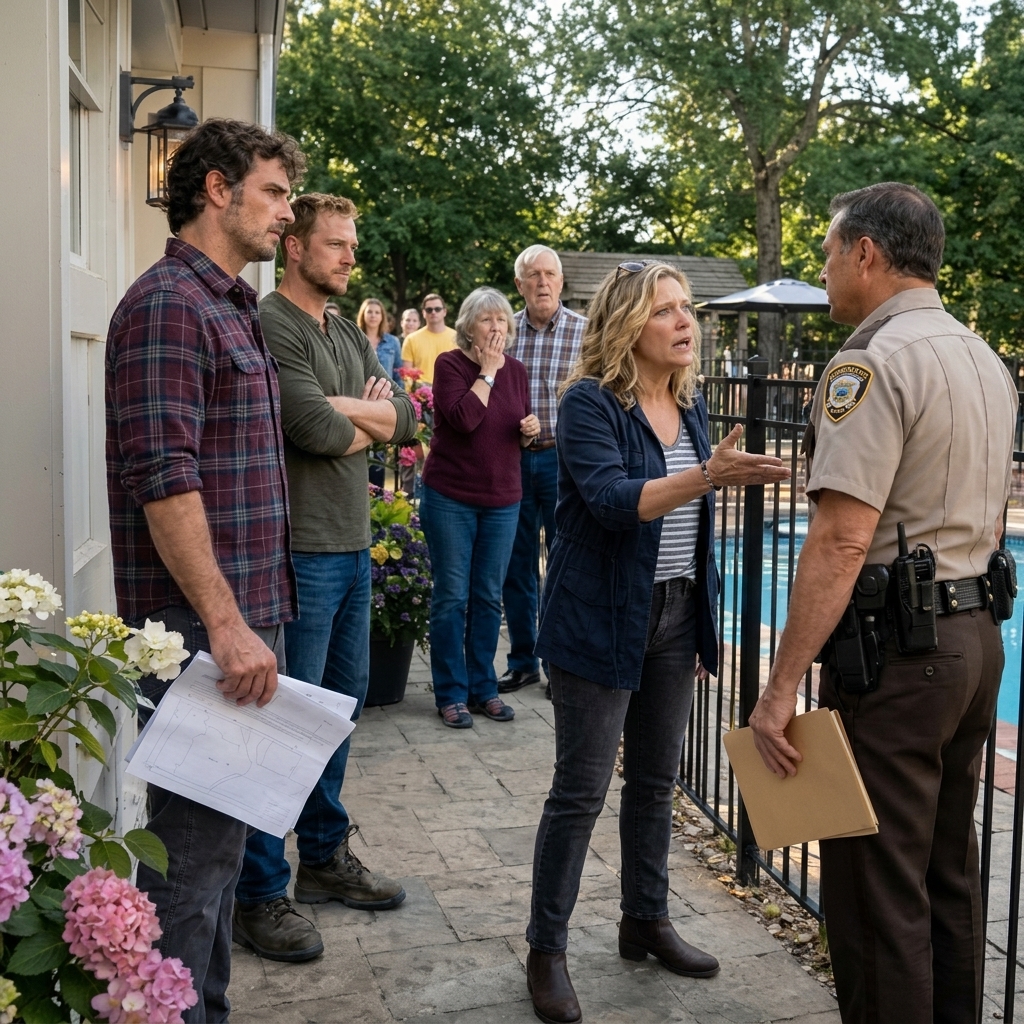
Naomi’s hand was an inch from the latch of my side gate when she finally saw the police officer standing beside it.
Her fingers froze in midair. They curled, uncurled, and hung there. Her oversized sunglasses slid out of her hair and clattered onto the sidewalk.
Nobody picked them up.
Behind her, spread across my side yard, the sidewalk, and halfway out into Alder Court, stood fifty-two of my relatives. They had coolers, folding chairs, trays of food under aluminum foil, kids in swim trunks with towels over their shoulders, a toddler in a sun hat, and a man holding a six-foot folding table over his head like a battering ram.
Beside the gate stood Sergeant Abernathy of the Rockford Police Department in a pressed navy uniform, with a gray mustache, a radio on his shoulder, and a manila folder under one arm. Behind him, bolted to the gatepost and gleaming silver in the noon sun, hung a brand-new padlock.
A toddler started to cry. Somewhere in the back, a woman whispered, loud enough for everyone to hear, “Is that a cop?”
My mother stopped two steps behind Naomi, holding a casserole dish in both hands. The dish tilted a few degrees and a corner of foil slid loose.
I stood on my front porch with a cup of coffee and a single sheet of paper folded in my shirt pocket.
I took it out and unfolded it. It was one screenshot, enlarged on the office printer until the text was the size of a church bulletin. I held it at chest height so the people in the back could see it.
“Naomi,” I said. “Would you like to read it, or should I?”
She didn’t answer.
Across the street, a little boy in dinosaur swim trunks asked his mother, very loudly, why nobody was going in the pool.
“Then I’ll read it,” I said.
My name is Gideon Voss. I’m thirty-eight, and I work on a survey crew for a civil engineering firm in Rockford, Illinois. I stick flags in dirt for a living, as my father likes to say. What those flags do is tell people exactly where one person’s ground stops and another person’s begins.
Nobody notices a good survey. They only notice when somebody has ignored one.
To understand that Sunday, you need to know about the house. The house is the whole story.
Eleven months before that Sunday, I bought a foreclosed 1962 brick ranch on Alder Court from the bank that had taken it back. The porch roof had collapsed, the kitchen hadn’t been touched since Eisenhower, and there was a concrete pool out back that the last owners had left full of leaves and green water.
The price was $189,000. I put down $38,000, my half of the money from selling the house my ex-wife and I had shared, and took a thirty-year mortgage for the rest. I signed the closing papers at a title company on East State Street on a gray Tuesday in June. The deed was recorded with the Winnebago County Recorder that afternoon.
That evening I drove a survey stake into the northwest corner of the lot, wrapped in orange flagging tape. I wrote NW COR on the side in pencil. Surveyors do that. It’s not sentimental. It’s habit.
Okay. It was sentimental.
My marriage had ended four months earlier. Renata and I had been together eleven years. She left on a Thursday, carefully, with two suitcases and a lawyer’s phone number. I’m not going to tell you what went wrong, because I don’t entirely know. I only know I spent that winter in an apartment with a mattress on the floor and a microwave, and the day I got the keys to that broken house, I felt for the first time in months like someone who owned something.
I put another $34,000 into it. A new roof was $11,800. New plumbing was $6,400. Rewiring was $5,200. Then came the tile, the flooring, and a kitchen I designed on graph paper during my lunch breaks. I paid for most of it out of savings and covered the rest with a $12,000 home improvement loan from my credit union.
I did most of the work myself, at night, after ten-hour days on job sites. I laid tile at midnight with a work light clamped to a stepladder. I learned what a P-trap was. I learned what it feels like to cry over a faucet that won’t stop dripping.
The house wasn’t impressive when I bought it. It was broken.
So was I. By the time the last cabinet went up, we were both a little better.
My family is a different story.
Popular Posts
→- 1
- 2
- 3
- 4




Recently Viewed
Stories you read recently will appear here.


