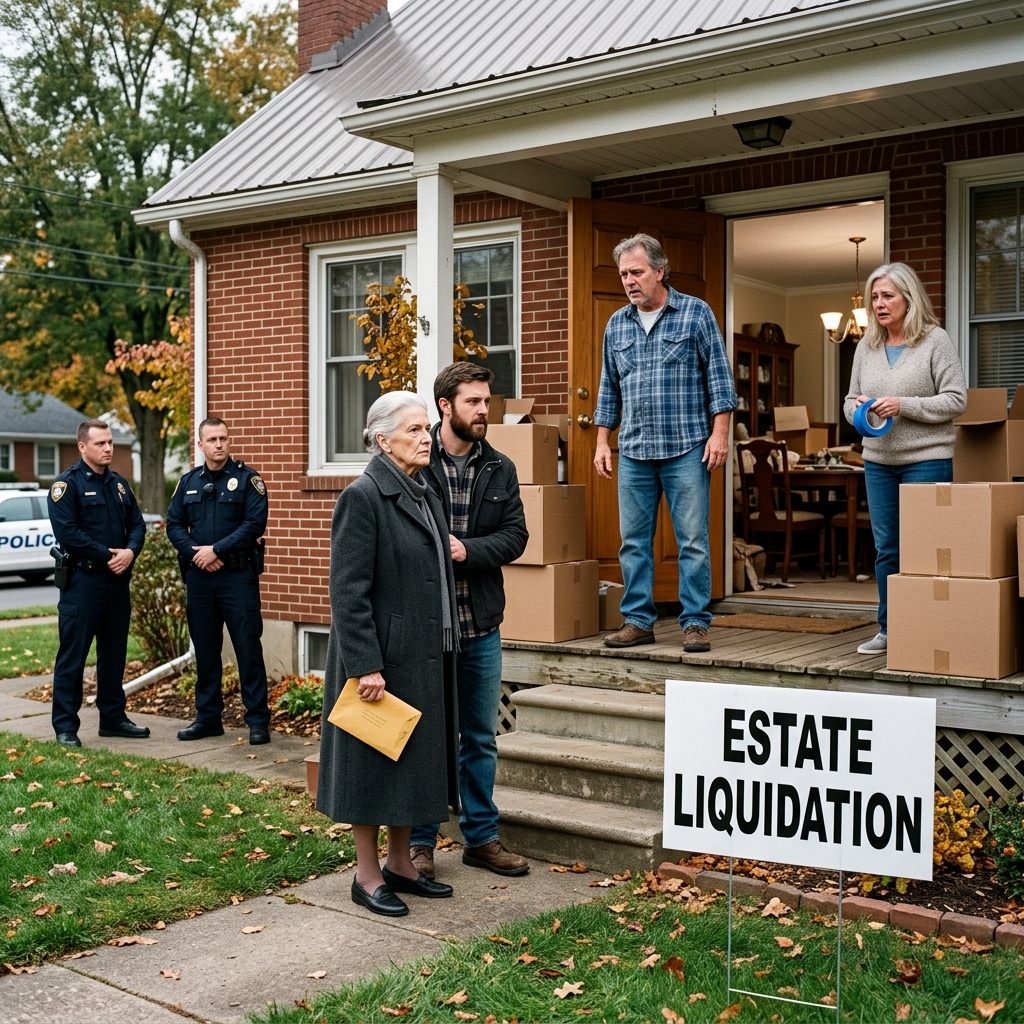
My parents promised Grandma lunch. Instead, a nursing home called to say they’d left her in the lobby with a suitcase and never returned. I drove 190 miles to get her. She buckled her seatbelt and said, “Don’t call them. Courthouse first. Then the bank.” When Dad finally called, she turned my phone facedown and pulled out an envelope marked “HOUSE DEED.” Then she looked at me. “They weren’t trying to find me somewhere to live…”
PART 1
My parents told my grandmother they were taking her to lunch. Three hours later, a woman from an assisted-living facility in Ohio called me and said Grandma’s suitcase was sitting in the lobby, her medications were in a grocery bag beside her chair, and the son who had brought her there had disappeared before the admission paperwork was finished. I was standing barefoot in my Indianapolis kitchen with a cup of coffee in my hand when the call came. “Are you Nathan Cole?” the woman asked. “Yes.” “Your grandmother, Margaret Cole, listed you as her emergency contact. I’m calling because there seems to be some confusion about whether she agreed to be admitted here.” My coffee went untouched after that. “Where are my parents?” There was a pause. “They said they were going to their vehicle to retrieve additional documents. That was more than two hours ago.” I called Dad. Voicemail. Mom. Voicemail. Again. Nothing. I was in my car within seven minutes.
The drive was just under three hours. I spent most of it trying to create explanations I could live with. Maybe Dad had gotten sick. Maybe Mom’s phone had died. Maybe they had gone to find some medical records. Maybe the facility employee had misunderstood. The problem was that every explanation collapsed against one detail: Grandma had not told me she was moving anywhere. Margaret was eighty-two, still mentally sharp, still living in the same red-brick house where my father had grown up, still balancing her own checkbook with the tiny mechanical pencil she kept beside the telephone. She had needed help after hip surgery the previous fall, but needing help getting groceries was not the same thing as surrendering your life.
When I arrived, she was sitting in a blue chair beside one brown suitcase. She wore her charcoal church coat despite the warm lobby. Her silver hair was pinned neatly at the back of her neck. A grocery bag at her feet held six prescription bottles, her reading glasses, and a paperback mystery novel. She did not look frightened. She looked furious in the contained, disciplined way I remembered from childhood, when one raised eyebrow meant every cousin in the room suddenly remembered how to behave. I crouched in front of her. “Grandma.” She studied me for a few seconds. “You took your time.” Relief hit me so hard I laughed. “I live in another state.” “You always drive too cautiously.” The admissions director, a woman named Denise Alvarez, came over and explained that my parents had brought Margaret in shortly before noon. They told staff she was “no longer safe alone” and would be staying permanently. But when Denise began reviewing the admission paperwork directly with Grandma, Margaret said she thought she was being taken to lunch and had never agreed to move. The facility stopped the admission immediately. “Your grandmother appears perfectly capable of making her own decisions,” Denise said. “We were not going to proceed based solely on what relatives told us.”
Grandma stood without waiting for my arm. I took the suitcase. She thanked Denise, walked outside, got into my car, and buckled herself in. Then she said, “Don’t call your father.” I looked at her. “I’ve been calling him for three hours.” “Stop.” “Grandma, he left you in a care facility.” “I know where he left me.” She turned my phone facedown in the cup holder. “We have things to do before he knows I’m out.” That sentence changed the temperature inside the car. “What things?” “First, my lawyer.” “You have a lawyer involved?” “As of yesterday.” “Yesterday?” “Drive.” I pulled out of the parking lot. Five minutes later she reached into her purse and handed me a folded bank statement. Three withdrawals were circled in red: $12,400, $18,000, and $24,750. Beneath them were several smaller electronic transfers. “Dad did this?” “Your father has power of attorney.” “I thought he was just paying bills while you recovered.” “So did I.”
Popular Posts
→- 1
- 2
- 3
- 4




Recently Viewed
Stories you read recently will appear here.


