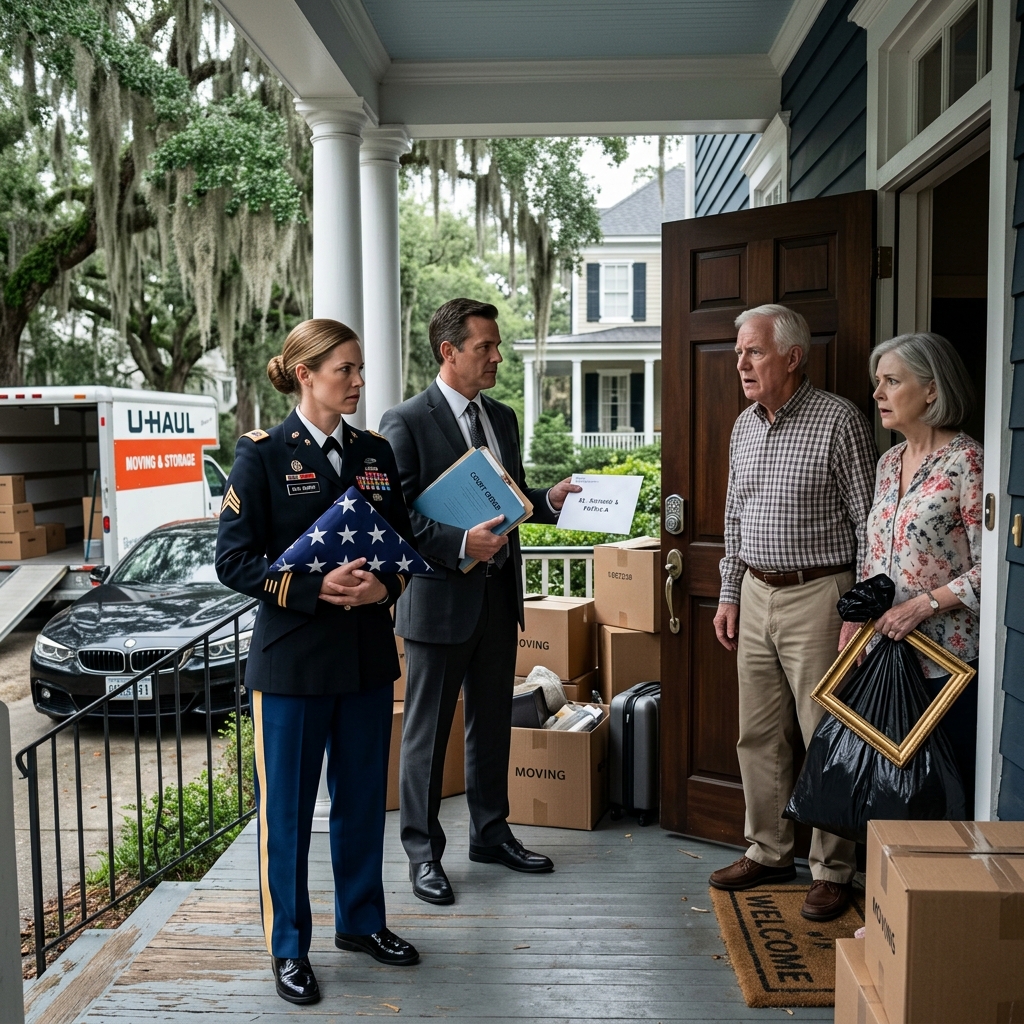
The morning after I buried Marcus, my key no longer opened our front door. His family had changed the locks, parked a moving truck in my driveway, and started carrying out my belongings while Raymond told me, “Blood is blood. Your time here is over.” But Marcus had left me an envelope, a phone number, and one final way to stop them….
PART 1
The morning after I buried my husband, my key no longer opened the front door of our home. There was still an American flag folded in my arms, still dirt on my shoes from the cemetery, and I had only come back to sit in the quiet and grieve. Instead, a moving truck was parked in my driveway, my brother-in-law was carrying out my grandmother’s floral chair, my mother-in-law had my jewelry box in her hands, and my father-in-law stood on the porch like he had been waiting to erase me. When I tried the lock and it would not turn, Raymond looked at me and said, “Blood is blood. Your time here is over.” He thought I was just a broken widow with nowhere to stand. He forgot the envelope Marcus left me, the key still in my hand, and the number my husband had made me memorize before he died.
My name is Major Molly Martin. I was thirty-five years old, and twenty-four hours earlier, I had stood at my husband’s funeral while an American flag was folded with perfect military precision and placed into my hands. Marcus had been my husband for eight years. He was the only man who knew how to look past the uniform, past the rank, past the version of me everyone else trusted in crisis, and still see the woman underneath. Cancer took him slowly, then all at once, and by the time I came home from the burial, I thought the worst thing life could do to me had already happened.
I was wrong.
Charleston was already heavy with heat that morning. Spanish moss hung low over the street, and the air felt thick enough to press against my skin. I pulled into the driveway expecting silence. What I found was a moving truck.
At first, my mind refused to understand it.
Then I saw Gerald carrying my grandmother’s armchair down the porch steps. I saw Patricia holding my jewelry box against her chest. I saw Timothy directing movers toward the dining room as if he had been hired to manage my grief. And on the porch stood Raymond, my father-in-law, calm and cold in a pressed shirt, watching me like I was the intruder.
I walked to the front door, still in my service uniform, still holding Marcus’s flag.
My key would not turn.
Raymond did not even pretend to be sorry.
“Blood family only,” he said. “Your time here is over.”
For a moment, I heard nothing. Not the movers. Not the truck. Not Patricia calling instructions from inside. Just those words. Blood family. As if eight years of marriage had dissolved between the funeral and sunrise. As if holding Marcus through chemo, sleeping in hospital chairs, managing medications, signing forms, praying over his pain, and burying him with my own hands had never made me family at all.
Patricia came out carrying our wedding photo from the mantel. She opened the back, removed the picture of me standing beside Marcus, and dropped it into a trash bag.
“We’ll keep the one of Marcus,” she said. “He doesn’t need you in the background anymore.”
Behind her, Gerald was taking my medals off the wall because Patricia had told him they “didn’t match the house anymore.”
That was when something inside me went still.
Not numb.
Focused.
Because three weeks before Marcus died, he had called me to the kitchen table. He was thinner then, tired in a way sleep could not touch, but his eyes had been clear. He opened an old leather briefcase, took out a sealed envelope, and slid it toward me.
My name was written across the front.
“If they ever move against you,” he said, “call Charles.”
I asked him what he meant.
He only shook his head and made me repeat the number until I knew it without looking.
I had not opened the envelope. Not then. Not after he died. Not even after the funeral. I had been too afraid of touching one more thing that proved he was gone.
But standing in my driveway while his family carried my life out of my home, I finally understood why he had made me memorize that number.
I stepped away from the porch, pulled out my phone, and called.
The man answered on the second ring.
“This is Molly Martin,” I said. “Marcus told me to call you if his family moved against me.”
There was a pause.
Then the man said, “Stay where you are.”
Ten minutes later, a black BMW pulled in behind the moving truck and blocked it completely.
Popular Posts
→- 1
- 2
- 3
- 4




Recently Viewed
Stories you read recently will appear here.


