That Thanksgiving, I finally understood that being needed and being loved were not always the same thing.
Eleven months earlier, I had begun planning something I hadn’t told my son about. By Christmas, those secret plans would become the most important decision I’d made in decades.
My name is Diane, and I was sixty-eight years old when I drove three hours to my son Michael’s house for Thanksgiving dinner.
In the back of my car were a roasted turkey, two homemade pies, sweet potato casserole, green beans, and enough food to feed twelve people. I’d started cooking before sunrise because I wanted everything to be perfect.
Michael had called the previous Sunday to ask whether I could bring a few dishes. His wife, Lauren, was overwhelmed with preparations, he explained,
and they were expecting several friends.
“Of course, sweetheart. Tell me what you need.”
By Wednesday evening, that small favor had become almost the entire Thanksgiving menu. I didn’t complain because cooking for my family had always been one of the ways I expressed love.
My husband, Robert, used to tease me about it. He would lean against the kitchen counter, steal a piece of turkey, and tell me I was feeding an entire neighborhood.
He had been gone for six years, and holidays still felt painfully quiet without him. Preparing Thanksgiving dinner gave me something familiar to hold on to.
When I arrived at Michael’s house, the driveway was crowded with expensive cars. Lauren opened the door wearing a beautiful cream-colored sweater and holding a glass of wine.
“Oh,
good. You’re here. The kitchen’s a disaster.”
She stepped aside without hugging me. I carried the first containers inside while she called over her shoulder for Michael to help with the rest.
He appeared from the living room, kissed my cheek, and immediately checked his phone.
“Thanks, Mom. You’re a lifesaver.”
I smiled because I wanted to believe he meant it. Then I spent the next hour reheating dishes, arranging serving platters, and washing the pans Lauren had left in the sink.
Her friends chatted around the dining table while I worked. Occasionally, someone came into the kitchen to ask when the food would be ready, but nobody offered to help.
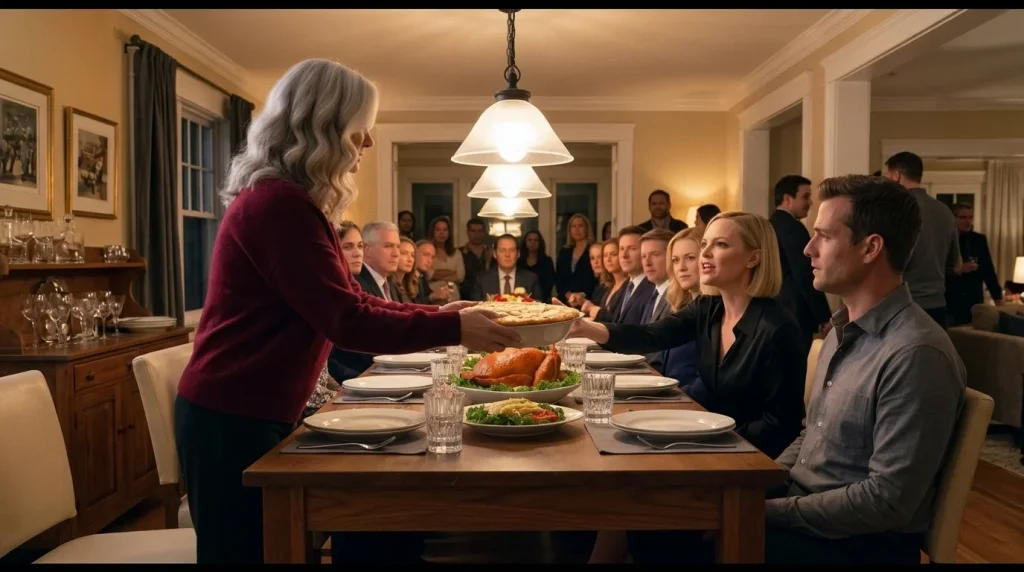
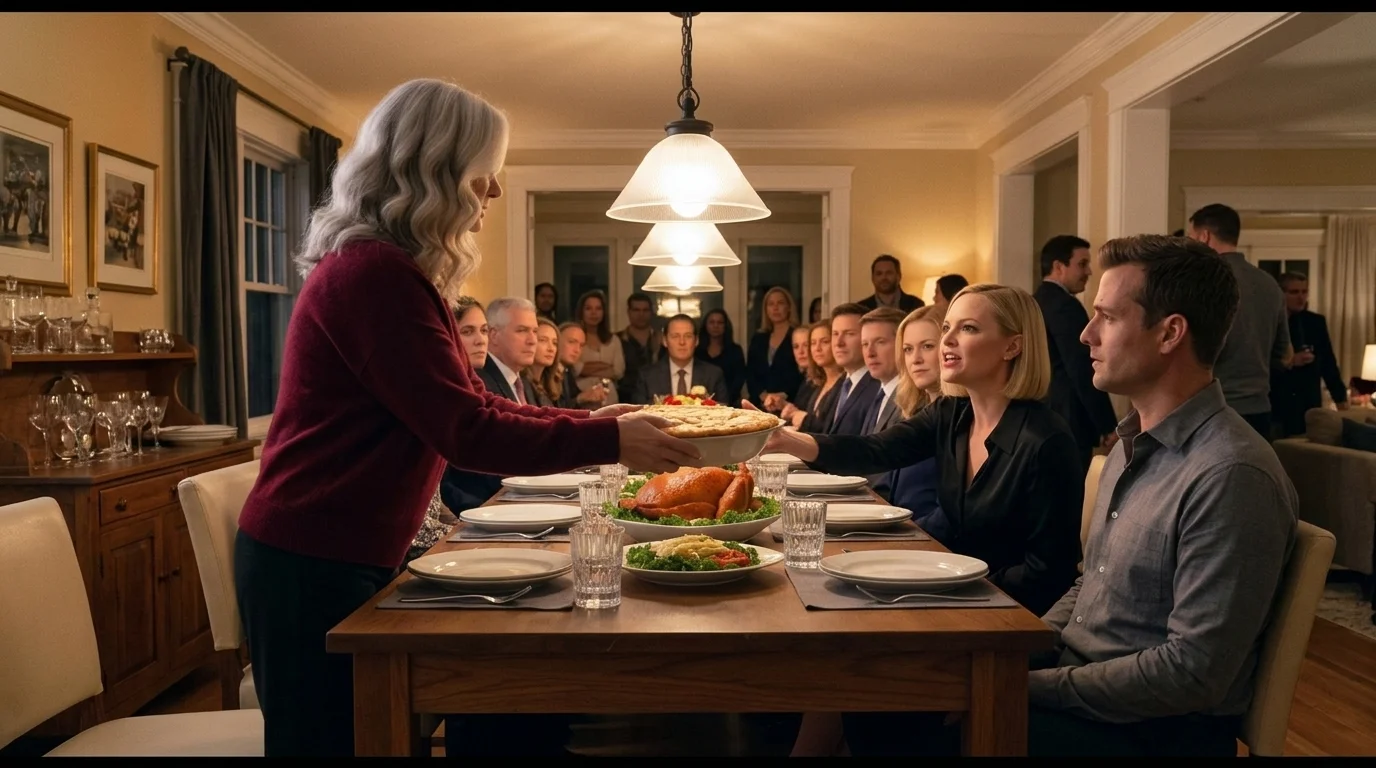
By the time everyone sat down, my feet ached and my back was stiff. Still, seeing the food spread across the table made me feel a little proud.
One of Lauren’s friends complimented the turkey and asked who had prepared everything.
Lauren laughed and waved her hand toward me.
“That would be Diane. She practically lives in the kitchen.”
I gave a polite smile, assuming she was simply making conversation. Then another guest remarked that she wished someone would handle all her holiday cooking.
Lauren leaned back in her chair and looked directly at me.
“Cooking and cleaning, that’s basically your whole personality, Diane.”
A few people laughed uncertainly. Others looked down at their plates, pretending they hadn’t heard anything uncomfortable.
For a moment, I couldn’t speak. I had spent two days preparing that meal, driven three hours to deliver it, and worked in her kitchen while everyone else enjoyed themselves.
I turned toward Michael, waiting for him to say something.
He stared at his plate.
I waited another second, hoping he would look up and tell his wife that she had gone too far. Instead, he reached for his water glass.
Lauren smiled as though she’d made a wonderful joke.
“Oh, Diane. Don’t look so serious. You know I’m kidding.”
I looked around the table. Everyone seemed to be waiting for me to laugh along, to make the moment comfortable again.
But I didn’t.
I folded my napkin, placed it beside my plate, and quietly finished the meal. Nobody mentioned Lauren’s comment again, although I noticed several guests avoiding my eyes.
After dinner, Lauren asked whether I could help clear the table. I carried a few dishes into the kitchen, then stopped when I saw the mountain of pans waiting beside the sink.
For the first time in years, I left them there.
“I think I’ll head home before it gets too late.”
Lauren glanced at the clock.
“Already? We haven’t even started cleaning.”
“I’m sure you’ll manage.”
Michael followed me into the hallway while I collected my coat. He looked uncomfortable, but not nearly uncomfortable enough.
“Mom, you aren’t upset about what Lauren said, are you?”
I studied his face, remembering the little boy who used to stand on a chair beside me and help cut shapes out of cookie dough.
“Would you have laughed if someone said that about Lauren?”
He sighed.
“Mom, please. It’s Thanksgiving. Don’t turn one joke into a whole thing.”
I nodded slowly.
“You’re right about one thing, Michael. It is Thanksgiving.”
Popular Posts
→- 1
- 2
- 3
- 4




Recently Viewed
Stories you read recently will appear here.





