Part 1: Introduction, When the Holiday Table Becomes a Stage
Few settings carry as much emotional weight as a family holiday dinner. The food is prepared, the decorations are hung, the relatives are gathered, and everyone is expected to perform harmony. That expectation is exactly what makes this ten-second vertical video so effective. It takes a scene designed for comfort and quietly turns it into a confrontation.
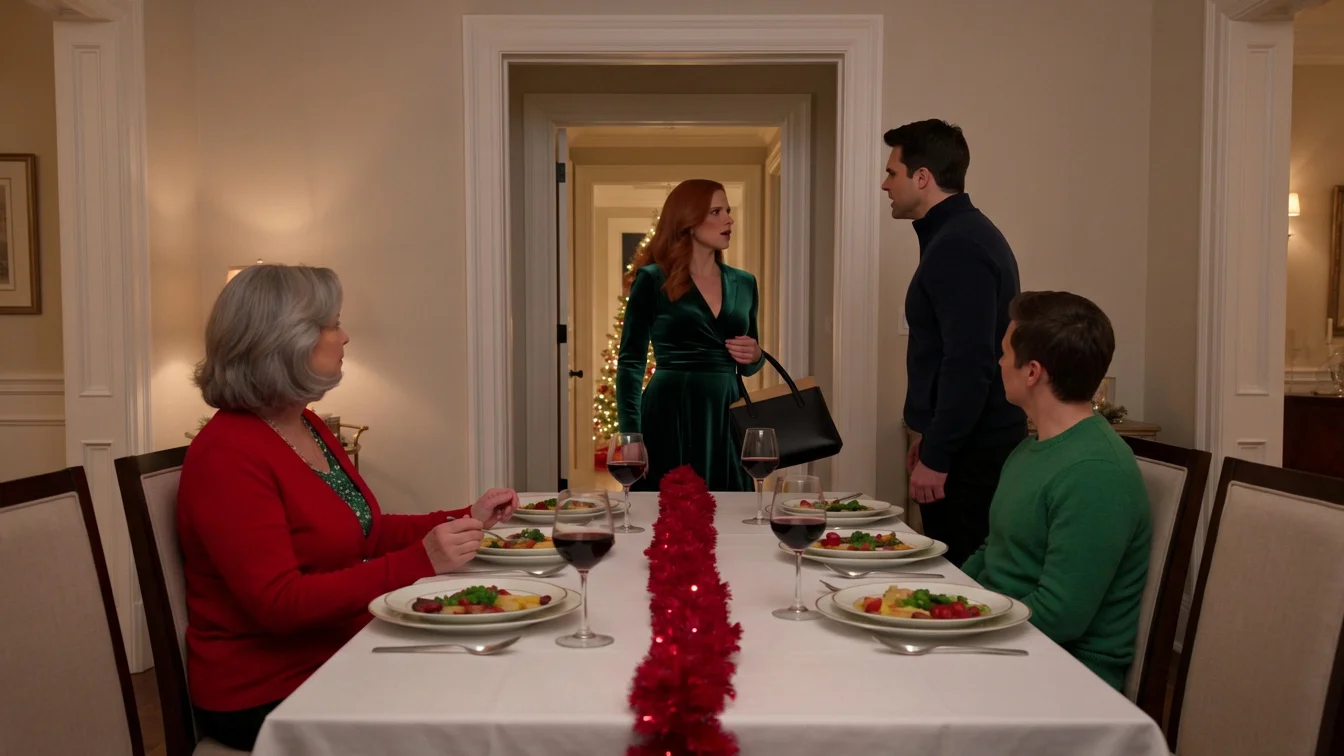
The clip opens in a formal dining room. A long table is covered with a white cloth, set with plates of colorful food, glasses of red wine, and a bright red garland running down the center. In the background, a hallway leads to a glowing Christmas tree. A woman in a green velvet dress appears in that distant doorway, and by the time she reaches the table, we understand that something has already happened. A mark is visible on her cheek. A man in a black sweater faces her. Seated guests watch from the edges of the frame.
What follows is a compact drama built from only a few ingredients: a face, a handbag, an envelope, and a roomful of silent witnesses. There is no chase, no shouting match, and no obvious violence on screen. The tension comes from restraint, from the sense that every person present is waiting for someone else to speak first.
A small disclaimer at the bottom of the frame identifies the video as an AI-generated fictional story made for entertainment purposes. That context is important, and we will treat it seriously in the final part of this series.
In this ten-part analysis, we will examine the clip piece by piece. We will study how the opening shot builds depth, how the protagonist’s costume and entrance establish her role, what the man’s body language suggests, how the guests function as an internal audience, and why the close-ups are so powerful. We will also look at the envelope as a narrative device, discuss the likely role of sound and dialogue, and explore how color and set design shape the mood.
A note on method: the analysis is based on what is visible. Spoken lines have been reconstructed from facial expressions and context, so they should be read as interpretation rather than transcription. Being honest about that limit makes the analysis stronger, not weaker.
As you read, keep one question in mind: how can such a short piece of video suggest so much history? We never learn the characters’ names, their relationship, or the contents of the envelope. Yet most viewers feel certain they understand the stakes. That sense of instant understanding is the real subject of this series. It comes from craft, and craft can be learned. Let us begin with the very first image: a doorway, a tree, and a woman who is about to change the evening.
Part 2: The Opening Shot, Depth, Doorways, and the Frame Within a Frame
The first image is a wide, symmetrical composition that rewards careful study. In the foreground, the dining table stretches across the lower half of the frame. In the midground, a man stands near the table, partially turned away. In the background, framed by a white doorway, a long hallway recedes toward a decorated Christmas tree. And in that hallway, small and distant, is our protagonist.
This is a classic frame-within-a-frame setup. The doorway acts like a picture frame inside the picture, drawing the eye straight to the woman. Because she is far from the camera, she looks small, but the composition makes her the most important element. Everything else, from the table lines to the position of the guests, points toward her.
Depth is used for storytelling. By starting her at a distance, the video gives her an entrance with a built-in countdown. We watch her approach step by step, which builds anticipation. In the first few seconds, the audience has time to read the room: the seated elderly women, the standing man, the abundant food, the glowing lights. When she finally arrives, we already know what she is walking into.
The red garland on the table is another compositional tool. It runs vertically through the frame like a bold stripe, dividing the image and creating a visual barrier between the foreground and the action beyond. It also introduces the color red early, a color that will recur in the guests’ clothing, the wine, and the mark on her cheek.
Lighting in the establishing shot is warm but uneven. The hallway glows golden, while the dining room is lit more softly, with a faint cool tone in the shadows. That gentle contrast separates the space she comes from, which feels festive and bright, from the space she enters, which feels formal and watchful.
Notice also how still the guests are. Their stillness gives the entering character more energy by comparison. Movement in a quiet frame draws attention instantly.
Popular Posts
→- 1
- 2
- 3
- 4




Recently Viewed
Stories you read recently will appear here.