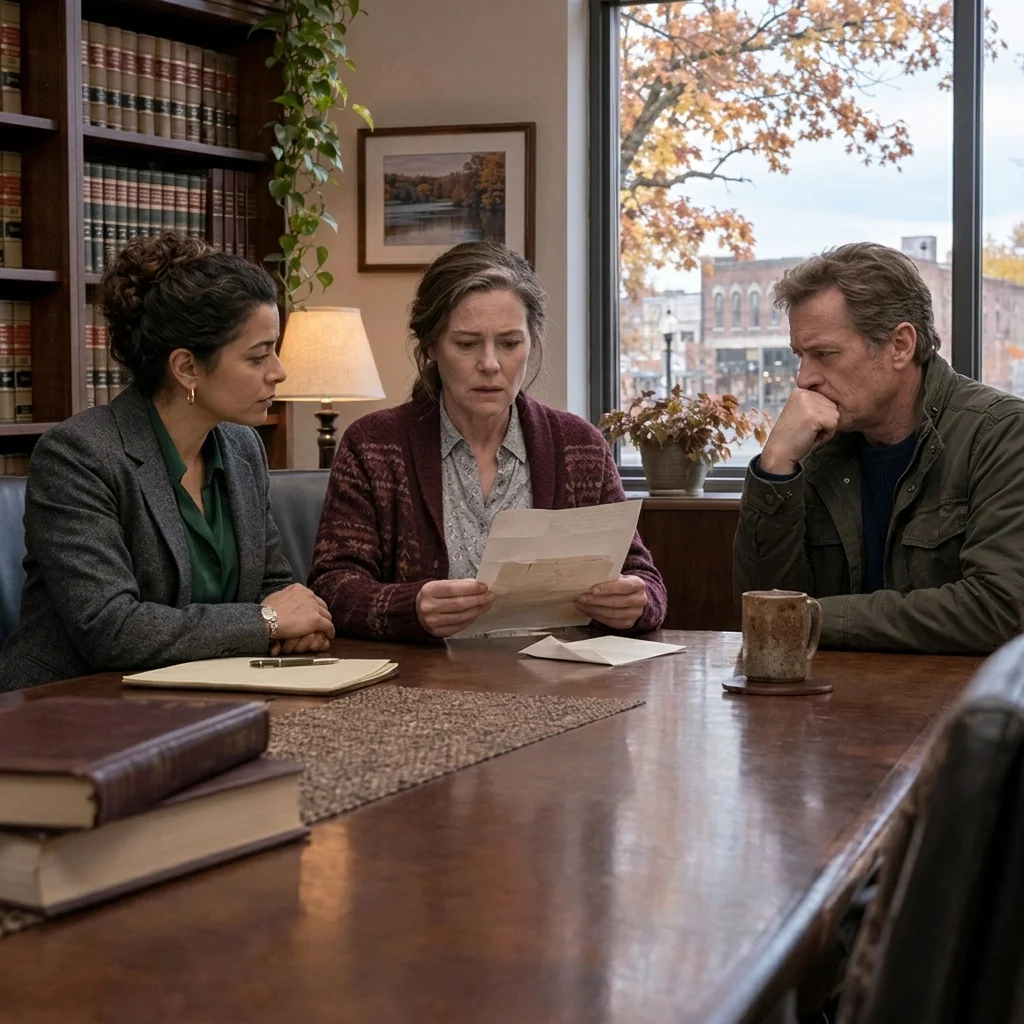
For several seconds, I couldn’t breathe.
The document trembled between my fingers.
Across the polished conference table,
Lyndon stopped tapping his foot.
Ms. Castellanos watched me carefully.
I stared at the date.
November 19, 2015.
Eleven years earlier.
Six weeks after Conrad’s funeral.
And there, beneath the bank’s seal,
was my full legal name.
Margaret Elaine Fennimore.
The next line made my stomach tighten.
Mortgage delinquency reinstatement.
Account number ending in 4472.
Property address: 816 Willow Creek Lane.
My house.
The home where Conrad and I
had raised our children.
The house I had nearly lost
after his death.
I recognized the account number immediately.
I had written it
on hundreds of payment envelopes.
But something else appeared below it.
A payment confirmation.
Twelve thousand, four hundred eighty-six dollars.
And seventeen cents.
I read the amount three times.
Then I looked at the payer.
Horace Edwin Pickett.
“No,” I whispered.
Ms. Castellanos leaned forward.
“Mrs. Fennimore?”
I swallowed.
“This can’t be right.”
Lyndon stretched across the table.
“Let me see that.”
I pulled the document closer.
His expression hardened.
“That’s my uncle’s money.”
I barely heard him.
Because suddenly I wasn’t sitting
in a lawyer’s office anymore.
I was standing inside a different November.
Eleven years earlier.
A November when our furnace barely worked.
When my children wore winter coats indoors.
When I kept the kitchen lights off
to save electricity.
When the mortgage company had called
three times in one afternoon.
And when a woman from the bank
had told me something impossible.
Someone had covered my overdue payments.
I had never learned who.
Until now.
“Mrs. Fennimore?”
Ms. Castellanos repeated my name.
I looked up.
“Where did you get this?”
“It was among Horace’s estate documents.”
“Why did he keep it?”
“Because he wanted you to know.”
Lyndon laughed bitterly.
“Know what?”
“That he was handing out money?”
Ms. Castellanos didn’t answer him.
Instead, she reached for another folder.
“Mr. Pickett left detailed instructions.”
“He wanted this document shown first.”
“And he specifically requested your presence.”
Lyndon leaned back.
“This is ridiculous.”
“My uncle couldn’t remember Tuesday from Thursday.”
“He wasn’t competent to arrange anything.”
The lawyer folded her hands.
“His medical records disagree.”
“Medical records can be wrong.”
“His physicians documented his capacity.”
“So did an independent specialist.”
Lyndon’s face reddened.
“You’re telling me that old man”
“gave away thousands of dollars”
“to someone who shoveled snow?”
“No,
” Ms. Castellanos replied.
“That isn’t what I’m telling you.”
She looked directly at me.
“I’m telling you he helped Maggie”
“before she ever shoveled his driveway.”
My throat closed.
Before?
I looked down at the date again.
November nineteenth.
The first storm that terrible winter
had arrived in early December.
I remembered it perfectly.
I remembered the bitter wind.
The knee-deep snow.
The heavy shovel Conrad had purchased
the autumn before he died.
And Mr. Pickett standing in his doorway.
But the bank document
was dated nearly three weeks earlier.
I felt the room tilt.
“Why?” I asked.
My voice sounded strangely distant.
“Why would he do that?”
Ms. Castellanos glanced toward Lyndon.
Then she returned her attention to me.
“I believe the explanation is complicated.”
“How complicated?”
“More than one document.
”
“More than one decision.”
She paused.
“And more than one person.”
Lyndon pushed back his chair.
“Enough.”
He pointed at the paper.
“That proves she took his money.”
“It proves a payment was made,”
Ms. Castellanos corrected.
“At Mr. Pickett’s direction.”
“He must have been manipulated.”
“Eleven years ago?”
“Exactly.”
“By a woman he barely knew?”
Lyndon opened his mouth.
Then closed it.
The lawyer continued.
“Your uncle signed the payment authorization.”
“The bank verified his identity.”
“The transaction was irrevocably recorded.”
“And the money was explicitly designated”
“as a gift, not a loan.”
She turned the paper toward him.
“That distinction matters.”
Lyndon stared at the signature.
For the first time,
he had nothing immediate to say.
I recognized Horace’s handwriting.
The same crooked letters
that appeared on the envelope.
The same stubborn downward slash
through the letter H.
He had signed his name
while I was trying
to keep my family together.
I remembered that November night.
The children were asleep.
I had been sitting at our kitchen table,
surrounded by unopened bills.
A glass of water sat beside me.
I couldn’t afford to waste money
on anything stronger than tap water.
The mortgage notice lay at the top.
Past due.
Final warning.
I remember tracing those words
with my thumbnail.
As if touching them repeatedly
might somehow make them disappear.
Conrad had earned good money
when the logging contracts were steady.
But we had never been wealthy.
There had been truck repairs.
School supplies.
Medical bills.
The roof we’d replaced that summer.
And after he died,
the bills kept arriving.
Only the paychecks stopped.
Popular Posts
→- 1
- 2
- 3
- 4




Recently Viewed
Stories you read recently will appear here.





