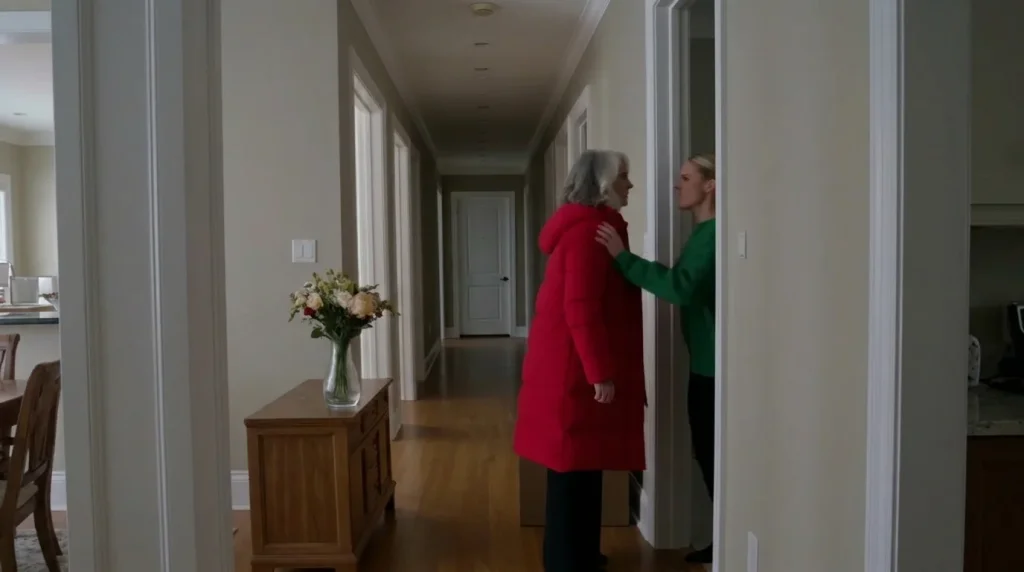
But his reaction to my estate plan suggested they’d been planning something far worse.
“GET OUT OF MY HOUSE!” Jessica screamed.
I stood in the doorway with my blue suitcase, staring at my daughter-in-law. Behind her stood Matthew, my forty-six-year-old son, looking as though he wished he could disappear.
“YOUR house? I’ve owned this house for thirty-eight years!”
“Mom, please,” Matthew muttered. “Let’s not make this difficult.”
I’d spent fourteen days helping my younger sister, Carol, recover from knee replacement surgery. Before leaving, I’d given Matthew an emergency key to collect my mail and check the heating during the December cold.
Apparently, he had mistaken that key for permission to rearrange my entire life.
The first thing I noticed was my Christmas tree. The colorful lights George loved had been replaced with perfectly arranged white strands,
and expensive silver ornaments covered every branch.
My mother’s glass bell was gone. So were Matthew’s childhood paper angels and the crooked wooden star George had made during our first Christmas together.
“WHERE ARE MY CHRISTMAS DECORATIONS?”
Jessica waved dismissively toward the garage.
“I packed them away. They were cluttered, and I wanted something more sophisticated.”
Then I noticed the empty hook beside the front door. George’s brown winter jacket had hung there since his death four years earlier, untouched except when I slipped my fingers into its pocket or brushed its sleeve.
“Where’s George’s coat?”
“Probably in the garage too.”
My eyes filled with tears. George had worn that jacket during our final Christmas together, when cancer had already begun stealing the strength from his body.
“You had no right to touch his things!”
Jessica rolled her eyes.
“Ellie, you can’t keep living in the past.”
I turned toward Matthew, hoping he would finally defend me. Instead, he studied the floor while his wife stood surrounded by the belongings she had moved into my home.
That was when I noticed the unfamiliar shoes beneath my hallway bench, shopping bags beside the staircase, and cardboard boxes stacked against the dining room wall.
“Why are there boxes everywhere?”
Jessica looked almost amused.
“Because we moved in.”
“YOU WHAT?”
“Our lease ended last week. Why waste money renting when there’s a perfectly good house sitting here?”
“But I LIVE HERE!”
“You were gone,” she snapped.
Fourteen days. I’d been away for fourteen days, not fourteen years, yet my daughter-in-law spoke as though my absence had erased my right to return.
I left my suitcase in the hallway and walked upstairs.
Matthew followed reluctantly, while Jessica hurried ahead of us as though she were showing a guest around her own property.
My bedroom door stood open.
Jessica’s dresses occupied half my closet, her perfume bottles covered my dresser, and her jewelry box sat beside my wedding anniversary photograph. Matthew’s clothes filled drawers that had belonged to George.
Worst of all, Jessica’s sweaters lay across the blue quilt my husband had given me during his final Christmas.
“WHY ARE YOUR THINGS IN MY BEDROOM?”
Jessica folded her arms.
“Because this is our room now.”
I looked at Matthew, remembering the little boy who had slept down the hallway, the teenager whose laundry I’d washed, and the grown man whose happiness I’d always placed ahead of my own comfort.
“Matthew, tell me you didn’t agree to this.”
“Mom, we thought you’d understand.”
“Understand WHAT? That you’ve taken over my home?”
Jessica stepped forward.
“Matthew will inherit this house anyway. We’re just making practical arrangements.”
Something cold settled in my stomach.
After George died, I’d updated my estate documents, naming Matthew as my primary beneficiary. He was my only child, and I’d always imagined leaving him the home where he’d grown up.
But inheriting something someday was not the same as owning it today.
“Matthew, did you tell Jessica this house belongs to you?”
He hesitated.
“Dad always said it would stay in the family.”
“That doesn’t mean it’s yours!”
Jessica shrugged.
“Eventually, it will be.”
I looked directly at her.
“The house becomes Matthew’s after I die. NOT BEFORE.”
Then I turned to my son.
“Who owns this house right now?”
Matthew swallowed.
“You do, Mom. Legally.”
That single word hurt more than Jessica’s shouting. Legally. As though my ownership were an inconvenient technicality standing between him and the future he’d already planned.
I walked downstairs, picked up my suitcase, and faced them.
“You have forty-eight hours to remove everything you’ve brought into my house.”
Jessica laughed.
“Are you seriously going to call the police on your own son before Christmas?”
“No.”
Her smile widened.
“I’m calling my attorney, changing my security codes, and reviewing my estate plan.”
Matthew went pale.
“Mom… you don’t need to do that.”
“Why not?”
He looked away.
Popular Posts
→- 1
- 2
- 3
- 4




Recently Viewed
Stories you read recently will appear here.





