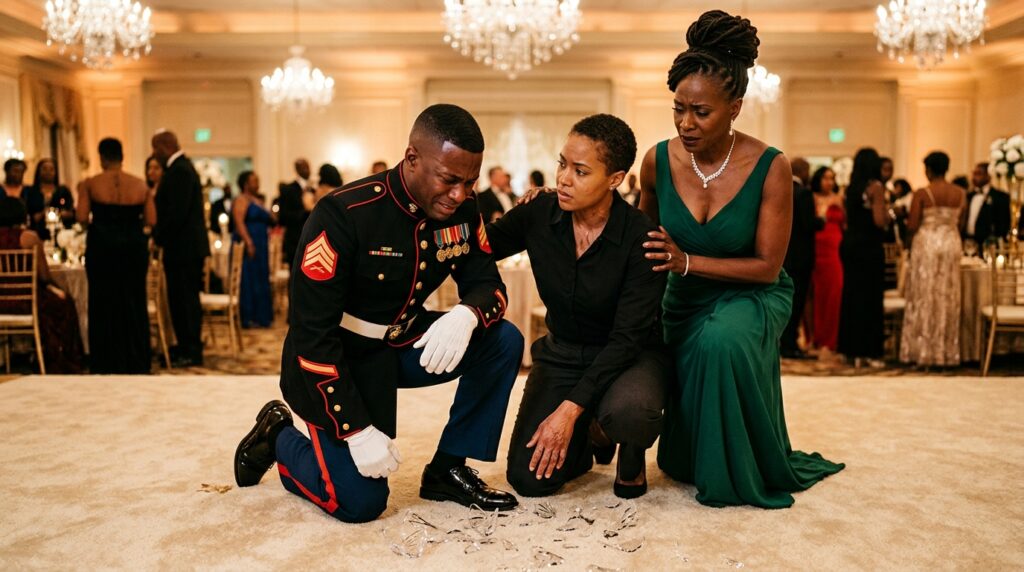
“YOU’RE DIRTY!” I Was On My Knees, Pulling Shattered Crystal From The Carpet With My Scarred Hands. My Mom Stood Over Me, Calling Me A Dirty, Worthless Soldier Before 44 Guests. Then A Marine Stepped Forward With Icy Fury And Said, “You Call Soldiers Lowlife?”
Part 1
“You’re dirty.”
My mother said it like the word tasted bad in her mouth.
Not quietly. Not in the kitchen, not behind a closed door, not with the decency of shame.
She said it in the middle of her Thanksgiving dinner party, in front of forty-four guests wearing silk dresses, tailored jackets, diamond watches, and expressions polished smooth enough to hide cruelty.
I was on my knees in her dining room, picking broken crystal out of the cream wool carpet with hands that had never fully healed.
My hands were the first thing people noticed when they looked at me too long. Burn scars ran over my knuckles, twisted across my fingers, tightened the skin around my palms. They were thick, ridged, ugly things. At restaurants, servers sometimes looked away. Children stared. Adults pretended not to.
My mother never pretended.
She hated them openly.
“Look at you,” she hissed, pointing down with one manicured finger. “Crawling around like some filthy animal. You’re just like those soldiers you wasted your life with. Rough, dirty, low-class, good for nothing.”
The whole room froze.
A roasted turkey sat untouched at the center of the table. Candles flickered in tall brass holders. Red wine spread across the carpet around me like blood, soaking into the wool, crawling toward the hem of my black dress.
Three feet away, my brother Julian stood with his hand still half raised from the story he’d been telling. He had knocked over the glass while making a grand gesture about some courtroom victory he probably exaggerated.
He knew it.
I knew it.
Everyone close enough knew it.
But my mother, Celeste Whitlock, did not turn toward him. She turned toward me.
Julian lowered his hand slowly and gave me the same small smirk he had used since childhood whenever he broke something and watched me get blamed.
I pinched a shard between my scarred fingers and dropped it into a napkin. My fingertip split open. A bead of blood formed, bright and neat.
Nobody moved.
The guests stared at me the way rich people stare at someone causing discomfort in a beautiful room. Not with compassion. With irritation.
My mother’s friend, Mrs. Bellamy, clutched her pearls. A banker near the fireplace looked down at his shoes. Julian’s girlfriend, Elise Montgomery, blinked between my brother and me as if something in the room had stopped making sense.
My mother leaned closer.
“You ruin everything, Mara,” she whispered, though every person heard it. “Even when I let you come home, you bring shame with you.”
That was the moment I should have stood up.
I should have thrown the bloody napkin at Julian’s chest. I should have told every guest the truth. I should have said that this house, this dinner, this glittering performance of old Southern money, existed because of me.
But I didn’t.
Because some humiliations do not make you angry right away.
Some take you backward.
I was suddenly seventeen again, standing on the porch with a duffel bag, waiting for my mother to hug me before I left for boot camp.
She hadn’t even looked up from the television.
I was twenty-two again, washing dishes at Julian’s graduation party while my mother called him “the future of this family.”
I was thirty-two again, waking in a field hospital with both hands wrapped in white gauze, asking whether the men from the helicopter had made it out alive.
So I stayed on my knees.
I breathed in for four seconds.
Held it for four.
Out for four.
A drill buried deep in my bones.
Then the front door opened.
Cold November air moved through the room.
 THE NEXT PART IS BELOW
 Don’t forget to switch from “Most Relevant” to “All Comments” to continue reading more
You Might Also Enjoy
Popular Posts
→- 1
- 2
- 3
- 4




Recently Viewed
Stories you read recently will appear here.


