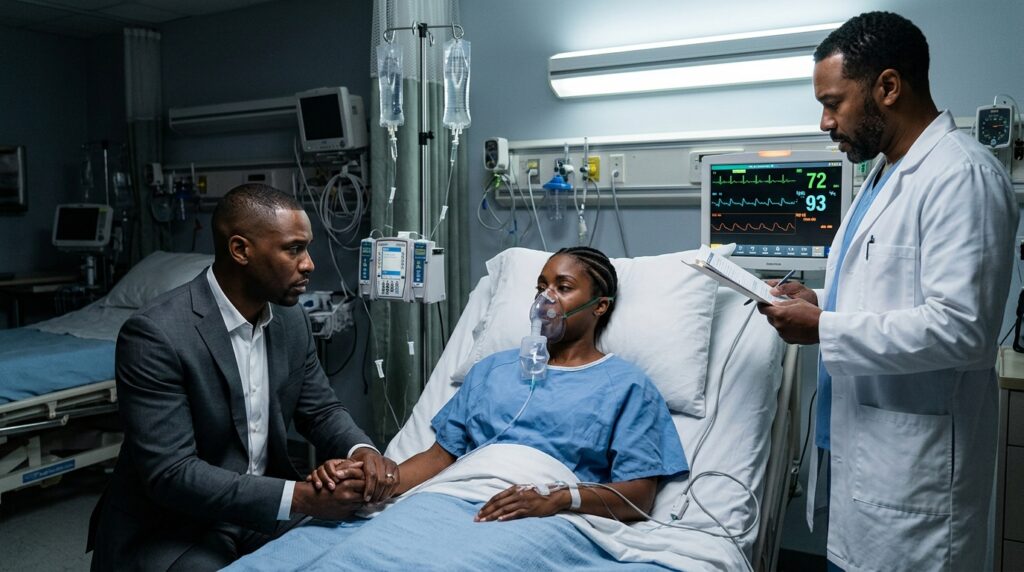
“Pull the plug,” my husband said, standing beside my ICU bed while I lay trapped inside my own body. The monitor screamed, my chest burned, and his voice stayed cold as he complained I was too expensive to save. Then my eyes opened. I whispered six words—and the doctor turned pale before calling 911. He forgot I heard everything.
Part 1
“Pull the plug,” my husband said. “If she wakes up broken, I’m not paying to keep her alive.”
I heard every word.
I was supposed to be unconscious.
The doctors thought I was lost somewhere deep inside my damaged brain, floating in blackness, unaware of the room, unaware of my body, unaware of the man standing beside my bed calmly ordering my death.
They were wrong.
I could hear the ventilator pushing air into my lungs.
I could hear the heart monitor fighting to prove I still existed.
I could hear my colleague, Dr. Julian Hayes, nearly lose his temper.
“Sterling, she needs surgery,” Julian said. “Her pupils still respond. We have a window. A real window. Sign the consent.”
My husband exhaled like Julian had asked him to sign for a bad mortgage.
“She always said she wouldn’t want to live like a vegetable.”
A lie.
I had never said that.
I had said the opposite after a trauma conference in Milwaukee two years earlier. I had told Sterling that as long as there was a chance, as long as my brain still fought, I wanted treatment.
I wanted time.
I wanted to see my daughter, Piper, graduate kindergarten.
I wanted Saturday pancakes in our kitchen, with syrup on the counter and her little pink socks sliding across the hardwood.
I wanted to live.
But my mouth would not move.
My body lay still under hospital blankets while my husband murdered me with a pen.
Julian’s voice dropped, deadly quiet.
“She is your wife.”
Sterling gave a small laugh.
“She is also my responsibility.”
Then came the sound.
Paper sliding.
A pen clicking.
The scratch of ink.
That sound cut deeper than any scalpel I had ever held.
He signed the DNR.
He refused the surgery.
He chose my grave.
And the worst part was that I knew why.
The night before I collapsed, Sterling had stood in our kitchen under the soft yellow pendant lights, wearing a navy suit and the fake smile he saved for bankers, lawyers, and people he planned to manipulate.
A stack of papers sat on the kitchen island.
“Sign it,” he said.
I glanced down and saw the deed transfer for the Oak Park house.
My parents’ house.
The one with the white porch, old brick fireplace, creaky stairs, and my mother’s rose bushes still climbing the fence.
The house my father left me in his will.
The house I promised would one day belong to Piper.
“No,” I said.
Sterling’s smile vanished.
“You’re my wife. Stop acting like some independent little queen.”
“That house is not yours.”
His eyes turned flat.
Cold.
Dangerous.
He tapped the paper with one manicured finger.
“I already have a buyer.”
My stomach dropped.
“You what?”
“I need liquidity.”
That was Sterling’s favorite word when he was hiding something ugly.
Liquidity.
Translation: debt.
“You gambled again,” I said.
His jaw tightened.
The bourbon on his breath reached me before his hand did.
He grabbed my hair and slammed the back of my head against the edge of the dining table.
White pain exploded behind my eyes.
I dropped to one knee.
He leaned over me, his Italian leather shoes planted beside my hand.
“You are a surgeon,” he whispered. “You know what happens when a brain bleed goes untreated.”
Then he smiled.
“Accidents happen.”
I should have called the police that night.
I should have gone to the ER as a patient instead of dragging myself to work as a doctor.
But shame is a cage.
Fear is a leash.
And for five years, Sterling had trained me to wear both.
At home, he controlled the bank accounts.
He tracked my phone.
He read my texts.
He took my paycheck and gave me grocery money like I was a child.
In public, he posted pictures of us at Thanksgiving dinner, Piper in a velvet dress, me smiling beside a pumpkin pie I barely had the strength to bake.
“Blessed beyond measure,” he wrote.
Behind that photo, I had three cracked ribs.
Nobody knew.
Not Julian.
Not Clara, my closest friend and head nurse.
Not my mother.
Not Piper, though now I wonder how much children notice while adults lie to themselves.
I hid bruises under long sleeves.
I blamed falls.
I treated my own injuries in the hospital locker room.
I became very good at saving strangers and very bad at saving myself.
Now I lay in my own ICU, trapped inside my body while my husband walked out after signing away my last chance.
Outside the door, I heard Julian call him again hours later.
“Sterling, reconsider. She can survive this.”
Sterling answered from somewhere loud.
A bar.
There was cheering in the background.
Glasses clinking.
A football game on TV.
Popular Posts
→- 1
- 2
- 3
- 4




Recently Viewed
Stories you read recently will appear here.


