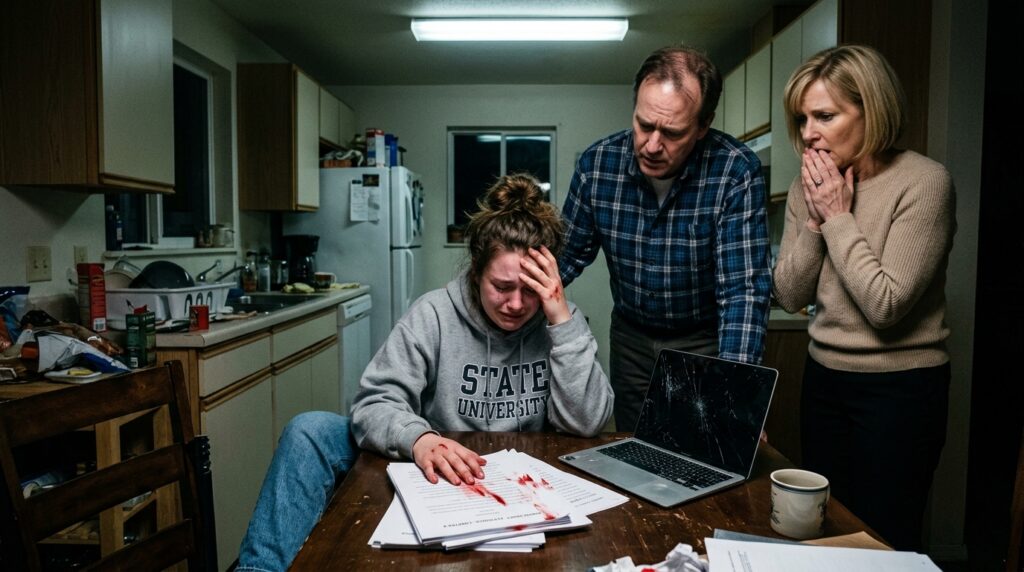
“Your future? That’s a joke,” Dad sneered—then smashed my laptop against my head right before my final thesis. “You don’t deserve a future. You’re just a leech.” Mom laughed. Neither of them had any idea what I would do next.
The laptop struck the side of my head so hard that I dropped to my knees.
“Your future?” Dad shouted, lifting the shattered computer by its cracked screen. “That’s a joke. You don’t deserve a future. You’re just a leech.”
Blood ran past my ear and splashed across the printed copy of my thesis.
Mom stood beside the kitchen table, laughing.
My final defense was scheduled for nine the next morning. Two years of research, interviews, and financial records had been stored on that laptop. Dad knew it. That was why he destroyed it.
He thought I had been writing about financial exploitation in small family businesses. What he didn’t know was that my research had begun pointing directly toward his construction company.
Earlier that evening, he had demanded the remaining $6,400 from my graduate fellowship.
“Your brother needs a reliable truck,” he said.
I reminded him that the money covered tuition and rent. Dad called me selfish. Mom said I owed them for raising me. When I refused to transfer it, Dad grabbed my laptop.
Now he stood over me, breathing heavily.
“Tell your professor you failed,” he said. “Then get a real job and start contributing to this family.”
I pressed a dish towel against my bleeding head and reached for my phone.
Dad kicked it beneath the refrigerator.
“You’re not calling anyone.”
Mom folded her arms. “Stop acting like a victim, Emma. You always make everything dramatic.”
I slowly stood. My vision blurred, but I managed to smile.
That made Dad hesitate.
He didn’t know my thesis automatically synced to university storage every sixty seconds. He didn’t know the laptop camera had been recording my practice presentation when he entered the room. And he definitely didn’t know I had already scheduled three emails containing copies of the company’s financial records.
They would be delivered at midnight.
One to my professor.
One to the state attorney general’s office.
And one to a detective who had been waiting six months for proof.
Suddenly, someone pounded on the front door.
Dad’s face went pale when a voice called from outside.
“Police. Mr. Parker, open the door.”
My parents believed destroying my laptop had erased everything. But the recording captured more than the attack—and the financial records revealed that I wasn’t the only person Dad had betrayed.
Dad shoved me against the refrigerator and whispered, “Tell them it was an accident.”
The pounding grew louder.
Mom grabbed the bloody towel from my hand and threw it into the sink. “Clean yourself up,” she hissed. “If he gets arrested, this family loses everything.”
Before I could answer, the front door opened. My younger brother, Ryan, stood outside with two police officers. He had received the emergency message automatically sent by my phone when the impact triggered its crash-detection feature.
Dad immediately changed his expression.
“She dropped her computer and became hysterical,” he told them.
Mom nodded. “Emma has been under enormous pressure.”
One officer looked at the dented laptop. The other looked at the blood running down my neck.
Then my phone began playing from beneath the refrigerator.
Dad’s recorded voice filled the kitchen: “You don’t deserve a future. You’re just a leech.”
Nobody moved.
The officers separated us. Dad was handcuffed after I showed them the video uploaded to my cloud account. Mom kept insisting I was destroying the family, even as paramedics examined the swelling near my temple.
At the hospital, my professor, Dr. Bennett, called.
“Your thesis files are safe,” she said. “But Emma, the documents you attached contain Social Security numbers, loan applications, and forged signatures. Where did you get them?”
I told her I had found them while handling bookkeeping for Dad’s company.
There were accounts under former employees’ names, payments to workers who didn’t exist, and loans secured using identities that didn’t belong to him. I had reported my suspicions months earlier, but investigators said they needed original records connecting Dad to the applications.
Those records were inside the scheduled emails.
At 12:01 a.m., they were delivered.
Ten minutes later, Detective Ramos entered my hospital room. She placed a folder beside me and asked whether I recognized the signature on the first page.
It looked exactly like mine.
“I never signed this,” I said.
The document showed an $86,000 business loan opened in my name shortly after my eighteenth birthday.
“That isn’t the worst part,” Ramos said. “Your father has been making payments from an account containing money left to you by your grandmother.”
I stared at her. Dad had always claimed Grandma’s estate went entirely toward medical bills.
Then Ramos lowered her voice.
“Your father was released on bail an hour ago. He’s already tried to access your university account.”
My hospital door opened again.
Mom stood there clutching a thick black ledger, her face wet with tears.
Popular Posts
→- 1
- 2
- 3
- 4




Recently Viewed
Stories you read recently will appear here.


