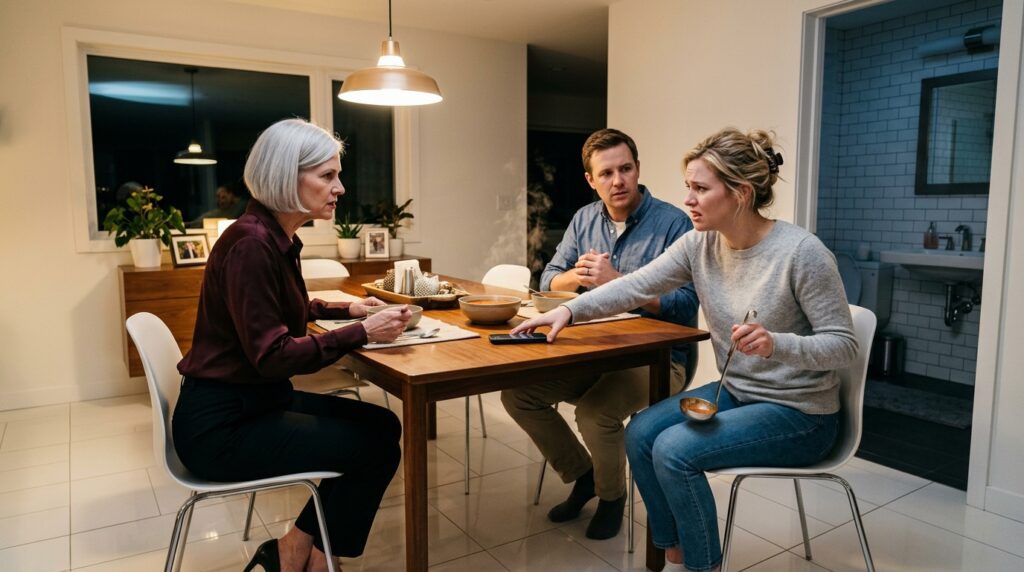
My mother-in-law punished me for serving dinner late by pouring scalding soup over my hand. As blisters rose across my skin, my husband laughed and said, “Maybe now you’ll learn.” I pressed ice against the burn and quietly called the family attorney. At breakfast, a process server arrived with an eviction order—and proof that the house they had ruled as their own had belonged to me all along.
I screamed as the bowl shattered against the kitchen tile. Broth soaked my sleeve, and angry red patches rose across my skin. My mother-in-law, Diane, stood over me holding the empty ladle.
“Dinner was supposed to be ready at six,” she said.
My husband, Mark, leaned against the refrigerator and laughed while blisters began forming across my knuckles. “Maybe now you’ll learn.”
For one stunned second, I looked at the man I had married and realized he wasn’t shocked by what she had done. He was enjoying it.
Diane ordered me to clean the floor. Mark stepped over the broken ceramic, took his dinner into the living room, and turned up the television to drown out my crying.
I locked myself in the downstairs bathroom, wrapped my hand in a dish towel packed with ice, and photographed every burn. Then I called Rachel Cole, the attorney who had handled my father’s estate.
“They did it again,” I whispered.
Rachel’s voice sharpened. “Do you still have the deed packet I told you to hide?”
“Yes.”
“Then don’t confront them. I’m filing tonight.”
At breakfast, Diane sat at the head of my table, complaining that my bandaged hand was “dramatic.” Mark slid a document toward me and demanded my signature. Before I could touch it, the doorbell rang.
A process server stood on the porch beside Rachel. He handed Mark a court-stamped eviction order. Then Rachel placed a certified deed on the table.
“You have no ownership interest in this property,” she told him. “Neither does your mother. This house has always belonged solely to Claire.”
Mark’s face drained of color. Diane lunged for the deed, but Rachel pulled it away.
Then the process server looked at me and said, “There’s another document you need to see. Your husband filed it three weeks ago—and the signature on it is supposed to be yours.”
I looked at Mark. He was already backing toward the hallway.
I thought the worst thing Mark had done was stand there laughing while my skin burned. Then Rachel opened the second document, and I saw my name beneath an agreement I had never read, never approved, and never signed. Whatever Mark had planned, the house was only the beginning.
“Don’t let him reach the office,” Rachel said.
Mark ran.
I moved instinctively, but pain shot through my burned hand. The process server caught Mark at the hallway entrance and ordered him to step back. Diane sprang from her chair, shouting that we were trespassing in her son’s home.
Rachel laid the second document beside the certified deed. It was a quitclaim deed transferring my house to a company called Briar Holdings LLC. My name appeared at the bottom in a careful imitation of my signature.
“I never signed that,” I said.
“Of course you did,” Mark snapped. “You forget everything when you’re upset.”
Rachel turned to the final page. “Then explain why the notary listed here died eight months before this was supposedly signed.”
The room went silent.
Diane stared at her son. “You said Claire agreed.”
Mark told her to shut up.
That was the first crack between them.
Rachel explained that my father had purchased the house before Mark and I married, then placed it in a trust naming me as the sole beneficiary. Mark had never been on the deed. The papers he had pushed at me for months—documents he called insurance forms and tax corrections—had been attempts to gain control of it.
But the forged deed revealed something worse. Briar Holdings had applied for a $420,000 loan using my house as collateral. The closing was scheduled for Friday.
“Tomorrow,” I whispered.
Mark rushed toward the table. The process server blocked him again. Diane began crying, insisting she knew nothing about a loan.
Then Rachel showed me the company registration.
Briar Holdings belonged to Mark—but its mailing address was Diane’s previous apartment. The loan application also contained bank statements claiming I had authorized the money to be deposited into an account held jointly by them.
Diane stopped crying.
I finally understood: she had not merely moved into my home. She had helped him prepare to steal it.
Mark’s expression changed. The panic disappeared, replaced by a calm smile that frightened me more.
“An eviction order doesn’t remove us today,” he said. “And a forged signature is only forged if you can prove who wrote it.”
Upstairs, a door slammed.
No one was supposed to be up there.
Rachel looked toward the ceiling. The process server reached for his phone. Mark stepped in front of the staircase, while Diane quietly slipped the company papers into her purse.
Then we heard my locked filing cabinet being dragged across the bedroom floor.
Popular Posts
→- 1
- 2
- 3
- 4




Recently Viewed
Stories you read recently will appear here.


