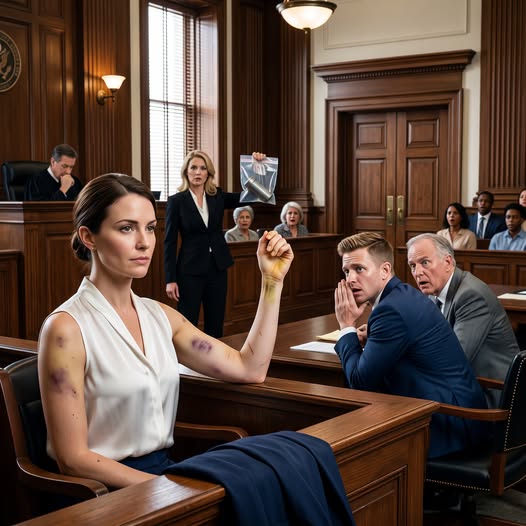
For months, my husband made me hide every bruise beneath long sleeves. Then, in court, his lawyer called me a liar and demanded proof. I rose, slipped off my jacket, and identified the age, direction, and weapon behind every mark. “Objection?” I asked calmly. As a former forensic doctor, I dismantled his story—one injury at a time.
“Show the jury your arms, Mrs. Carter—or admit there is nothing to see.”
Daniel’s attorney, Victor Hale, let the challenge hang in the courtroom. My husband sat beside him in a navy suit, wearing the wounded expression he had practiced for months. Twelve strangers watched me. So did Daniel’s mother, who smiled as if the verdict had already been read.
For months, Daniel had chosen my clothes before we left the house. Long sleeves in July. High collars at dinner. Once, when a cuff slipped at a pharmacy, he squeezed my injured arm until I nearly screamed and whispered, “Cover it, Emily.”
Now Hale called me unstable, bitter, and desperate for money.
“You photographed nothing,” he said. “You visited no emergency room. You have no proof that my client ever touched you.”
My attorney, Rachel Kim, rose. “Counsel is badgering the witness.”
“Overruled,” Judge Alvarez said. “The witness may answer.”
I looked at Daniel. His confidence vanished when I placed both hands on my jacket buttons.
“I do have proof.”
I removed the jacket and laid it across the witness rail. A murmur moved through the gallery. Yellowing marks circled my left wrist. Darker bruises crossed my upper arms. A narrow healing line ran below my elbow.
Hale recovered quickly. “Bruises prove injury, not who caused it.”
“Correct,” I said. “So let’s examine them.”
I pointed to my wrist. “Approximately twelve days old. Compression injury. Four fingers on the outer surface, thumb pressure inside. A right-handed grip.”
Then my upper arm. “Five to seven days old. Blunt impact from a cylindrical object, moving downward.”
Daniel leaned toward Hale and whispered urgently.
I touched the healing line. “And this was not caused by the kitchen accident described in his sworn statement. The angle is wrong.”
Hale stared at me. “You expect this jury to accept your personal diagnosis?”
I faced them calmly. “Before I left medicine, I was a forensic physician for eleven years.”
Then Rachel opened a sealed evidence bag and lifted out the object Daniel had sworn never existed.
Daniel thought my silence had erased every trace of what happened inside our home. But the object in that evidence bag carried a history neither his attorney nor the jury was prepared to hear—and one person in the courtroom suddenly tried to leave.
Inside the bag was Daniel’s black walking cane.
He did not need it. He had bought it at an estate sale because he liked the silver wolf carved into its handle. At home, it had another purpose.
Hale shot to his feet. “Objection! No foundation.”
“The foundation is in Exhibit Twenty-Six,” Rachel said. “The defendant reported this cane stolen six weeks ago.”
She displayed Daniel’s insurance claim. Then she placed a photograph beside it: the cane lying behind our garage, wrapped in a contractor bag. Police had recovered it two days earlier after receiving an anonymous tip.
I described the oval bruising on my arm and the downward pattern of impact. The cane’s shaft matched both. More importantly, the silver handle had a damaged edge that matched the narrow cut below my elbow.
“She could have done that to herself,” Daniel shouted.
The judge ordered him silent, but the jurors had heard the panic in his voice.
Rachel asked one question. “Dr. Carter, why did you leave forensic medicine?”
My throat tightened. “Because my husband sabotaged a homicide examination and made it appear that I had mishandled evidence.”
The courtroom erupted.
Years earlier, Daniel had worked as a county evidence technician. A blood sample disappeared during a murder investigation. My findings were challenged, the case collapsed, and I resigned under suspicion. Daniel comforted me through every sleepless night. I did not learn until after our separation that he had accessed the evidence locker.
Hale’s face drained of color. He demanded a recess.
That was when Daniel’s mother rose from the gallery and hurried toward the exit.
Two detectives stopped her at the doors.
Rachel handed the judge a second sealed filing. “Your Honor, the state obtained a warrant this morning. The anonymous tip about the cane came from an encrypted account linked to Linda Carter.”
Linda screamed that it was a lie. Daniel shouted for her to say nothing.
Then Detective Marcus Bell entered carrying a small red ledger recovered from Linda’s safe. It listed dates, evidence numbers, and payments—including one made three days after the blood sample vanished from my case.
But the final entry was dated tomorrow.
Beside my name was an address I did not recognize and a time: 9:30 p.m.
Judge Alvarez immediately cleared the courtroom. As deputies surrounded Daniel, he looked past them at me and smiled.
“You still don’t understand,” he said. “The cane was meant to be found.”
Then Rachel’s phone lit up with a security alert from my apartment.
Someone had just opened my front door.
Popular Posts
→- 1
- 2
- 3
- 4




Recently Viewed
Stories you read recently will appear here.


