My Mother-in-Law Said I Didn’t Belong at the Table—By Morning, They Were All at My Door
At My Father-In-Law’s Military Retirement Banquet, My Mother-In-Law Knocked My Dinner Plate To The Floor And Said, “You Don’t Belong At This Table.” My Husband Looked Away. I Slowly Stood, Straightened My Dress Uniform, And Said Three Words That Silenced The Entire Room. The Next Morning, They Were All At My Door.
### Part 1
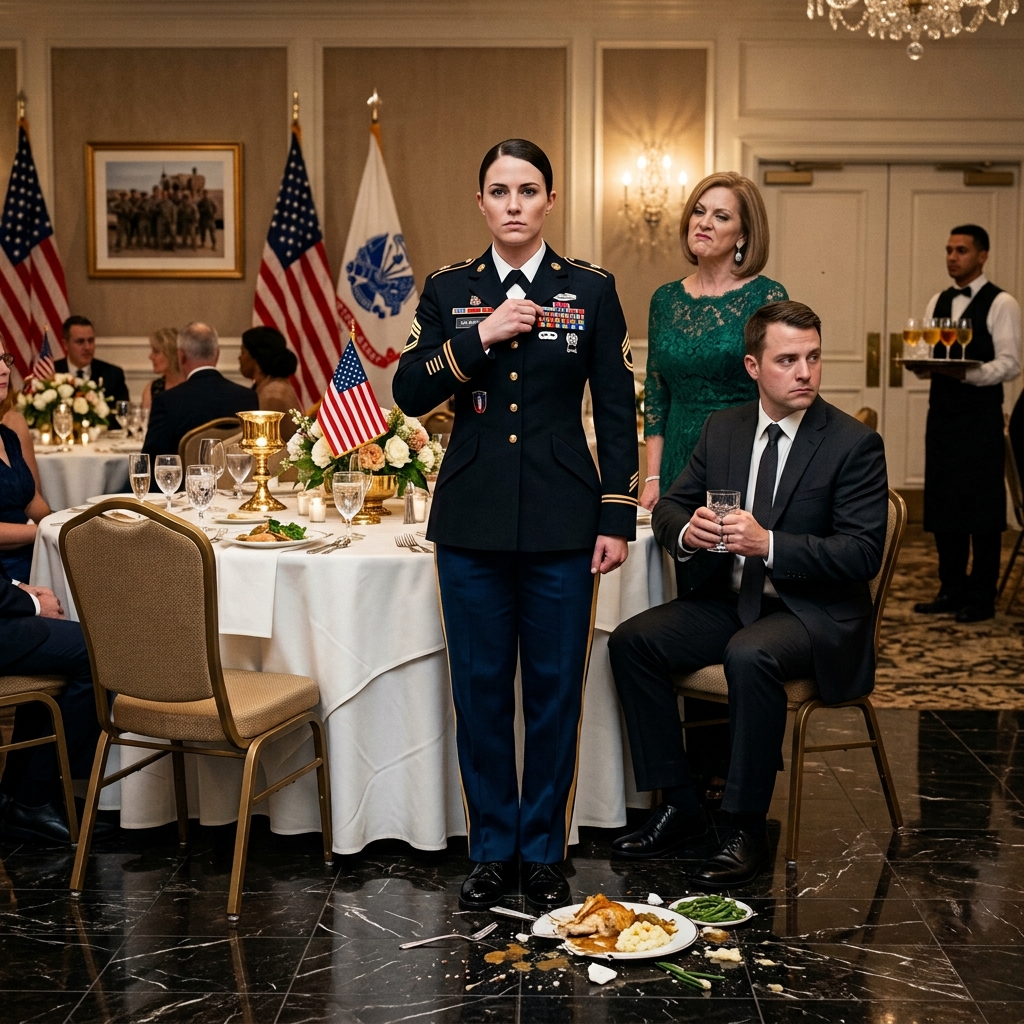
The plate hit the ballroom floor so hard that the conversations died before the china stopped spinning.
Roast chicken slid across the polished tile. Green beans scattered under my chair. A scoop of mashed potatoes landed beside my black dress shoes, close enough that I felt the heat through the leather. Somewhere behind me, a fork clattered onto a linen-covered table.
My mother-in-law, Vivienne Mercer, stood over the mess with her chin tilted high, her pearl earrings shining under the hotel lights.
Then she said, loud enough for every officer, spouse, veteran, and waiter in the banquet hall to hear, “You don’t belong at this table.”
For one second, I forgot where I was.
I forgot the American flags behind the stage. I forgot the framed deployment photos lining the walls. I forgot the weight of the ribbons on my Army dress blues and the medals pinned over my heart.
All I could do was look at my husband.
Caleb sat beside me with both hands folded near his water glass. His jaw tightened. His eyes flicked toward his mother, then toward the guests staring at us, then down at the table.
He looked away.
That small movement cut deeper than Vivienne’s words.
I had been embarrassed before. I had been dismissed before. I had survived worse than a plate of food hitting the floor. But something inside me changed when my husband chose silence in front of two hundred witnesses.
Not anger.
Not tears.
Stillness.
The kind of stillness that comes when a storm has already made its decision.
I slowly pushed my chair back. The scrape of the legs against the tile echoed through the ballroom. A waiter froze near the double doors with a tray of iced tea in his hands. At the head table, my father-in-law, Colonel Grant Mercer, sat motionless beside the major general who had come to honor him.
Vivienne’s mouth curved like she expected me to apologize.
I stood, smoothed the front of my uniform, and straightened one ribbon that had shifted when I rose.
Then I looked past her, straight toward the stage.
“Read my orders.”
The room went so quiet I could hear the ice settling in water glasses.
Vivienne blinked.
Caleb turned toward me for the first time since his mother had opened her mouth. Confusion moved across his face, then fear. Not fear of me. Fear that there was something he didn’t know.
There was.
The night had been advertised as Colonel Grant Mercer’s retirement banquet after thirty-six years in the United States Army. Northern Virginia hotel ballroom. White linens. Brass centerpiece lanterns. Old photographs from Germany, Kuwait, Iraq, and Fort Bragg. A screen looping pictures of Grant shaking hands with soldiers whose names he still remembered.
Vivienne had planned the banquet for months.
She had controlled the seating chart like a military operation. She had inspected the flowers twice. She had told Caleb three times that my deployment schedule was “such a convenient excuse” and that if I came home exhausted, I should “rest quietly somewhere else.”
I had returned from overseas three days earlier.
My body still felt like it belonged to another time zone. My duffel bag still sat half-unpacked in our bedroom. But Grant had called me himself and said, “Captain Vey, I would consider it an honor if you attended in uniform.”
So I came.
Quietly. Respectfully. Determined to get through one evening without drama.
Vivienne had other plans.
She saw my name card beside Caleb’s. She saw me sitting near the head table instead of tucked near the back with distant cousins. Her face hardened, and ten years of polished resentment finally stepped into public view.
Now the whole room was staring at the woman she had tried to reduce to a stain on the floor.
The major general slowly turned toward the podium.
“Command Sergeant Major,” he said, voice calm but sharp enough to cut glass, “bring me Colonel Mercer’s ceremony folder.”
A retired command sergeant major crossed the stage and lifted the dark leather folder that had been waiting there all night.
Vivienne looked at Grant.
Grant did not look away from me.
And that was when I understood.
He had known this moment might come.
### Part 2
Popular Posts
→- 1
- 2
- 3
- 4




Recently Viewed
Stories you read recently will appear here.


