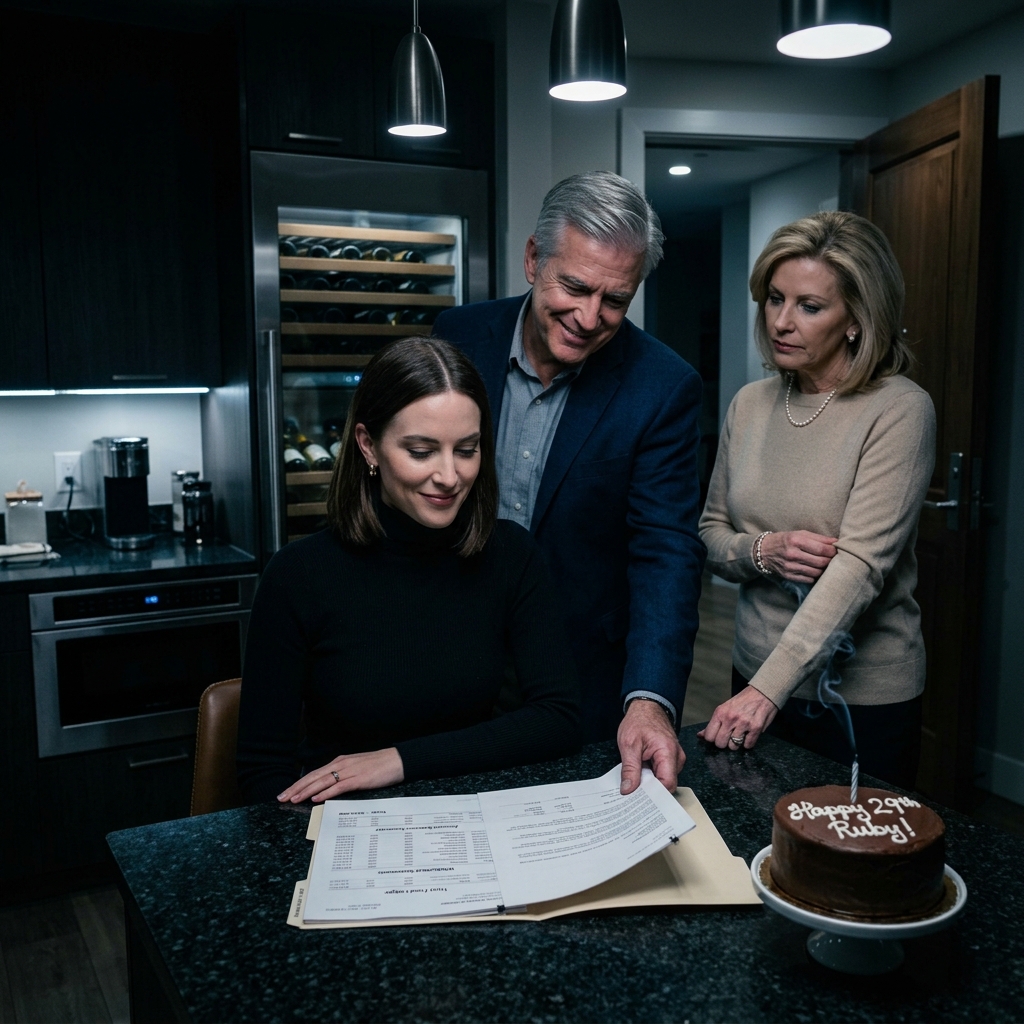
On my 29th birthday, my parents walked into my apartment without knocking and dropped a folder on my table like it was the bill for my existence.
My father laughed first, the soft, satisfied kind that fills a room faster than smoke.
My mother didn’t bother to sit.
She just tapped the folder and said my sister’s future was now secured.
They never noticed the candle on the cake behind them burning itself out.
I didn’t argue.
I didn’t even ask why.
I only asked one question in my head.
How long until they realized what they took wasn’t mine to lose?
I learned early that silence was easier than asking for anything.
Growing up, our house always sounded like someone else’s life.
My sister Grace’s piano lessons echoing down the hallway.
My mother cheering from the kitchen.
My father’s voice booming with plans made for her, never with her.
I moved around that noise like a shadow, careful not to interrupt the music of their expectations.
Money was the first thing they took without asking.
I was 17 when my father borrowed the savings from my part-time job.
He stood at the doorway, jingling his keys, saying it was for something important.
He never told me what.
My mother told me not to be dramatic.
That families shared everything.
Grace got a new dress that week.
I figured out the math on my own.
By 20, I’d learned to keep my victories small.
When I got my first certification in data security, my father skimmed the paper and asked if I could fix his password problems instead.
My mother changed the subject to Grace’s internship.
At dinner that night, only one story mattered.
And it wasn’t mine.
So I worked quietly.
Consistently.
Every extra hour I stayed at the office, every freelance job I picked up, every weekend I said no to invitations, I funneled it all into a savings account the way some people write diaries.
Numbers became my timeline.
My 20s passed inside spreadsheets no one else would ever read.
I lived in a cheap studio then.
The walls were thin.
The heater rattled.
And I had to tape the window frame in winter so the wind wouldn’t whistle through.
Still, every month I transferred what I could.
$100.
$300.
Sometimes $1,000 when a bonus came through.
I watched the balance rise slowly like water filling a cracked glass.
Never fast.
Never clean.
But steady.
The misleading part was how proud I felt.
Not because of the money itself, but because it was mine.
Something untouched.
Something no one had rewritten or redirected to Grace.
I carried that account like a secret proof that I wasn’t entirely invisible.
But each year, my family found new ways to remind me where I stood.
Grace’s graduation party lasted a week.
Mine ended before the cake melted.
At her first-job celebration, relatives toasted to her bright future.
When I earned a promotion, my father handed me a list of bills he needed me to cover “just this month.”
My mother smiled in that soft, pitying way and said I didn’t mind helping.
Everyone nodded, assuming generosity was my personality instead of my only choice.
The worst moment came six years ago.
I had just finished a major project.
The kind that changes careers.
I walked into my parents’ living room expecting, even hoping for, a small acknowledgment.
Instead, they were already mid-conversation about Grace’s newest idea.
I stood there holding my folder like a guest who’d arrived at the wrong house.
That was the day I learned my place in this family.
Not the star.
Not even the supporting role.
Just the resource they’d forgotten could run out.
My father pushed the folder across my kitchen table like he was delivering paperwork I had already agreed to.
The edges were worn, as if someone had handled it many times before bringing it to me.
My mother didn’t sit.
She drifted behind him, arms folded, eyes scanning the apartment the way people inspect a hotel room they don’t plan to stay in long.
I opened the folder because staying still was the only thing I trusted myself to do.
The first page was a withdrawal confirmation.
The number at the bottom didn’t make sense at first.
My brain refused to attach meaning to something so clean.
So absolute.
$2,900,000.
Ten years of extra hours.
Skipped holidays.
Saved bonuses.
Paychecks divided into careful portions.
All gone in a single signature.
My father let out a short laugh, the kind he used whenever he talked about winning.
“Thanks,” he said, tapping the page with one finger. “Your money secured your sister’s future.”
The room went quiet enough for the fridge hum to grow loud.
My mother adjusted the sleeve of her blouse.