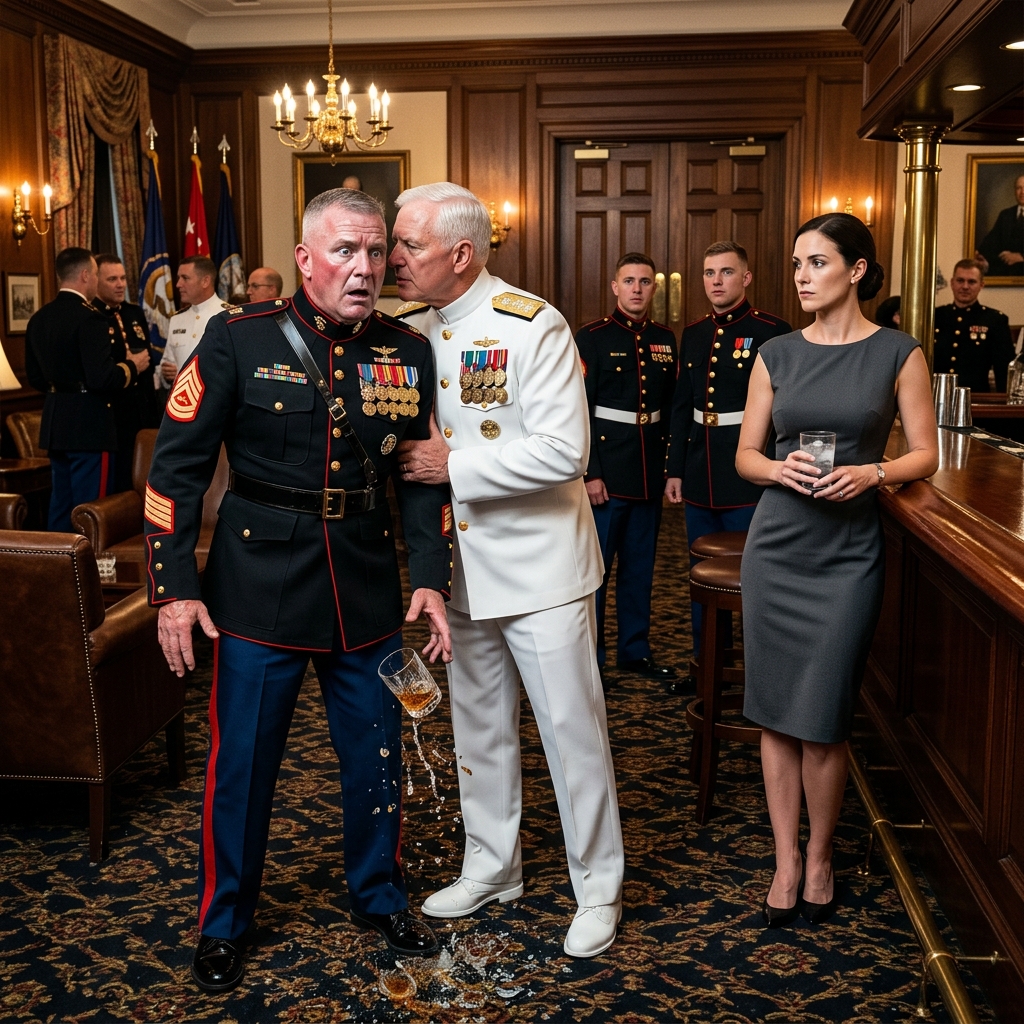
“She’s Not Aircrew. Look At Her,” The Colonel Waved His Glass At Me Across The Club. “Ladies Don’t Fly The Hard Stuff. They Fly Desks.” The Lieutenants At His Table Grinned. I Finished My Water And Stood To Go. Then His Admiral Crossed The Room, Leaned To The Colonel’s Ear, And The Colonel Went White. His Glass Hit The Floor.
### Part 1
The lieutenant asked me what I did, and I made the mistake of answering like an honest person.
We were standing at the far end of the bar inside the officer’s club, where the lights were too bright, the carpet smelled faintly of spilled beer and floor polish, and everyone laughed one second too late because rank was scattered through the room like loaded furniture.
The symposium reception had been going for almost an hour. Navy. Marines. A few Air Force exchange officers. Contractors in tailored suits who knew how to hover near admirals without looking like they were hovering.
I had come because my office expected me to come. I had stayed because leaving early would have raised more questions than staying quiet.
The young woman beside me introduced herself as Lieutenant Junior Grade Keira Lin, a surface warfare officer with a fresh haircut, nervous hands, and the open face of someone who had not yet learned how many rooms in the military were built to make her feel like a guest.
“What brought you here, ma’am?” she asked.
“Staff work, mostly.”
She nodded as if staff work sounded noble instead of slow death by calendar invite.
“What community are you from?”
I should have said operations. I should have said headquarters. I should have smiled and given one of the bland answers I had spent years perfecting.
Instead, because she had been kind, and because I was tired, and because sometimes the truth slips out of you before the old caution can catch it, I said, “I fly Hornets.”
Keira’s eyes brightened. “Super Hornets?”
“Once upon a time.”
I said it softly. I did not say anything about combat. I did not say anything about the ribbon hanging on the service dress uniform in my hotel closet, pressed and waiting for the next morning’s panels. I did not say anything about the night that still woke me with my hands clenched around invisible throttles.
I just told her the aircraft, the way a woman might tell someone the town where she grew up.
A few feet away, a Marine colonel turned his head.
I had noticed him the moment I walked in. You learn to locate the loudest man in any room. He was broad through the shoulders, heavy at the waist, with a sunburned face and the confident laziness of someone who had been applauded for too long. He held a glass of whiskey in one hand and a cluster of junior officers in the other.
Not literally. But close enough.
His name, I later learned, was Colonel Derek Marlowe.
At that moment, he was simply the man at the center of the laughter.
He looked me over once. Slowly.
I was wearing a charcoal dress. No uniform. No rank. No wings. No ribbons. No hint that I belonged anywhere near a cockpit, a carrier deck, or a conversation he considered his property.
“She’s not aircrew,” he said.
He did not say it to me. He said it to his little court, loud enough for me to hear and quiet enough to pretend he had not meant me to.
His captains grinned.
Marlowe lifted his glass toward me. “Look at her. Ladies don’t fly the hard stuff. They fly desks.”
The laughter came quickly.
A young Marine first lieutenant at his elbow leaned in and murmured, “Sir, maybe don’t.”
Marlowe waved him away without looking, the way a man waves away smoke.
Keira froze beside me. Her face changed from curious to ashamed, as if she had been the one who had invited the insult into the room.
I felt nothing at first.
That surprised me.
Then I felt the old thing open under my ribs. Not anger. Not exactly. Something deeper and more tired. The familiar humiliation of being measured incorrectly by a man who had never imagined the ruler might be broken.
I smiled at Keira.
“You’ll do fine,” I told her. “This room is less frightening than it looks.”
Her eyes flicked toward Marlowe. “Ma’am, I’m sorry.”
“Don’t be.”
I set my glass of water on the bar so carefully it made no sound.
Then I turned toward the door.
I had made a life out of leaving rooms quietly. It was my most practiced skill.
Three steps from the exit, a chair scraped hard behind me.
Not Marlowe’s chair.
A different one.
Popular Posts
→- 1
- 2
- 3
- 4




Recently Viewed
Stories you read recently will appear here.


