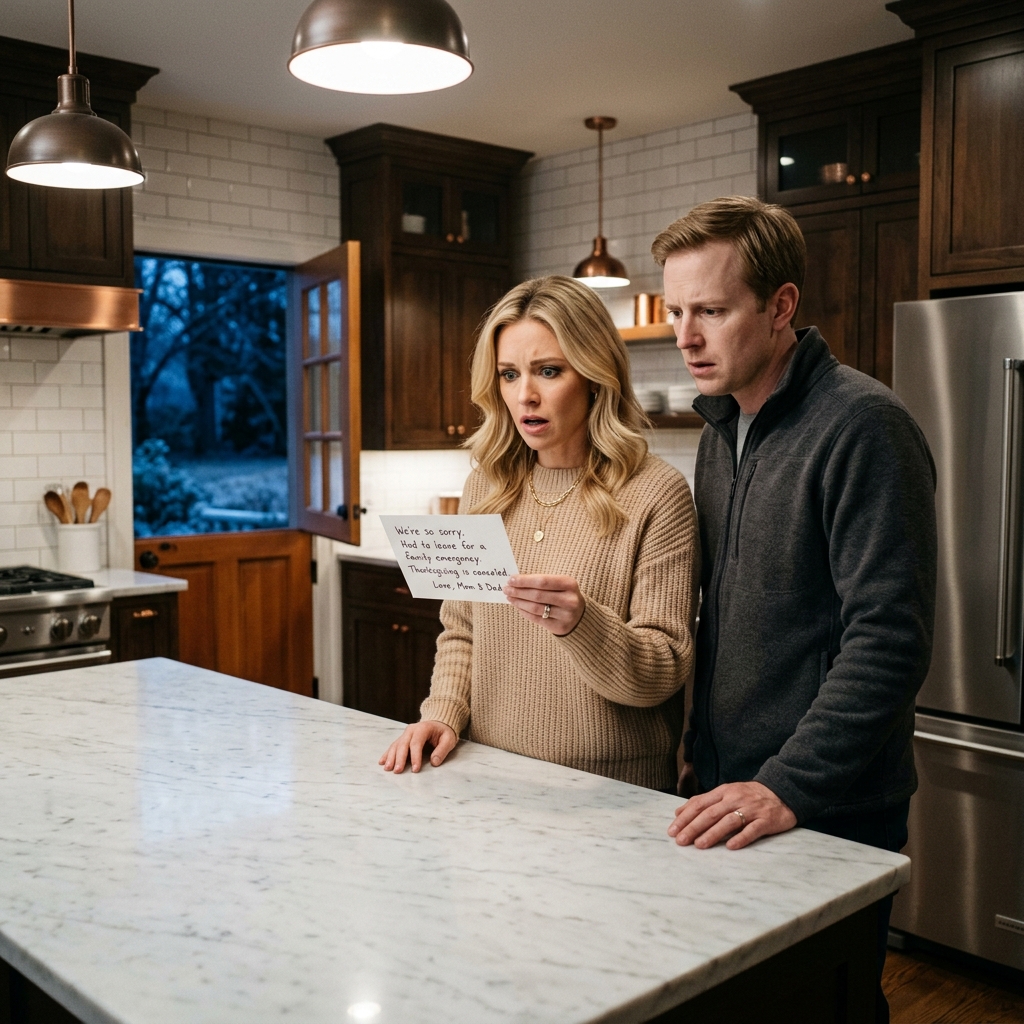
“26 people are coming. Be here at 5:00 a.m. The kitchen is yours,” my daughter-in-law texted my wife beneath a fourteen-dish Thanksgiving menu—as if Evelyn were hired help. She clearly said she couldn’t cook it alone. Even our son knew it was too much and still expected her to do it. I didn’t argue. I booked two flights to Florida. Thanksgiving morning, they entered our empty kitchen and found one note: “You both chose not to hear me. The kitchen is yours.”
### Part 1
My name is Martin Calder. I’m sixty-two years old, and before I retired, I spent thirty-five years supervising commercial construction projects across central Ohio.
I learned early that buildings tell the truth.
A wall may be painted beautifully, trimmed in expensive wood, and decorated with photographs, but none of that means it is carrying weight. Sometimes the plainest beam in the room is the only thing keeping the roof from collapsing.
Families are not so different.
Three weeks before Thanksgiving, my wife, Evelyn, walked into our living room holding her phone as though it had become unpleasant to touch.
The evening news murmured from the television. Rain ticked against the windows, and the house smelled faintly of the cinnamon candle Evelyn had lit after dinner.
She didn’t say anything. She simply handed me the phone.
The message was from our daughter-in-law, Vanessa.
Turkey, two birds, at least twenty-two pounds total.
Sausage stuffing from scratch.
Ten pounds of mashed potatoes.
Sweet potato casserole with pecan topping.
Green bean casserole.
Corn pudding.
Roasted Brussels sprouts.
Fresh cranberry sauce.
Turkey gravy.
Homemade dinner rolls.
Pumpkin pie.
Pecan pie.
Apple crisp.
Cheese board for guests upon arrival.
Beneath the list, Vanessa had added:
Twenty-six people confirmed. Please arrive by 5:00 a.m. I’ll leave the side door unlocked. The kitchen is yours.
I read the final sentence twice.
The kitchen is yours.
Not, Would you be willing to help?
Not, Could we divide the cooking?
Not even, Thank you.
It sounded like a supervisor assigning a subcontractor to a job site.
I looked up at Evelyn.
She stood beside the sofa with her arms folded over her cream-colored cardigan. Her face was calm, but I had been married to her for thirty-six years. I recognized the tightness around her mouth.
“Did she call before sending this?” I asked.
“No.”
“Did Colin?”
“No.”
Our son was thirty-five and worked as a structural engineer. As a boy, Colin had been thoughtful, cautious, and almost painfully fair. When two children fought over a toy, he was the one who suggested taking turns.
That was why his silence had become so difficult to understand.
Evelyn sat beside me. The cushion dipped under her weight.
“I told Vanessa it might be too much for one person,” she said.
“What did she say?”
Instead of answering, she opened the next message.
Oh, Mom, you’re amazing at this stuff. The rest of us would only get in your way. Besides, I’ll be busy decorating and getting ready.
I felt heat rise behind my ears.
Evelyn had taught elementary school for twenty-nine years. She remembered former students’ allergies, reading difficulties, siblings, and favorite books long after they had grown up. She was organized enough to run a classroom during a fire drill and kind enough to kneel beside a crying child without making that child feel embarrassed.
But kindness had become a currency everyone expected her to spend.
“I’ll call Colin,” I said.
Evelyn caught my wrist.
“Not yet.”
“Why not?”
“Because I want to give Vanessa one chance to hear me.”
She typed slowly.
I’m happy to contribute, but I cannot prepare fourteen dishes for twenty-six people by myself. Please divide the menu among the family, or let’s order some of it.
The reply appeared before Evelyn had time to set the phone down.
Don’t worry. You’ve handled big dinners before. It’ll be perfect.
Evelyn stared at those words. Then she turned the phone facedown on the coffee table.
Something changed in her expression—not anger, exactly, but recognition.
Vanessa had not misunderstood her.
She had heard Evelyn clearly and decided the answer did not matter.
“I suppose that’s my one chance,” Evelyn said.
Her voice was quiet, yet the room suddenly felt different, as though a crack had appeared inside a wall everyone else believed was solid.
Then she looked at me and said, “Martin, I think this Thanksgiving needs to happen without us.”
And for the first time in thirty-six years, my wife did not look guilty when she said it.
### Part 2
When Colin married Vanessa two years earlier, I believed she was simply direct.
She had a sharp voice, immaculate clothes, and a habit of making decisions before anyone else realized a discussion had begun. At first, I mistook that certainty for confidence.
The wedding took place in their backyard beneath strings of white lights. Evelyn spent two evenings sewing hems on table runners Vanessa had ordered in the wrong size.
Vanessa thanked her by saying, “You saved me so much money.”
Not, They’re beautiful.
Not, I appreciate you.
Only money.
I noticed. Evelyn told me not to make too much of it.
The requests began small enough to dismiss.
A birthday dinner for twelve people, mentioned four days in advance.
Popular Posts
→- 1
- 2
- 3
- 4




Recently Viewed
Stories you read recently will appear here.


