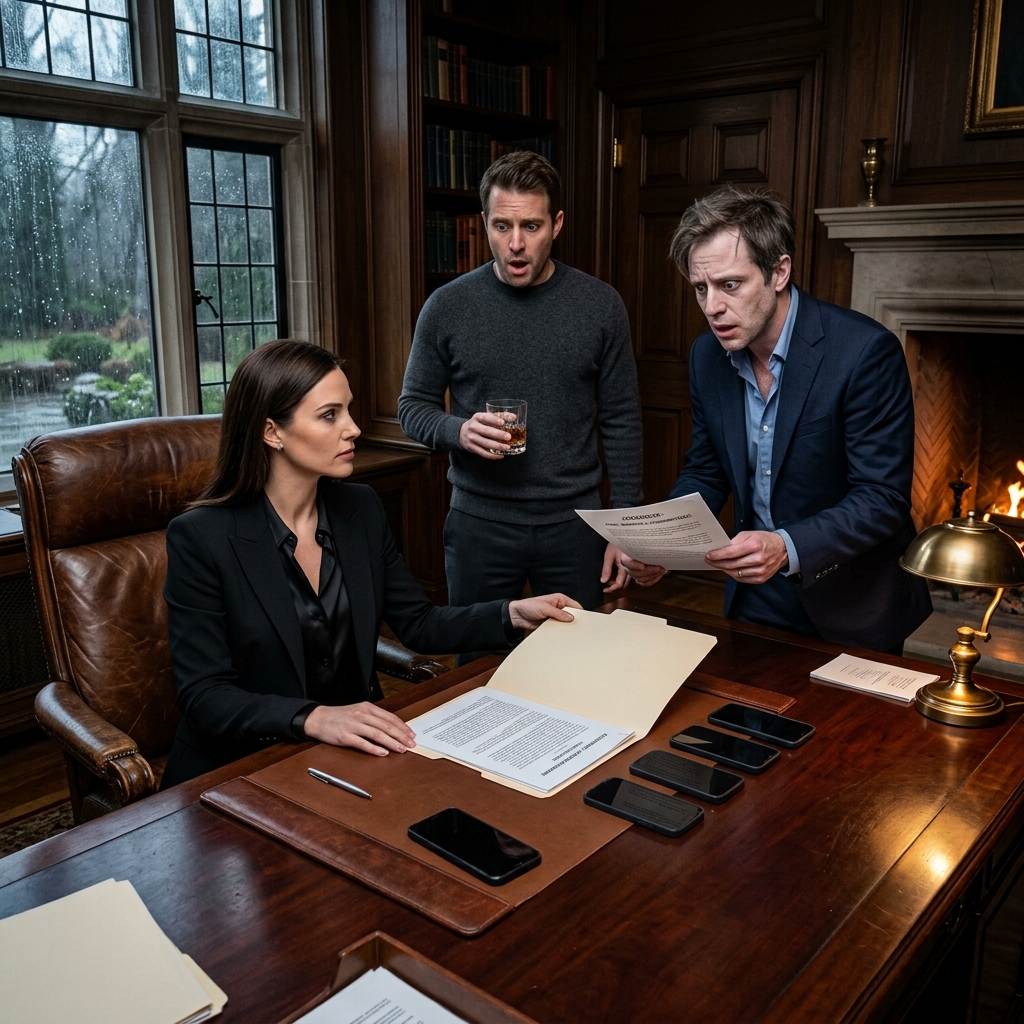
They Met To Divide My Inheritance—Then Found Out I Already Owned Everything
“Sorry, sis, but the estate is ours now,” my brothers said while casually dividing Dad’s houses, marina, and company before the paperwork was even opened. I let them finish. Then I slid one folder across Dad’s desk. “Actually, Dad sold everything to my firm years ago.” Their smiles vanished as the acquisition papers proved I already controlled the company and every major property. Then Grant reached the final page—and went white. Dad had left one last warning: “ONE OF YOU BETRAYED ME.”
### Part 1
The rain started before dawn and showed no sign of stopping.
By three in the afternoon, water streamed down the tall windows of Whitmore Hall, turning the gardens outside into blurred smears of green and gray. The old house smelled exactly as it had when I was a child—beeswax, cold stone, damp wool, and the faint trace of my father’s pipe tobacco trapped in the curtains.
My brothers were already dividing his life.
“The Nantucket house makes sense for me,” Grant said, standing beside the fireplace with one hand in his pocket. “Lauren and the kids use it every summer.”
He said it as if the deed were already folded inside his jacket.
Across the study, Owen poured himself another two fingers of Dad’s bourbon.
“You use it for three weeks,” he said. “I’m the one who pays the marina fees.”
“You submit those fees to the company.”
“Because Dad told me to.”
Grant laughed through his nose. “Dad told you a lot of things when you cornered him after dinner.”
I sat in my father’s leather chair and ran my thumb over a split in the armrest. I remembered making that split with the buckle of my shoe when I was nine. Dad had looked furious until I burst into tears. Then he had sighed, crouched beside me, and said, “Furniture can be repaired, Claire. Dishonesty is harder.”
Neither of my brothers had asked where I wanted to sit.
Neither had asked what I wanted from the estate.
At thirty-one, I was still the youngest in their eyes. The impulsive daughter who had left Massachusetts after college, disappeared into consulting work, and started a small investment company nobody in the family understood.
Grant had called it my “little finance experiment.”
Owen had once asked whether I made money by posting advice online.
Now Grant glanced at me as if he had just remembered I was in the room.
“You’ll probably want the cabin in Vermont,” he said. “It’s quiet. Artistic. More your speed.”
“I’m not an artist.”
“You know what I mean.”
I did.
Small. Decorative. Unimportant.
The study door opened, and Mrs. Bell, Dad’s longtime house manager, entered carrying a silver tray. The cups rattled slightly against the saucers.
“Ms. Mercer has arrived,” she said.
Grant checked his watch. “Finally.”
Dana Mercer had been my father’s attorney for twenty-six years. She walked in wearing a charcoal coat dotted with rain, carrying a black leather case that seemed too heavy for her narrow arm. Her silver hair was pinned tightly at the back of her head.
She did not offer condolences. We had already endured those at the funeral.
Instead, she closed the door and looked at each of us in turn.
“Before we begin,” she said, “I need your phones placed on the desk.”
Grant frowned. “Why?”
“Your father’s instructions.”
Owen shrugged and tossed his phone down. Grant hesitated before doing the same.
I placed mine beside theirs.
Dana opened her case and removed three identical envelopes, a laptop, and a brass key attached to a faded blue ribbon.
My breath caught when I saw the ribbon.
Dad had tied that same strip of blue silk around my wrist the night he first took me into the sealed records room beneath Whitmore Industries.
Count the doors, he had whispered.
I had never understood why he said it.
Dana inserted the brass key into a hidden panel beneath one of the bookshelves. A section of dark wood clicked open, revealing a small steel box built into the wall.
Grant stared.
“I’ve been in this room my entire life,” he said. “That wasn’t there.”
“It was,” Dana replied. “You simply never looked.”
She removed a sealed inventory from the box and set it in front of us.
Grant reached for it.
Dana placed her hand over the document.
“This is not a conventional will reading,” she said. “Your father did not leave his estate to be divided according to assumption, seniority, or family tradition.”
Owen lowered his glass.
“What does that mean?”
Dana opened the inventory.
Her expression did not change, but her next words made the room feel suddenly colder.
“It means there is almost nothing in Richard Whitmore’s estate.”
Grant’s smile disappeared.
Popular Posts
→- 1
- 2
- 3
- 4




Recently Viewed
Stories you read recently will appear here.


