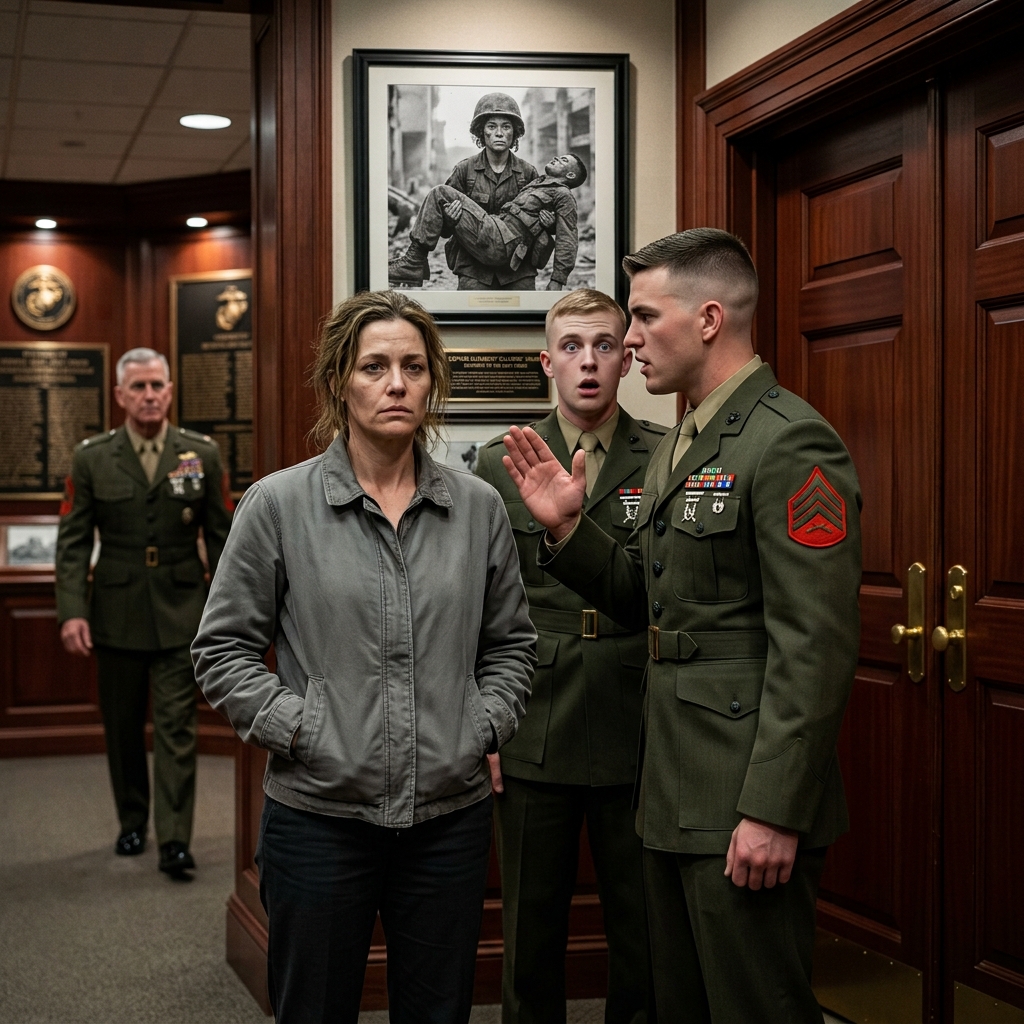
A young sergeant blocked me inside a Marine memorial hall and said, loud enough for everyone to hear, “This hall is for Marines who earned it. You didn’t.” I kept my ID in my pocket. Behind him, a lance corporal stared from my face to the photograph on the wall—and stopped moving.
The hall was empty when I finally got to stand in front of the glass.
It was a little before six the next morning. The overhead lights were still on their low overnight setting, soft enough that the room felt less like a museum than a chapel before anyone had arrived to pray.
My shoes were the only sound.
I walked past the flags, the shadow boxes, the carefully preserved photographs and old unit citations whose paper had faded slightly at the edges. I passed display cases that had been dusted so thoroughly the glass almost disappeared.
Then I stopped where I had wanted to stop from the beginning.
Two names were etched into a brass plate beneath a photograph I had spent fifteen years trying not to look at for too long.
I put my palm against the glass.
It was cold.
For a while, I said nothing.
There was nothing I could say to those two men that I had not already said at three in the morning, in motel rooms, military housing, apartments, offices, and every other place where the rest of the world was sleeping and I was not.
I had driven roughly four hundred miles to have that minute.
Depending on how you count it, I had also traveled fifteen years.
What I had not expected was that I would have to earn the room first.
That part happened the afternoon before.
And to understand it, you have to understand why I was there at all.
My name is Ellaner Prescott. Most people call me Nell.
I am a major in the United States Marine Corps.
I joined when I was twenty-two, which means I have now been a Marine longer than I was almost anything else before it.
I grew up in an Ohio river town in a family with no military tradition. I worked behind the counter of an auto parts store, took community college classes at night, and eventually walked into a recruiting office in a tired strip mall because something in me had decided I needed a harder life than the one I was drifting toward.
Nobody pushed me into it.
I raised my own hand.
I took my own oath.
The Corps gave me many things after that—some useful, some painful, some permanent—but the most important lesson came early.
The surface of a person tells you something.
It rarely tells you enough.
That Tuesday afternoon, I was passing through on the way to a new assignment several states away.
I had been driving since before sunrise.
The road took me close to a base I had avoided for years.
I knew what was there.
A memorial hall.
Inside it, a wall.
On that wall, a photograph.
Under the photograph, two names.
Lance Corporal Daniel Cutler.
Corporal Wyatt Sable.
Both had been Marines in my platoon.
Both had died because of a day in 2011 that never really stopped happening for the people who survived it.
I had known the memorial existed.
Knowing something exists and standing in front of it are not the same thing.
For almost fifteen years, I lived comfortably in the distance between those two facts.
I told myself I was busy.
Sometimes I really was.
There were schools, assignments, deployments, evaluations, commands, staff work, boards, relocations, new responsibilities and all the ordinary machinery of a military career.
But none of that explained fifteen years.
The simpler answer was that I was afraid.
Not of a building.
Not of a wall.
Of standing still in daylight with nowhere else to be and nothing to do except feel what I had spent years learning how to carry.
I pulled into the parking lot anyway.
Then I sat in the rental car with the engine running for eleven minutes.
The air conditioner worked hard against the afternoon heat.
A paper coffee cup sat in the console, cooling by the minute.
In my jacket pocket was a folded piece of paper.
Two names were written on it.
I did not need the paper.
I knew those names the way you know your own address.
Still, I had carried that slip of paper through moves, commands, hotel rooms, apartments and countless uniform pockets.
The folds had become soft with use.
One corner was nearly worn through.
I told myself I did not have time to stop.
Traffic would get worse.
I needed to make miles before dark.
I could come back another year.
I could visit on a quieter day.
They were all reasonable arguments.
They were also lies.
Eventually, I turned off the engine.
Heat entered the car at once.
I took the folded paper, left the cold coffee behind, and got out.
That small action has repeated itself throughout my life.
Popular Posts
→- 1
- 2
- 3
- 4




Recently Viewed
Stories you read recently will appear here.


