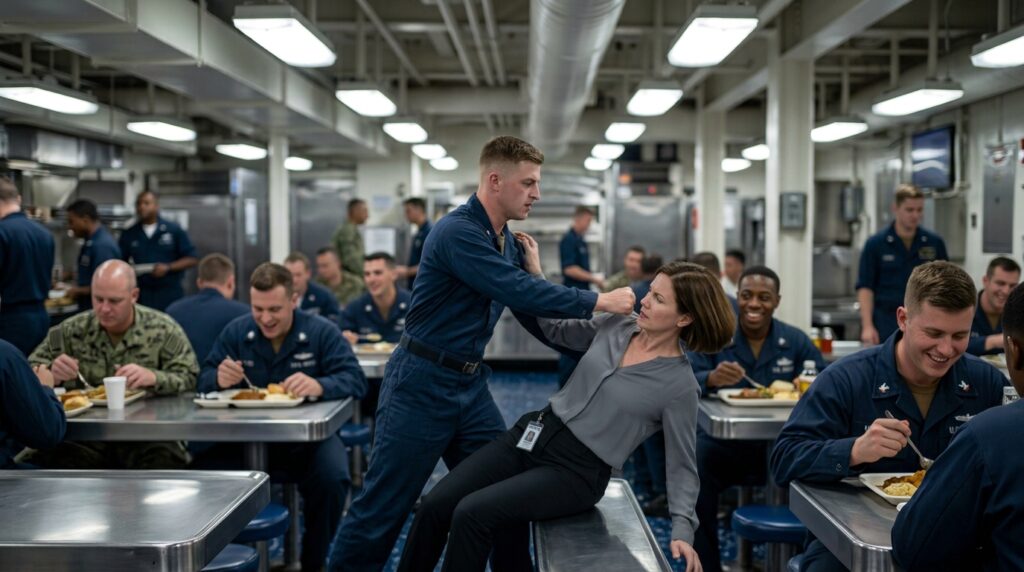
The Mess Was Packed. I Took The Last Seat At The End Of A Bench. A Petty Officer Decided It Was His. “Up. This Section’s Spoken For.” He Put A Hand On My Shoulder And Shoved Me Off Onto The Deck, And A Dozen Tables Laughed. Then A Master Chief Turned, Saw Me, And Set His Tray Down. “You Have No Idea Who You Just Put On The Deck.”
A young petty officer looked at my civilian clothes, my temporary visitor badge, and decided I was nobody worth respecting. Seconds later, he shoved me off a mess-hall bench while half the compartment laughed. I could have ended his career with one sentence, but I stayed quiet. What he didn’t know was that I knew those deck plates better than he did—and when an old Master Chief saw my face beneath a photograph mounted on the bulkhead, the laughter died one table at a time.
### Part 1
The mess deck was packed when I found the last open seat.
Forks hit plates. Coffee machines hissed behind the serving line. Somewhere near the scullery, somebody dropped a metal pan and shouted something that disappeared beneath a hundred conversations.
It smelled like burnt coffee, industrial cleaner, hot bread, and the particular mix of steel and machinery that every Navy ship carries no matter how much fresh paint gets rolled over the bulkheads.
I slid onto the end of a bench with my tray.
I had been aboard since before sunrise, walking passageways in civilian clothes with a temporary visitor badge clipped to my jacket. Dark pants. Gray blouse. Flat shoes. Nothing about me said officer.
That was intentional.
I had barely picked up my fork when a shadow stopped beside me.
“You’re in my spot.”
I looked up.
The sailor standing over me was broad through the shoulders, maybe twenty-four, with the confidence of a man who had recently discovered that other people sometimes moved when he told them to.
His name, I would learn, was Petty Officer Second Class Jordan Keene.
Three younger sailors stood behind him carrying trays.
I glanced at the empty inches of bench beside me.
“There’s room.”
Keene laughed.
“This section’s spoken for.”
He pointed toward another table without actually looking at it.
“Visitors eat over there.”
“I’m fine here.”
That should have ended it.
Instead, something changed in his expression.
Maybe he thought I had embarrassed him in front of his friends. Maybe the three sailors behind him made it harder for him to let a small thing go.
There is a certain kind of bad decision people make only because an audience is watching.
Keene leaned closer.
“I said move.”
“I heard you.”
One of the sailors behind him chuckled.
That was permission.
The others smiled.
Keene put his palm flat on my shoulder.
For half a second, I assumed he was simply going to emphasize the order.
Then he shoved.
The end of the bench disappeared beneath me.
My tray tipped.
A cup bounced once.
My hip hit the nonskid deck hard enough to send a dull shock through my leg.
And the mess deck erupted.
Not everyone laughed.
But enough did.
A dozen tables, maybe more.
It was the ugly kind of laughter that spreads because nobody wants to be the first person who refuses to join.
Keene grinned down at me.
“Problem solved.”
I stayed on one knee for a second.
Not because I was hurt.
Because the deck felt familiar.
The rough nonskid pressed against my palm.
Seventeen years vanished.
For one breath I smelled smoke that wasn’t there.
I heard a low-pressure alarm screaming inside a breathing mask.
I saw orange light moving behind black smoke.
Then the mess deck came back.
White overhead lights.
Stainless steel tables.
Hot food.
Laughter.
I got up the way I had gotten up from much worse things.
One knee.
Then the other.
Slowly.
Steadily.
I placed my tray back on the table and straightened it.
A crooked tray bothers me.
Keene was still talking.
“Berthing tours are on the pier. You’re lucky you even got down here.”
“I know where I am.”
He laughed again.
“Sure you do.”
I did know.
Better than he could imagine.
Directly behind me, bolted to the bulkhead under a narrow white light, hung a framed photograph.
I did not turn around.
I didn’t need to.
I knew every face in it.
Six sailors.
Gray morning.
Soot-streaked uniforms.
Four survivors.
Two men who never answered muster again.
I had spent seventeen years learning how not to turn around whenever I walked beneath that photograph.
Across the compartment, a culinary specialist first class named Marcus Reed was watching me from behind the serving line.
I had noticed him earlier.
Good first classes notice things.
Popular Posts
→- 1
- 2
- 3
- 4




Recently Viewed
Stories you read recently will appear here.


