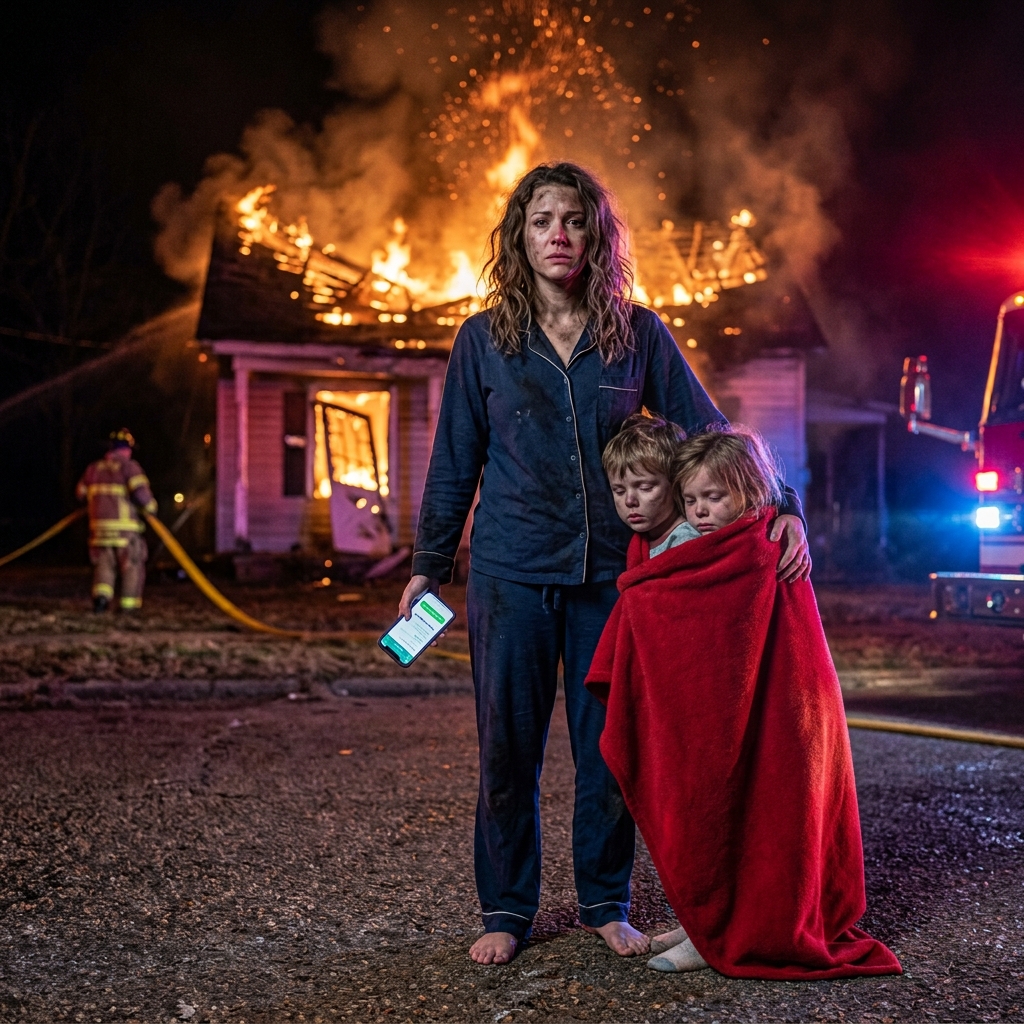
“Your sister never has these crises—she planned properly,” my mother snapped while refusing to open one of her three empty guest rooms after my house burned down. I stood barefoot in the freezing street, smoke clinging to my pajamas as my four-year-old twins shivered beneath one blanket. So I silently canceled the $3,600 I’d sent my parents every month for eleven years. Before sunrise, Grandma arrived at our motel carrying quilts and a locked steel box. Mom thought she’d denied us shelter. Instead, she had just exposed everything.
### Part 1
My name is Nora Whitaker, and I learned what my family truly thought of me while standing barefoot on freezing asphalt at two seventeen in the morning, watching the roof of my house collapse.
The sound was not dramatic like it is in movies. There was no single thunderous crash. First came a long wooden groan, almost human, followed by a series of sharp snaps. Then the center of the roof folded inward, sending orange sparks spinning into the Mississippi night.
A firefighter pushed me farther behind the yellow hose line.
“Ma’am, you need to stay back.”
I barely heard him.
My four-year-old twins, Ethan and Emma, were wrapped together in a neighbor’s red fleece blanket. Their pajama sleeves were streaked with soot. Emma had lost one slipper. Ethan kept asking whether his stuffed dinosaur was still inside.
I worked as a property insurance claims adjuster. I had spent twelve years walking through burned kitchens, flooded bedrooms, and tornado-flattened neighborhoods. I knew how to recognize a total loss.
That night, I watched one happen to me.
The fire marshal needed answers. The insurance company needed photographs. The firefighters needed me available while they determined whether the electrical fire had spread to the neighboring property.
But my children needed a safe bed.
My parents lived twenty minutes away in a five-bedroom house with three unused guest rooms. My mother often bragged that the upstairs wing was “practically its own apartment.” She hosted garden clubs, church committees, and holiday luncheons there.
I called her.
She answered on the fourth ring.
“Nora?” Her voice was thick with sleep. “Do you know what time it is?”
“Our house is on fire.”
There was a pause.
Behind me, a window shattered from the heat.
“What do you mean, on fire?”
“I mean the kitchen is gone. The roof just came down. Ethan and Emma are outside with me. I need to bring them to your house for a few hours.”
My mother sighed.
It was not a frightened sigh. It was the irritated breath she used when a waiter brought her lemon instead of lime.
“Oh, Nora.”
I gripped the phone harder.
“I need somewhere safe for them while I talk to the fire marshal.”
“You can’t bring them here tonight.”
For a moment, I thought I had misheard her over the engines.
“What?”
“I’m hosting the Magnolia Garden Circle tomorrow. The guest rooms are full of floral arrangements, linens, and serving trays. I’ve been preparing for three days.”
“They can sleep on the couch.”
“They’re upset. They’ll cry. Your father needs his rest.”
Emma pressed her face into my hip. I could feel her shaking through the blanket.
“Mom, they just watched their house burn.”
“And I’m sorry,” she said, in the careful tone of someone attempting to sound reasonable. “But you always expect us to rearrange everything whenever something goes wrong.”
I stared at the flames pushing through what had been my bedroom wall.
“Whenever something goes wrong?”
“Your sister never has these crises, Nora. Camille planned properly. She bought a new home in Madison with modern wiring and fire-resistant materials.”
The words landed with more force than the collapsing roof.
My younger sister’s perfect home. Her white SUV. Her vaulted ceilings. Her country club brunches.
My mother was comparing an electrical fire to poor character.
“I understand,” I said.
Relief entered her voice immediately.
“I knew you would. Try a hotel near the interstate. We’ll talk after my luncheon.”
She hung up.
I lowered the phone and looked at my children.
For eleven years, I had transferred $3,600 into my parents’ account every month. My father supposedly needed help keeping his hardware store alive. My mother supposedly faced crushing medical expenses. I worked sixty-hour weeks, bought clearance shoes for my twins, and delayed replacing my aging car because family took care of family.
At least, that was what they had taught me.
Red emergency lights swept across my banking screen as I opened the recurring-payment menu. My thumb hovered over the transfer labeled FAMILY SUPPORT.
The next payment was scheduled to leave my account in less than forty-eight hours.
I pressed Cancel.
A green confirmation symbol appeared.
The money stopped.
Popular Posts
→- 1
- 2
- 3
- 4




Recently Viewed
Stories you read recently will appear here.


