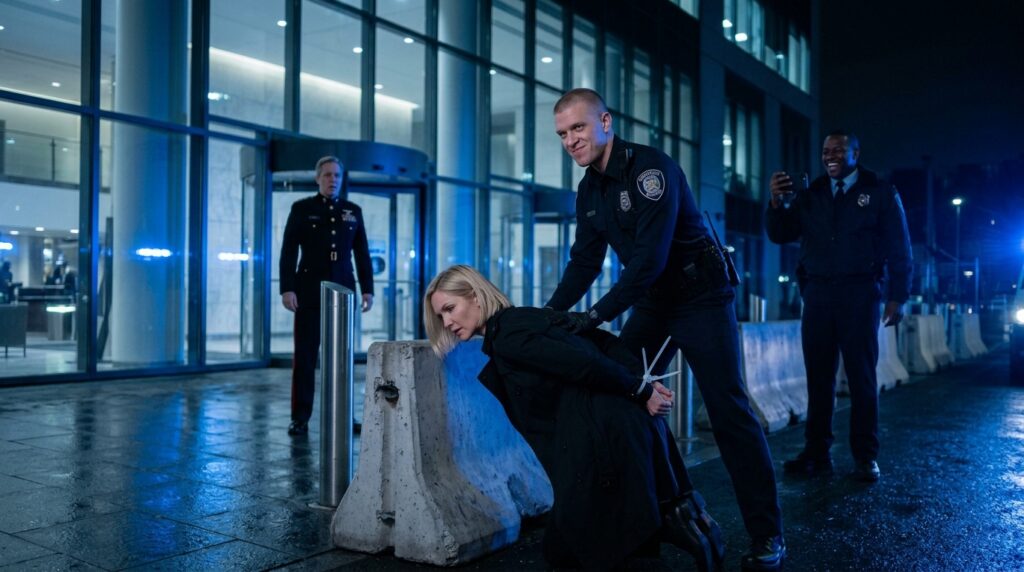
Two Sentries Zip-Tied Me Outside The Command Post—They Thought No One Saw
“She’s Not On Any List. Cuff Her.” They Forced Me Onto The Curb Outside Headquarters And Zip-Tied My Wrists While A Sergeant Filmed, Laughing. I Didn’t Raise My Voice. “Check The Log Again, Corporal.” The Duty Officer Pushed Through The Doors, Saw My Face, And Went White. They Couldn’t Untie Me Any Quicker.
I walked onto an Army installation dressed like an ordinary civilian and asked two sentries to perform the simplest procedure in their own rulebook. Minutes later, I was sitting on a concrete curb with my wrists cinched behind me while one soldier filmed and laughed. They thought I was nobody important. They thought nobody who mattered was watching. What they did not know was why I had come, what was hidden inside my jacket, or who was about to walk through those glass doors.
### Part 1
My name is Evelyn Hart. I was forty-four years old that summer, and I had spent twenty-two years in the United States Army learning that the most dangerous place on a military installation was often the place everyone had grown bored with. People imagine danger arriving with alarms, shouting, and flashing lights, but most disasters begin quietly, after enough ordinary mornings convince good people that nothing bad will happen on this one. That was why I had always paid attention to gates.
My first platoon sergeant taught me that lesson when I was twenty-three and terrified of letting anyone know how little I understood. Sergeant First Class Daniel Mercer watched me trying to memorize an entry-control binder before dawn, took it out of my hands, and told me the binder was not the job. “The job is deciding who crosses the line,” he said. “You do it with courtesy in one hand and suspicion in the other, and you never drop either one.”
I did not understand the elegance of that sentence until years later. A gate at dawn has its own language: diesel hanging in cold air, tires grinding over damp pavement, floodlights fading while the eastern sky turns pale, tired faces appearing behind windshields one after another. Most people approaching you are exactly who they claim to be, which is why treating every one of them like an enemy is not toughness; it is laziness wearing an angry face.
By 2012, I was commanding a protection element at an overseas operating site where the gate was tested in a way I still do not enjoy describing. For several terrible minutes, discipline mattered more than courage because courage without discipline only creates louder mistakes. The clearest voice I heard that day belonged not to a senior officer but to a nineteen-year-old private named Maya Serrano, who kept reporting what she saw with such calm precision that everyone around her began matching her breathing without realizing it.
Years passed. I became a major, then a lieutenant colonel, commanded military police units, and eventually transferred into inspector general work, a job I had once thought sounded painfully administrative. I learned quickly that an inspector general’s real task was not catching villains; it was identifying the quiet distance between what an organization claimed to be doing and what people actually did when they believed nobody important was watching.
That distance had begun appearing in reports from Fort Calder. Access checks recorded in impossibly identical time blocks. Visitor complaints dismissed with suspiciously similar explanations. An authorization roster that had not been reconciled correctly for months, followed by a near miss involving a vehicle that traveled far beyond the point where it should have been challenged.
Nothing alone justified panic. Together, the details bothered me enough that I read the reports twice, then a third time with a legal pad beside me. The problem was not simply carelessness; there was an attitude buried inside the statements, a swagger suggesting some guards had begun treating humiliation as evidence of control.
So I decided to inspect the installation without warning anyone.
I wore gray slacks, comfortable shoes, and a plain navy jacket over a white shirt. My military identification and credentials remained inside an interior pocket, and the rental sedan I drove had nothing about it that would attract a second glance. I wanted Fort Calder to meet me exactly as it met a civilian who possessed no rank worth impressing.
The main vehicle gate began answering my questions almost immediately. A delivery truck rolled through after a guard barely glanced at the driver’s paperwork, yet two vehicles later a nervous woman in a minivan was made to sit through an unnecessarily hostile exchange while her toddler waited in the rear seat. The inconsistency mattered more than either incident because a checkpoint that is strict according to mood and careless according to mood is not secure; it is unpredictable.
Popular Posts
→- 1
- 2
- 3
- 4




Recently Viewed
Stories you read recently will appear here.


