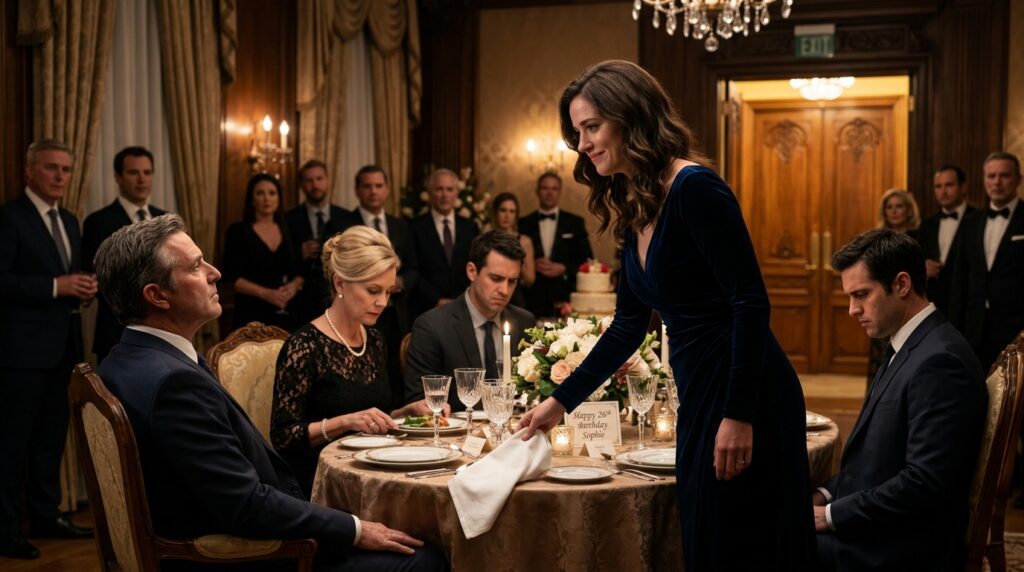
At his birthday dinner, dad announced, “sometimes i wish you’d never been born.” the whole table froze. i smiled calmly. “then consider that wish granted. from now on, pretend i never existed.” i walked out without looking back. three days later, dad called from an unknown number and his voice was shaking.
My name is Sophie Grant. I was twenty-six when my father told me, in front of a table full of people, that sometimes he wished I had never been born.
It happened at his birthday dinner in New York, in a private dining room he had chosen because the restaurant was quiet enough for conversation and expensive enough to impress the people he wanted to impress.
There were relatives there, but family wasn’t really the center of the evening. Dad had invited colleagues, business partners, old friends from professional associations, and people connected to a community investment initiative he had been developing. He spent most of dinner moving easily from one conversation to another, accepting congratulations, telling stories, making introductions.
He was good at rooms like that.
My older brother, Ethan, was sitting two seats away from him. At one point Dad raised his glass and spent several minutes talking about Ethan’s latest accomplishment. Nobody minded. Ethan was doing well, and I was used to Dad being proud of him loudly.
Then Martin, one of Dad’s longtime professional contacts, turned toward me.
“Sophie, your father mentioned you’re working on some kind of sustainability platform.”
I nodded. “We’re developing a way to compare fashion brands using verified sourcing, material standards, repairability, and transparency instead of just marketing claims.”
Martin looked interested. “That sounds close to what you were describing earlier, doesn’t it?”
He looked at Dad.
Dad laughed.
“Well, we’ve all been kicking ideas around. It’s become a bit of a family effort.”
His hand moved casually toward Ethan.
“Ethan’s medical background gives us another perspective too.”
I looked at my brother.
Ethan didn’t say anything.
Then I looked at Dad.
“Actually, I developed the original research and strategy.”
Dad’s smile stayed in place for about half a second too long.
“Sophie.”
“You were talking about my work.”
A few people lowered their eyes.
Dad set down his glass.
“Do you always have to make everything about you?”
I remember how strange that accusation felt.
He had just been talking about something I had created.
“I don’t think asking you to describe it accurately is making it about me.”
That was when his face changed.
He leaned back in his chair and stared at me.
“Sometimes I wish you’d never been born.”
Nobody laughed.
Nobody moved.
Even the servers seemed to disappear.
For several seconds, I heard only the low music from the restaurant outside the room and the faint clink of silverware from another table.
Mom stared at her plate.
Ethan looked at Dad, then at me.
Dad looked almost satisfied, as if he had finally found a sentence sharp enough to put me back where he wanted me.
I should have been devastated.
Instead, I became very calm.
Maybe the pain was too familiar to arrive all at once.
I smiled.
“Then consider that wish granted. From now on, pretend I never existed.”
I placed my napkin beside my plate, picked up my coat, and walked out.
Nobody stopped me.
The first thing I did outside the restaurant wasn’t cry.
I checked my phone.
There were already eleven messages in the family group chat.
Mom had written, Please come back before you make this worse.
Ethan followed with, Dad shouldn’t have said that, but you know how he gets when he’s embarrassed.
That sentence stopped me on the sidewalk.
When he’s embarrassed.
Dad’s embarrassment had always been treated like weather. Something unavoidable. Something the rest of us had to prepare for, accommodate, and clean up afterward.
Another message appeared from Mom.
Your father is devastated. Don’t throw away your family over one sentence.
One sentence.
I kept walking.
The birthday dinner hadn’t gone wrong because of one sentence.
It had gone wrong because, earlier that evening, I had recognized my own work coming out of my father’s mouth.
Months before, Dad had asked me to explain the sustainability platform my team and I were developing. He was organizing a community investment initiative through one of his professional associations and said he wanted to understand how younger consumers were thinking about transparency and responsible business practices.
Some foolish part of me had been thrilled that he was interested.
I sent him an early overview.
His response had been one word.
Interesting.
Two weeks later, he asked for several slides so he could understand the scoring model better.
I sent those too.
I assumed I was helping my father understand my work.
I never imagined he would reuse my language in his own presentation.
At dinner, before Martin asked me about the project, Dad had been describing his initiative to several people across the table. The phrasing had sounded familiar. Then he repeated one of my explanations about converting vague sustainability claims into measurable comparisons.
Almost word for word.
Popular Posts
→- 1
- 2
- 3
- 4




Recently Viewed
Stories you read recently will appear here.


