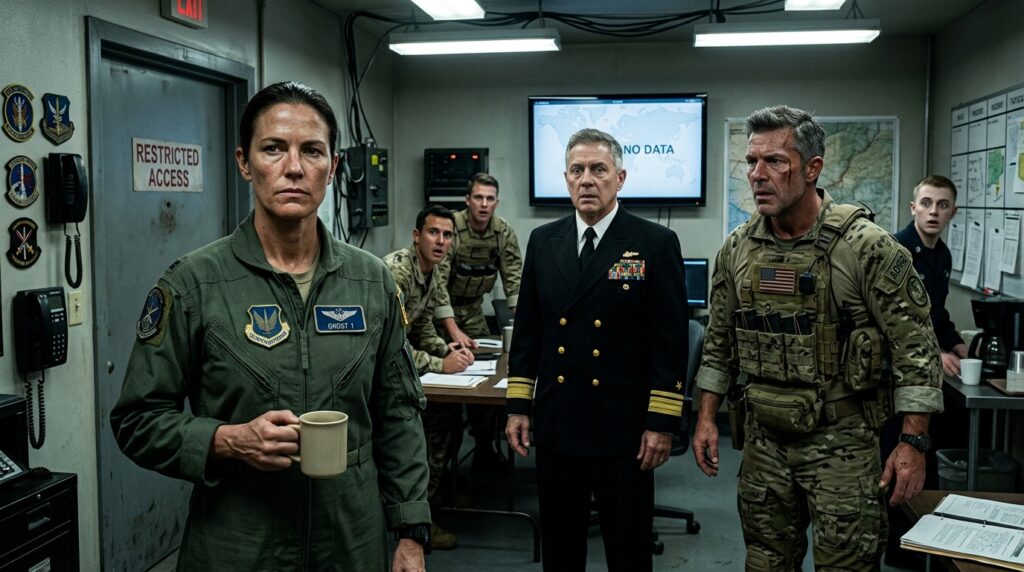
“Boys, We’ve Got A Visitor Who Thinks She Belongs In Here,” The Admiral Said, And The Team Room Laughed. “Go Easy. What’s Your Call Sign, Sweetheart?” He Said It Like The Joke Was Already Over. “Ghost One,” I Said. The Room Changed In A Single Beat. Two Operators Rose To Their Feet. The Admiral’s Smile Vanished Instantly.
### Part 1
The coffee in my hand had gone lukewarm before Rear Admiral Victor Sloane decided I was the funniest thing in the team room.
I arrived at 0915 on the fourth morning of my inbrief week because the schedule said the incoming aviation detachment commander was expected at the operations update, and after twenty years in uniform, I still considered arriving late a form of theft. Other people had set aside time for me. I did not waste it.
The room smelled of burnt coffee, gun oil, damp canvas, and the sharp floor wax used in buildings where men worked through the night and slept after sunrise. Fluorescent lights hummed overhead. A television on the far wall displayed a blank tactical map, waiting for the classified briefing to begin.
Seven operators stood or leaned along the walls. Most were younger than I was. Two had gray beginning at their temples. Their uniforms were worn in the places that mattered—knees, elbows, shoulder straps—not decorated to look worn.
Admiral Sloane stood near the center, finishing a story.
He carried the relaxed weight of a flag officer who had spent years entering rooms already owned by his rank. The operators laughed at the right moments. Sloane liked them, and they respected him. I could tell that much before the door had closed behind me.
Then he looked at me.
I knew the change immediately.
A woman in my profession develops an instinct for the second a room assigns her a role she did not ask for. The eyes move first. The shoulders follow. Suddenly, you are somebody’s assistant, somebody’s wife, a civilian visitor, or a confused staff officer who wandered through the wrong door.
I wore a flight suit with subdued lieutenant colonel rank, but Sloane glanced past the insignia as if it were part of the fabric.
I had been misread in worse rooms by more dangerous men. Usually, I let it happen. Correcting every assumption costs more energy than it returns, and I preferred spending mine on aircraft, crews, and missions.
That morning, however, Sloane wanted an audience.
He looked from me to the operators, and I saw the joke forming before he opened his mouth.
“Gentlemen, it appears we have a visitor who thinks she belongs in here.”
Several operators glanced at one another. The older men did not smile, but one of the younger petty officers gave a nervous chuckle.
Sloane turned fully toward me.
“Easy, sweetheart. Before you wander any farther, why don’t you tell the boys your call sign?”
He said “call sign” as though he were asking a child to perform a trick at a family dinner.
A young petty officer beside the coffee station laughed first. It was a short, eager sound—the kind people make when they are trying to prove they understand a powerful man’s humor.
Two others smiled.
My left leg began to ache beneath the flight suit. It always did when the air-conditioning ran too cold.
I did not shift my weight.
I did not smile.
I let the silence settle long enough for Sloane to realize I was not going to help him finish the joke.
Then I gave him the only honest answer.
“Ghost One.”
I said it in the same level tone I used over a radio.
The laugh Sloane had prepared never came.
For one second, nothing happened.
Then a chair scraped across the floor behind him.
A second chair moved.
The young petty officer near the coffee station stopped smiling so quickly that his face seemed to collapse.
Against the far wall stood a broad-shouldered senior chief with gray threaded through his dark hair. I had noticed him when I entered, but I had not recognized him. Eleven years can redraw a man’s face. It adds weight around the eyes and takes softness from the mouth.
His name tape read ROURKE.
The moment he heard my call sign, his hands dropped from where they had been folded across his chest.
He stared at me.
Not at my rank.
Not at my flight suit.
At my face.
I watched him searching through eleven years of memory, trying to make the woman in front of him fit a fact he had believed impossible.
One operator stood.
Then another.
They rose without being ordered, one man at a time, their expressions changing from amusement to confusion and then to something much heavier.
Popular Posts
→- 1
- 2
- 3
- 4




Recently Viewed
Stories you read recently will appear here.


