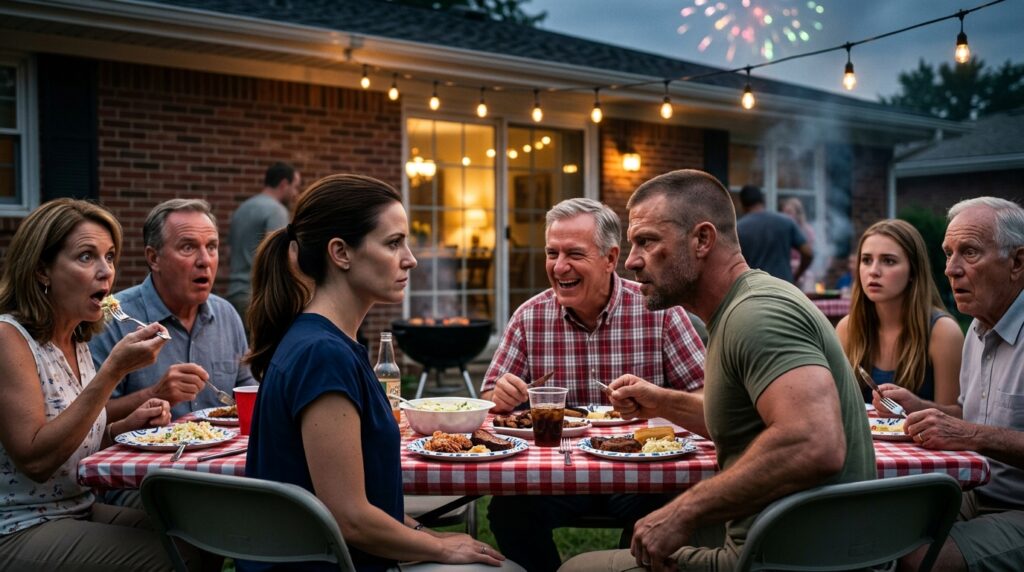
At 4th Of July Cookout, 30 Relatives Watched. “Couldn’t Hack Week One Of Basic,” My Uncle Announced. “They Sent Her Home.” I Kept My Voice Level. “That’s Not What Happened, Ray.” His Guest, Special Forces, Leaned Forward. Forks Stopped. “Sir, Do You Know Who This Is?” My Uncle Grinned. “Enlighten Me.”
### Part 1
The fireworks were still cracking over the rooftops when I drove away from my uncle’s house on July 4, 2026.
It was 8:40 in the evening. My windows were down, and the Ohio air pressed against my face like a damp towel, carrying the smell of charcoal, cut grass, citronella, and burned gunpowder. Red and white sparks opened above the neighborhood in my rearview mirror, but I kept my eyes on the county road and drove exactly the speed limit.
Thirty relatives were still sitting behind me at folding tables, probably staring at one another and wondering which version of me they were supposed to believe now.
I did not cry.
I did not smile, either.
Both reactions were somewhere inside me, waiting for permission, but the only thing I truly felt was finished.
A lie had occupied the best seat at my family’s table for twenty-two years. It had been repeated at birthdays, Christmas dinners, weddings, funerals, and every Independence Day cookout my uncle hosted. It survived because correcting it would have required a scene, and my family had always valued quiet more than truth.
To explain what happened in that backyard, I have to begin with my father.
His name was Daniel Ellison, and most of my childhood memories of him contain the smell of coffee, leather boots, and gun oil. He served in the Ohio Army National Guard, an infantry sergeant who disappeared one weekend each month and returned Sunday night with dust on his trousers and a voice worn rough from giving instructions.
When I was five, he deployed to the Middle East for several months.
I remember my mother, Helen, leaving the kitchen radio on after midnight. I remember her pretending to read the same page of a paperback for half an hour. Most of all, I remember the heavy thump of my father’s duffel bag landing on our porch when he finally returned.
It sounded like the whole house breathing again.
Dad never turned his service into a performance. He owned one faded unit cap, and he wore it mostly while mowing the lawn. If someone thanked him, he nodded once and changed the subject. If people asked what deployment had been like, he usually said, “Hot,” then reached for the potato salad.
When I was eight, he took me to an open-house event at the armory. In a storage room that smelled of canvas and dust, he taught me to organize a footlocker.
Every shirt had to be folded to the width of my hand. Every object had to be placed where someone could find it in the dark.
“Slow is smooth, Mara,” he told me. “Smooth is fast.”
At eight years old, I thought he was teaching me about socks.
Years later, I understood he had been teaching me how to live.
Then there was his younger brother, Curtis.
Curtis never served, which would not have mattered if he had not spent his adult life pretending proximity to my father’s service made him an authority on sacrifice. He had an opinion about every war, every branch of the military, every generation of recruits, and every supposed weakness in modern America.
At cookouts, Curtis stood in the center of the yard with a drink in one hand and an audience arranged around him. Dad stood near the grill, quietly turning burgers while his brother explained courage to people who had never asked.
Once, when I was thirteen, I asked Dad why he tolerated it.
He flipped a burger, waited for the meat to hiss against the grate, and said, “Your uncle is fighting a war, too.”
“What war?”
“One nobody else can see. That’s why it never ends.”
I did not understand.
Curtis looked confident to me. He had a loud laugh, a firm handshake, a successful construction business, and a talent for making every room feel like it belonged to him.
My father saw what the rest of us missed.
He saw that Curtis was not standing tall.
He was standing on other people.
I was never the strongest or fastest kid in school. I played forward on a basketball team that lost so regularly our coach celebrated narrow defeats. My grades were ordinary, my social life was small, and nobody predicted an exceptional future for me.
But I could endure.
Cold practices, long runs, late study sessions, repetitive work—I did not burn brightly, but I kept burning.
Popular Posts
→- 1
- 2
- 3
- 4




Recently Viewed
Stories you read recently will appear here.


