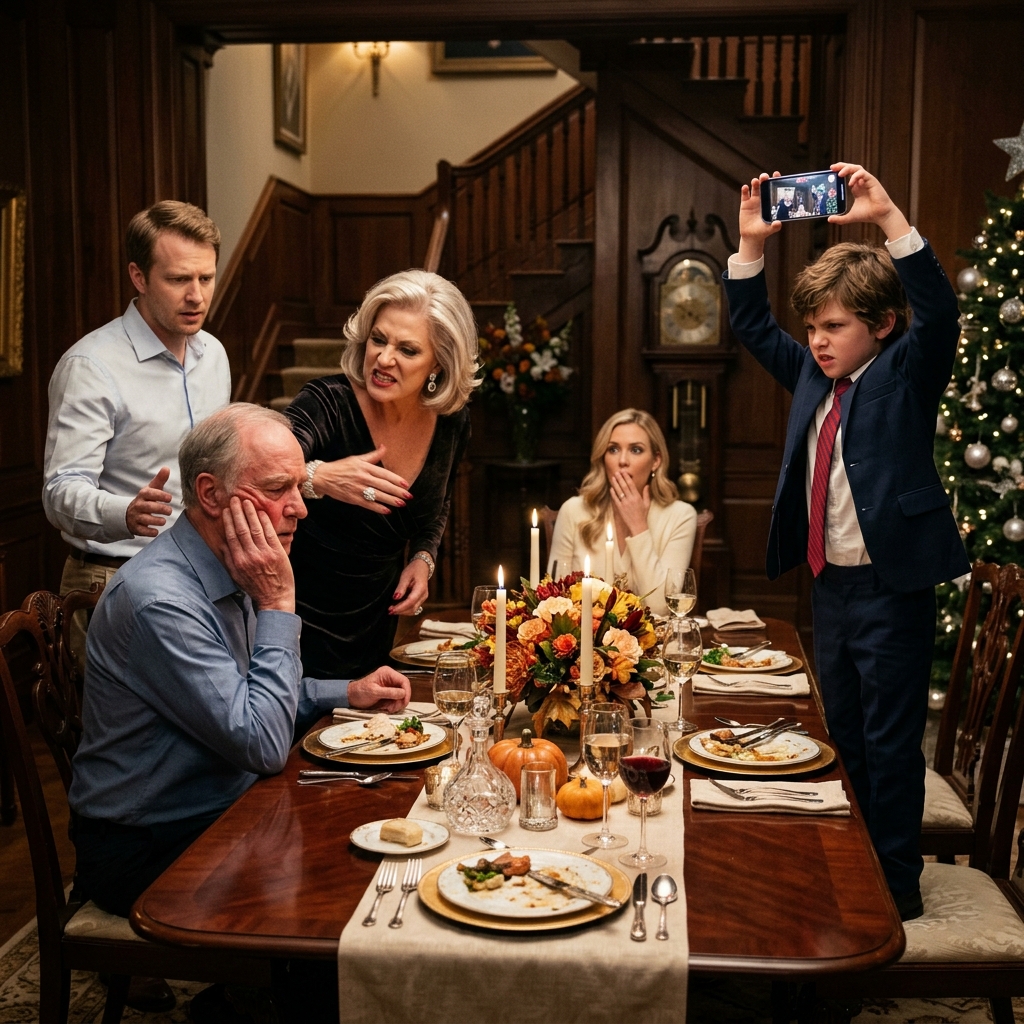
At Thanksgiving, My Daughter-in-Law’s Mother Struck Me Across the Face and Said, “Poor People Belong Outside”—Then My Own Son Told Me to Apologize, Until My Nine-Year-Old Grandson Raised His Phone and Made the Entire Table Go Silent
The smell of roasted turkey and sage had always been my favorite part of the holidays.
For years, that smell meant home. It meant my wife, Helen, standing over the stove in a flour-dusted apron, humming along with the oldies station on the kitchen radio. It meant our son, Michael, weaving between our feet and trying to steal a warm dinner roll before the basket reached the table.
It meant noise, laughter, and the kind of love that made an ordinary house feel strong enough to withstand anything.
But on that particular Thanksgiving afternoon, as I walked up the gravel path toward my son’s home outside Charlotte, the aroma drifting from the open kitchen windows did not bring comfort.
It brought dread.
The late-November air was sharp enough to sting my lungs. Across the quiet North Carolina neighborhood, American flags moved gently from porch posts, and driveways were crowded with SUVs belonging to families gathering for dinner.
Michael’s house stood at the end of the cul-de-sac, all pale stone, black shutters, and tall windows glowing against the early dusk. Through the glass, I could see the outline of a Christmas tree that had apparently gone up before Thanksgiving was over.
I paused at the bottom of the front steps.
It is a strange thing to be a father. You spend your life trying to build a fortress for your children. You teach them how to tell right from wrong, how to work for what they want, and how to stand beside the people they love when standing beside them becomes inconvenient.
You hope those lessons remain after they grow up.
You hope they remember the love rather than the lean years.
You hope they remember the father who came home tired but still helped with homework, the mother who turned inexpensive ingredients into warm meals, and the family that never let embarrassment become more important than loyalty.
But sometimes the fortress you built gets renovated by people who never respected the original foundation.
Standing outside Michael’s front door, I felt like a relic from an earlier version of his life. I was not his father arriving for Thanksgiving. I was an inconvenient reminder of where he had come from.
I smoothed my only good jacket. It was the same charcoal jacket I had worn to Helen’s funeral three years earlier. The cuffs were frayed, and one elbow had been patched with fabric that did not quite match, but it was clean.
I had pressed it myself the night before.
In one hand, I carried a bottle of red wine from the grocery store near my apartment. It was not expensive, but I had spent more than I should have because I did not want to arrive looking careless.
I raised my hand to knock.
The door opened first.
Michael stood in the entryway wearing a pale blue dress shirt and dark trousers. At thirty-two, he should still have looked young, but the tension in his jaw made him appear older. His shoulders were stiff, and his smile did not reach his eyes.
“Dad,” he said, with exaggerated brightness. “You made it.”
“I said I would.”
“Right. Of course. Come in.”
He stepped aside.
There was no hug.
Inside, the warmth hit me immediately, followed by the scent of perfume and holiday candles. The house was immaculate in a way that felt almost sterile. White couches sat beneath abstract artwork. A glass coffee table reflected the lights of a silver-decorated Christmas tree. Not a magazine, toy, or misplaced shoe disturbed the arrangement.
It was a world away from my small apartment, with its worn recliner, crowded bookshelf, and stack of unopened mail beside the microwave.
I stood near the entrance, afraid I might brush against something too expensive to replace.
Michael closed the door.
“Let me take your coat,” he said.
He did not reach for it. He waited while I worked the zipper with fingers made stiff by age and decades of construction work.
When I handed him the jacket, his eyes dropped to the patched elbow.
A flicker crossed his face.
Embarrassment.
It vanished quickly, but not quickly enough.
Michael turned toward the hall closet.
A sharp voice cut through the room.
“Is that the old man?”
Michael stopped.
From the white couch, my daughter-in-law’s mother studied me over the rim of a champagne glass.
Her name was Margaret. I remembered it only because Helen had once said it sounded too gentle for a woman who could make a compliment feel like an accusation.
Margaret was tall and narrow, with silver-blonde hair arranged in a polished sweep. She wore a burgundy dress, pearl earrings, and a diamond ring on nearly every finger. Even while sitting, she carried herself like someone accustomed to deciding who belonged in a room.
Popular Posts
→- 1
- 2
- 3
- 4




Recently Viewed
Stories you read recently will appear here.


