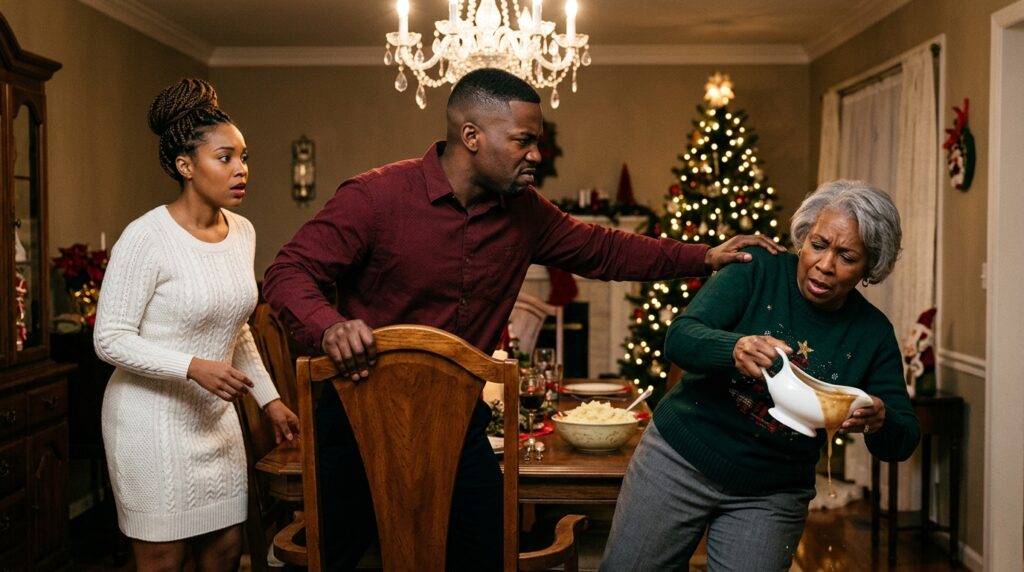
My son-in-law looked me in the eye on Christmas evening and said, “You won’t be sitting there,” as he pointed toward the head of the table inside my own house. The room fell completely silent, waiting for me to accept the insult without protest. Instead, I stood calmly and made a choice that changed our family forever.
“You won’t be sitting there.”
Brandon said it the way you’d tell a stranger. The men’s room was out of order. Casual, almost bored. His hand was already resting on the back of my chair. The chair at the head of my own table, in my own dining room, in the house I’d owned for 31 years.
Behind him, his mother, Donna, was already settling into the seat beside it, tucking her purse under the table like she’d done it every Christmas of her life.
I stood in the doorway with the gravy boat still in my hands. Nobody said anything.
My daughter, Clare, stood frozen by the kitchen counter, a bowl of mashed potatoes going cold in her grip. My grandchildren, Lily and Owen, were wedged at the far end of the table between two of Brandon’s cousins I’d met exactly once at the wedding four years ago.
“My mother’s the guest of honor this year,” Brandon said, like he was doing me a kindness by explaining it.
I looked at the chair, then at him, then at my daughter, whose face had gone the color of the tablecloth.
I set the gravy boat down.
I want to tell you, I saw it coming. I didn’t. But somewhere underneath the shock, something old and tired in me simply nodded like it had been waiting for this exact moment to arrive so it could finally stop pretending otherwise.
“You’re right,” I said. “I can’t sit here.”
I untied my apron. I folded it slow and deliberate and set it on the seat of the chair that apparently wasn’t mine anymore.
Then I picked up my coat from the hook by the door and my purse from the side table.
And I walked out into 6 in of fresh snow without my scarf because I’d left it hanging on the same hook I’d hung it on every Christmas since Clare was in elementary school.
Behind me, I heard Clare say my name once.
I didn’t turn around.
What none of them knew, what I didn’t even fully know myself yet, standing in that driveway with snow soaking through my shoes, was that the man who just banned me from my own table had already been taking things from this family for the better part of a year.
And within 18 hours, I’d have the bank statements to prove it.
My name is Margaret Doyle. I’m 64 years old, and for 29 years I did bookkeeping and tax preparation out of a small office two blocks from the courthouse in Lansdale.
I retired four years ago, but I still do returns for a dozen or so longtime clients every spring. Partly because I like the extra income and partly because, if I’m honest, I like knowing exactly where every dollar in a ledger is supposed to go.
It’s a habit that doesn’t retire even when you do.
My husband Richard died 6 years ago. Heart attack, fast, no warning, the kind of death that leaves you standing in a kitchen wondering what you’re supposed to do with the rest of a Tuesday.
Claire was 28 then, already married to Brandon for 2 years.
I made her a promise at the funeral, the kind of promise you make when you’re grieving and looking for something to hold on to. I told her I’d keep this family together no matter what.
I didn’t know yet what that promise would end up costing me.
Brandon Whitaker runs a small commercial landscaping business. Whitaker Ground Solutions, three trucks, a crew of six in the summer.
When he and Clare got married, the business was barely 2 years old and still bleeding money. I co-signed a small business line of credit for him, and later, I co-signed the mortgage on their house when his numbers were too thin for the bank to approve him a loan.
I never took my name off either one.
I told myself it didn’t matter. Clare was happy. The kids were healthy. That was supposed to be enough.
Over the years, I noticed things, small things.
Brandon didn’t like when I stopped by without calling first. He’d go quiet and short with Clare at the dinner table if she disagreed with him about something as small as which restaurant to pick for a birthday.
Once, at Owen’s fifth birthday party, I overheard him tell his mother that Clare needed reminding sometimes of who paid the bills.
And I told myself it was just a bad day, that every marriage has bad days, that it wasn’t my place to referee.
There was another moment two summers ago that I only understood in hindsight.
Popular Posts
→- 1
- 2
- 3
- 4




Recently Viewed
Stories you read recently will appear here.


