He apologized, gathered his equipment, and motioned for his crew to leave. Within moments, the truck disappeared down the street.
Lydia spun toward me, furious.
“No,” I answered evenly. “You embarrassed yourself.”
She stepped closer.
For several seconds, neither of us spoke.
Finally, she stormed inside, slamming the back door so hard that the windows rattled.
That evening, Connor attempted to smooth everything over.
“She just likes planning things,” he explained while avoiding eye contact.I folded my newspaper.
“Planning improvements on someone else’s property isn’t planning. It’s pretending.”
Connor sighed.
“Mom—”
“No,” I interrupted him gently. “You are both welcome to stay until you’re financially stable, but don’t mistake kindness for ownership.”
He nodded without arguing.
Once again, nothing changed.
Or so he thought.
Over the following weeks, another visitor became a regular presence in my home: Lydia’s mother, Janice.
She arrived carrying oversized suitcases despite claiming she was staying just a short while.
From the moment she entered the house, she criticized everything—the lighting, the furniture, the wallpaper, even the color of my kitchen cabinets.
During dinner on her second evening, she finally revealed why she had become so interested in my house.
She set down her fork and smiled.
“You know,” she began sweetly, “a woman living alone doesn’t really need that large master suite downstairs.”
Connor immediately became fascinated by his mashed potatoes.
Lydia remained silent, waiting, watching.
Janice continued.
“My knees aren’t what they used to be. The stairs upstairs are difficult. The downstairs bedroom would make much more sense for me.”
I took a sip of water before answering.
“It certainly would.”
Her smile widened.
“But it’s my bedroom.”
The smile disappeared just as quickly.
“Family should help family.”
I nodded thoughtfully.
“I agree. Which is why I’ve allowed three adults to live in my home without paying rent.”
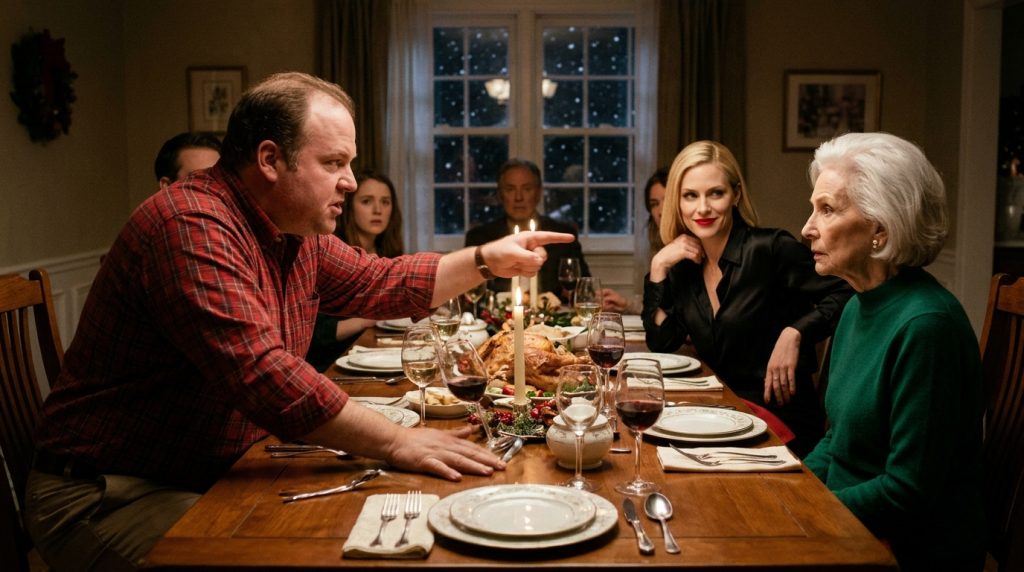
Silence settled over the dining table.
Connor shifted uncomfortably in his chair. Janice frowned. Lydia stared at me with obvious irritation.
Dinner ended shortly afterward.
The next morning, I returned from my usual walk around the neighborhood. The moment I entered the hallway, I stopped.
Three large suitcases sat directly outside my bedroom door.
Lydia stood nearby with folded arms. Connor lingered several steps behind her.
“Mom’s back is acting up,” Lydia announced confidently. “We’ve already started moving her downstairs.”
I glanced at the luggage, then at the closed door to my bedroom.
No one had asked.
They had simply decided.
Without saying a word, I grabbed the first suitcase and rolled it toward the front door.
Janice hurried from the kitchen.
“What are you doing?”
I ignored the question.
One by one, I carried every suitcase outside and placed them neatly on the front porch.
Lydia’s face turned bright red.
“You can’t do that.”
I finally looked at all three of them.
“If the guest room upstairs isn’t comfortable,” I replied calmly, “there’s a lovely hotel less than 10 minutes away.”
Janice gasped.
“You’d throw family out?”
“No. I’d protect my home.”
Connor finally stepped forward.
“Mom, can’t we compromise?”
I looked directly into my son’s eyes.
“The compromise,” I answered quietly, “is that you’ve lived here rent-free for 8 months. My bedroom isn’t part of that agreement.”
Without another word, I unlocked my door, stepped inside, and locked it behind me.
Outside, I could hear Lydia complaining, Janice grumbling, Connor apologizing.
But none of it mattered anymore.
For the first time since they moved in, they had discovered something important.
I wasn’t giving up my home.
Not today. Not ever.
After the confrontation over my bedroom, the atmosphere inside the house became unbearably tense.
Lydia no longer bothered pretending to be polite. She barely acknowledged me when we crossed paths in the hallway.
And every conversation she had seemed intentionally loud enough for me to hear.
“I don’t understand why some people refuse to move on,” she remarked one afternoon while speaking to Janice in the kitchen. “They cling to things that should belong to the next generation.”
I knew exactly who she meant.
I simply poured myself another cup of coffee and walked outside.
Arguing with people determined to rewrite reality was a waste of energy.
Instead, I watched, I listened, and I prepared.
A week later, colorful invitations began arriving in the mail.
Lydia had planned an extravagant anniversary celebration to mark 10 years of marriage with Connor.
She invited nearly everyone she knew—friends, co-workers, distant relatives, and neighbors I had never even met.
The guest list grew larger every day.
So did the expenses.
A few mornings later, an email appeared in my inbox from a local catering company. The total bill exceeded $2,000.
The invoice had been addressed to me.
Apparently, Lydia had assumed I would pay for everything without asking.
I didn’t call the caterer to complain. I simply forwarded the invoice to Connor.
My message contained only one sentence.
“This belongs to you. Please handle it today.”
Less than 5 minutes later, Lydia burst into the kitchen.
“You embarrassed us,” she snapped.
I continued slicing vegetables for lunch.
“I haven’t embarrassed anyone.”
“You refused to pay the caterer.”
“I wasn’t asked.”
She folded her arms.
“You know we’re trying to save money.”
Popular Posts
→- 1
- 2
- 3
- 4




Recently Viewed
Stories you read recently will appear here.