The Blackwoods were the ones missing from his life.
Perspective reversed.
Logan later told Claire:
“I kept thinking we were restoring something he lost.”
Claire said:
“No. You were restoring something your family took.”
Different.
Important.
This insight changed how Logan handled his own daughter years later.
He stopped assuming family tradition deserved priority because it was older.
Tradition had to earn continuation.
Some did.
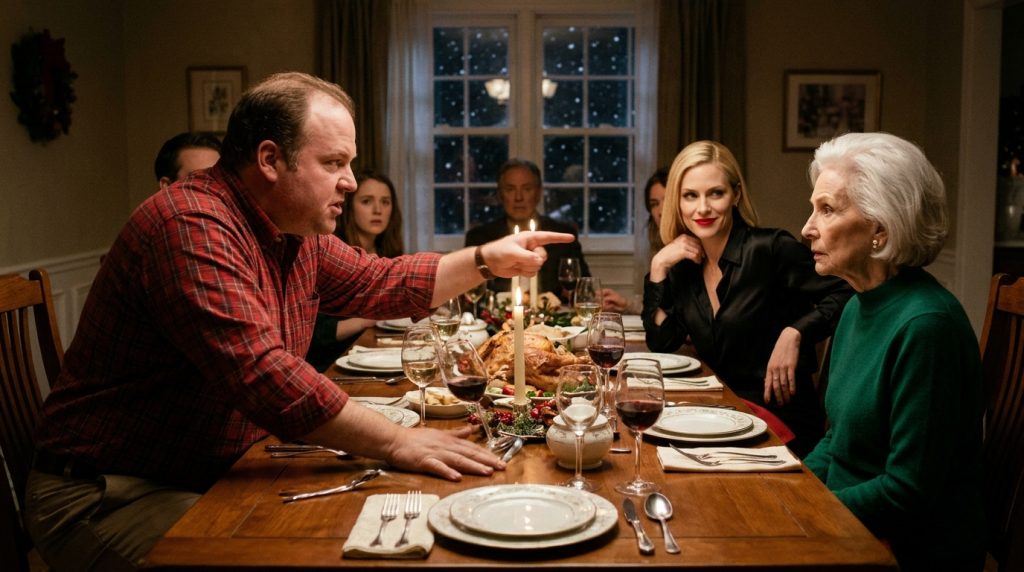
Thanksgiving dinner.
Family recipes.
Company scholarship fund.
Others ended.
Mandatory attendance.
Inheritance tied to obedience.
Public family photographs.
Claire saw real change when Logan stopped defending customs simply because they were Blackwood customs.
The brothers’ settlement also required them to decide what happened to Charles’s remaining personal archive.
Logan initially assumed it belonged to him.
Then stopped.
Michael had equal claim.
They hired an archivist.
Family letters were digitized.
Medical and trust records separated.
Items connected to Anne and Robert copied for Michael.
No single son controlled the story.
That structural decision prevented future fights.
Among the archive was one photograph of Evelyn holding infant Michael.
She looked exhausted.
Also tender.
Michael stared.
He had never seen her hold him.
For the first time he understood that erasure had come after attachment, not instead of it.
That made the hurt more complicated.
He gave the photograph to Logan.
“I don’t want it.”
Logan asked:
“Why me?”
“Because I don’t want to build a shrine to the version of her I didn’t get.”
Logan kept it.
Not displayed.
Stored.
People deserve control over which memories they live beside.
The settlement finalized after eighteen months.
No press conference.
Lawyers filed documents.
Independent trustees took over.
Michael’s economic interest restored.
Logan’s exclusive control ended.
The company continued.
The world did not explode.
That ordinary ending exposed how much damage had been caused by decades of fear about what truth would do.
Truth changed things.
May you like
It did not destroy everything.
Michael eventually asked to meet Claire.
He wanted to thank her.
Claire refused the framing.
“I found records. You chose what to do with them.”
Michael smiled.
“Fine. I’m grateful you found records.”
They became friends slowly.
Not because they were both outsiders.
Because they both understood what happens when families confuse belonging with obedience.
Michael told Claire about Anne.
She was stubborn.
Warm.
Protective.
She never spoke badly about Evelyn.
That surprised Claire.
“Why not?”
“She said children shouldn’t carry adult wars.”
Claire wrote that down mentally.
She wanted to live that way too.
When Claire later had a daughter, she refused to make the child a symbol of reconciliation with the Blackwoods.
Evelyn had no access initially.
Logan did.
Under boundaries.
Michael met the baby once and brought a children’s book.
No inheritance joke.
No family claim.
Ordinary.
That became Claire’s preferred version of extended family.
Specific.
Chosen.
No automatic rank.
Claire’s friendship with Michael deepened because neither asked the other to carry the whole Blackwood story.
They talked about work.
Michael complained about insurance reimbursements.
Claire complained about document retention policies.
Ordinary topics became the safest ground.
One afternoon Michael asked:
“Do you ever feel guilty for opening all this?”
Claire answered:
“No.”
Then thought.
“Sometimes I feel responsible for the consequences.”
“Same thing?”
“No. Responsibility asks what I did. Guilt asks whether I should have left a lie alone.”
Michael nodded.
He had felt similar guilt.
If he had ignored Claire’s letter, Logan would still control everything.
Evelyn might not be in prison.
The company might appear stable.
But apparent stability depended on erasure.
Neither had created that condition.
They only stopped cooperating with it.
Michael later invited Claire to Anne and Robert’s memorial garden.
Small plaque.
No Blackwood name.
Claire stood quietly.
Michael said:
“They would have hated all this money discussion.”
Claire smiled.
“Most sane people would.”
He showed her Anne’s old ledger of Michael’s medical appointments.
Every visit documented.
Not for litigation.
Because Anne was organized.
Claire saw decades of caregiving reduced to dates, prescriptions, mileage.
Family can look like paperwork too.
That softened her view of records.
Documents are not only weapons.
They can be memory.
Michael eventually chose to use part of his restored wealth to endow cardiac care grants in Anne and Robert’s names.
Not Charles.
Not Evelyn.
His choice.
Logan donated separately to the same program without asking for recognition.
Michael found out later.
That small act improved their relationship more than a public apology would have.
No speech.
Shared support.
No ownership.
Claire watched and learned that repaired families often grow through parallel actions rather than forced conversations.
Michael and Claire also shared a distrust of public redemption stories.
A magazine requested a joint interview titled THE OUTSIDERS WHO TOOK DOWN A DYNASTY.
Both declined.
Michael said:
“I didn’t take down anything.”
Claire said:
“And I was married into it, not outside it.”
The headline wanted heroes and villains.
Reality had systems, fear, money, illness, silence, and choices.
Less catchy.
More true.
Their friendship became useful professionally.
Michael invited Claire to speak at his clinic about medical power of attorney and family financial coercion.
Claire invited Michael to a whistleblower fund event about how identity and caregiving records can conflict.
Neither presented the other as symbol.
They talked about process.
At one conference Michael said:
“If a person’s legal family and lived family are different, do not assume one is fake.”
Claire wrote it down.
Later she used it when advising a client whose aunt raised him while biological parents retained legal rights.
The Blackwood story produced knowledge without becoming every story.
That mattered to Claire.
She feared projection.
Not every difficult mother was Evelyn.
Not every hidden account concealed a lost heir.
Professionalism meant recognizing patterns without forcing conclusions.
Michael said medicine was the same.
Symptoms can suggest.
Tests confirm.
Claire liked the analogy.
Evidence first.
Their children eventually became friends too.
Sophie helped Claire’s daughter with college applications.
Caleb interned briefly with Logan’s governance consulting firm.
No one engineered it.
Relationships grew where useful.
The next generation did not carry the same competition because adults stopped assigning them roles.
Claire’s friendship with Michael eventually became one of the few Blackwood-connected relationships that required almost no management.
Maybe because neither expected family roles from the other.
Michael did not call her sister.
Claire did not call him brother-in-law unless context required.
They were simply people connected by the same disclosure.
That freedom made conversation easier.
When Claire and Logan’s daughter Maya was born, Michael sent a short note:
Welcome, Maya. You inherited no obligations from any of us.
Claire kept that.
It captured everything she wanted for the next generation.
No duty to company.
No duty to reconcile.
No duty to carry guilt.
Only information and choices.
Popular Posts
→- 1
- 2
- 3
- 4




Recently Viewed
Stories you read recently will appear here.